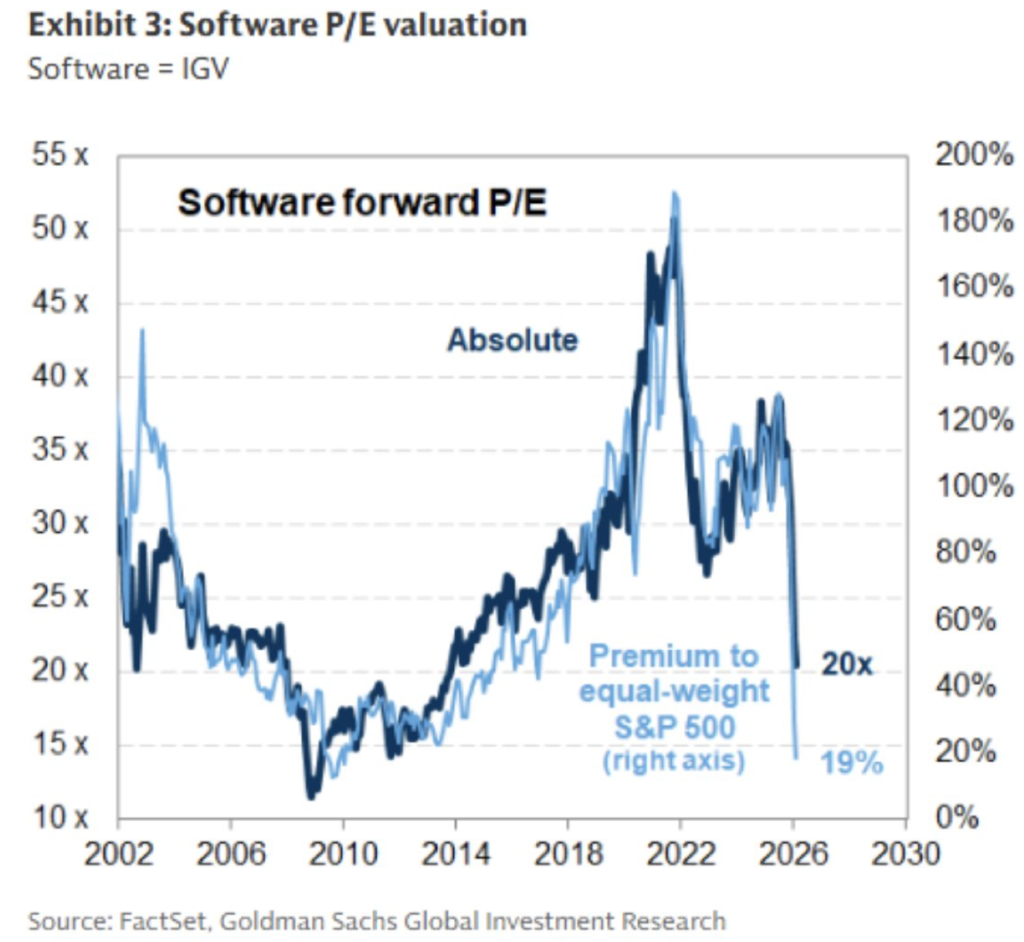
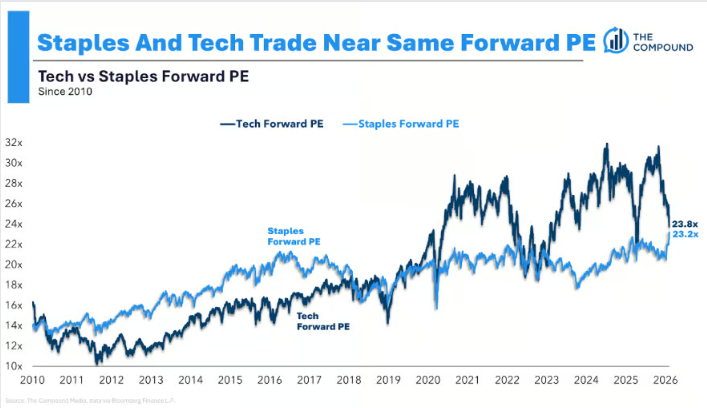
2. Software Stocks Premium in P/E Valuation vs. Rest of Market Drops to Even
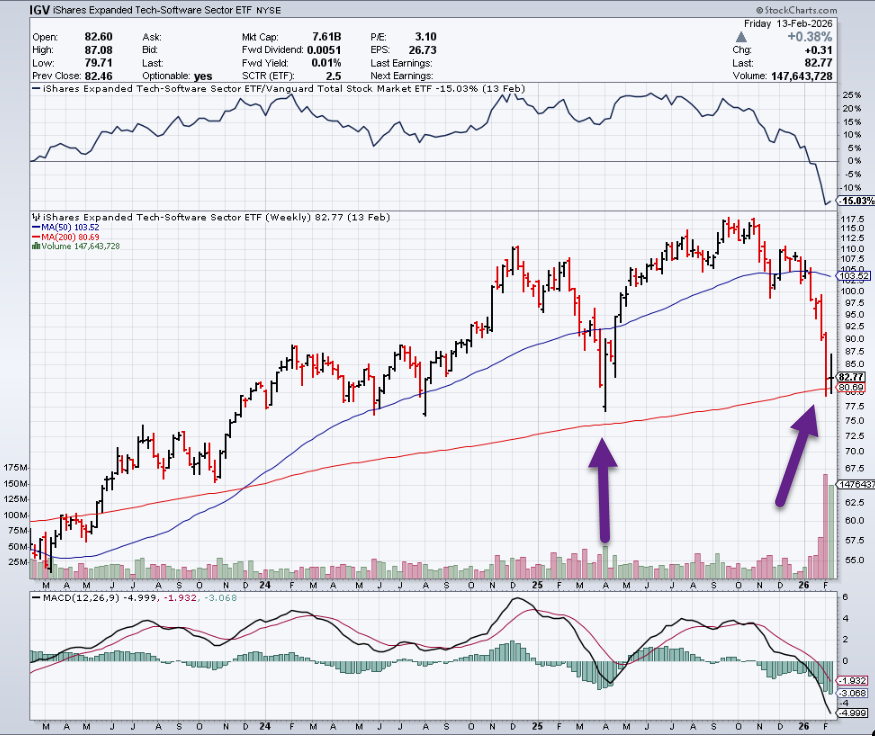
3. Software ETF Right on Its 200 Week Moving Average
StockCharts
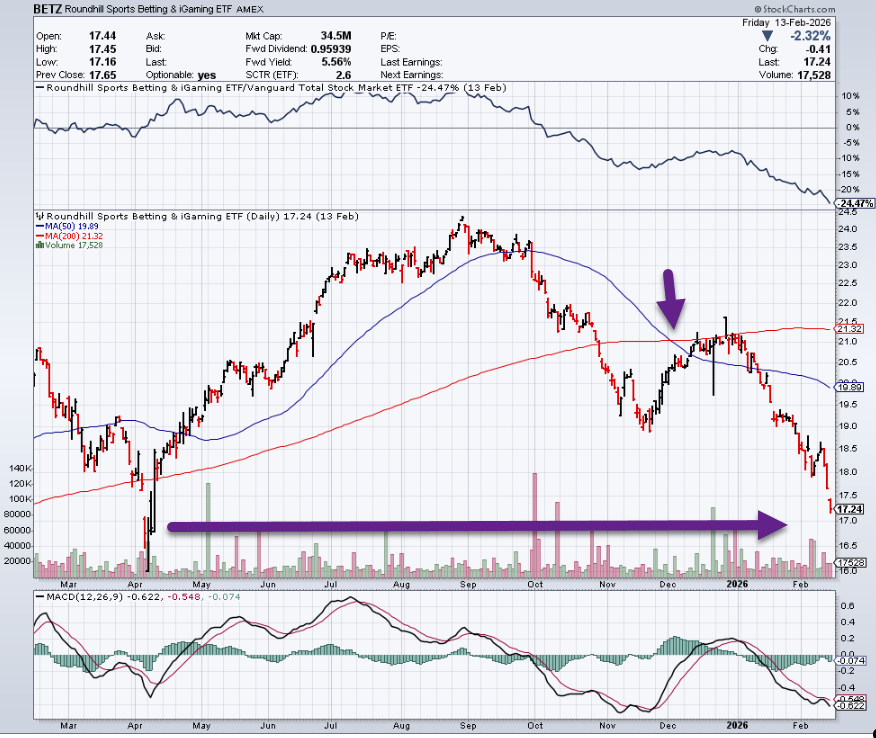
4. BETZ Sports and Gaming ETF Falls Back to Liberation Day Levels …Polymarket and Kalshi Competition?
StockCharts
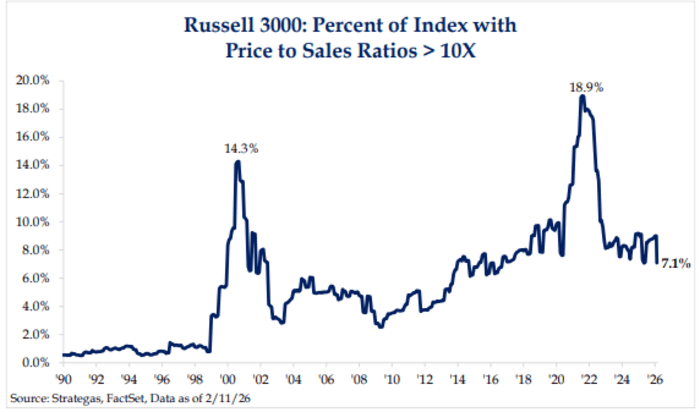
5. Number of Small Cap Stocks Trading at 10x Sales Back to Normal Levels
The chart-“Despite broader concerns around market valuations, our data on the percentage of Russell 3000 companies trading at 10x price-to-sales does not currently raise red flags,” say Ryan Grabinsky and Jon Byrne at Strategas Securities. “At 7.1%, the reading is among the lowest levels observed in the post-COVID period. That said, it is worth noting that this metric offered limited signal in the run-up to the financial crisis, so we remain mindful of its limitations,” they add.
MarketWatch
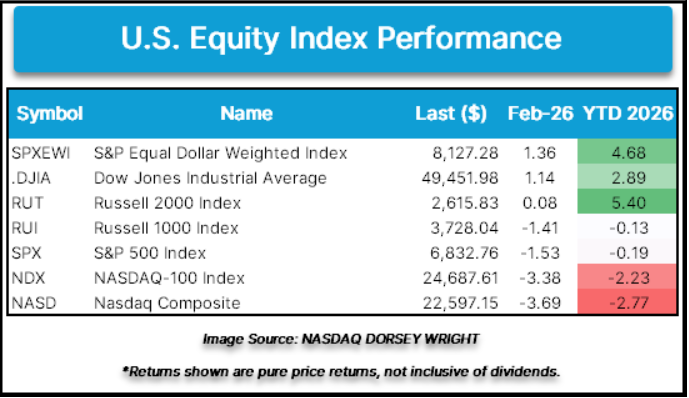
6. 2026 Returns S&P Equal Weight +7.5% Above QQQ
Nasdaq Dorsey Wright
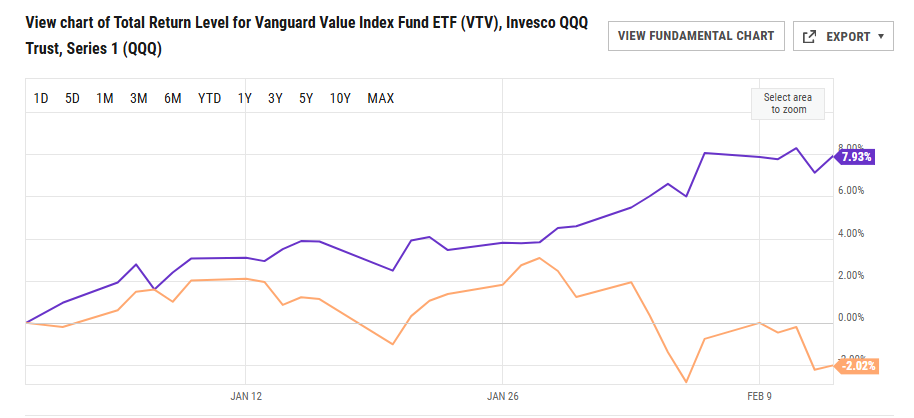
7. Vanguard Value VTV +8% vs. QQQ -2% 2026
Ycharts
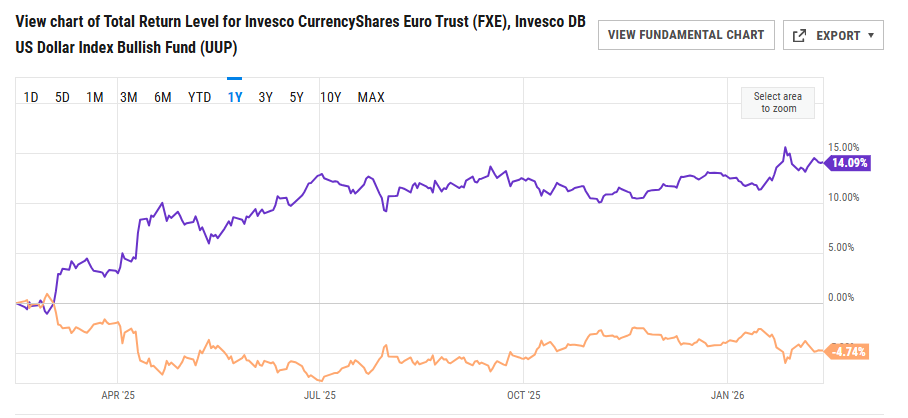
8. Last 12 Months….Euro Trust Currency ETF +14% vs. UUP U.S. Dollar Chart -5%
Ycharts
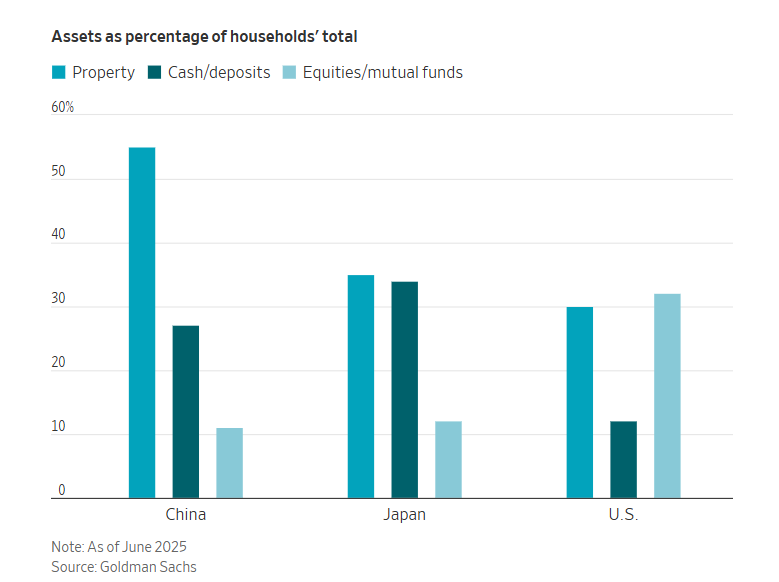
9. Americans are Stock Nation vs. Rest of World…Double Percentage of Holdings Versus China/Europe
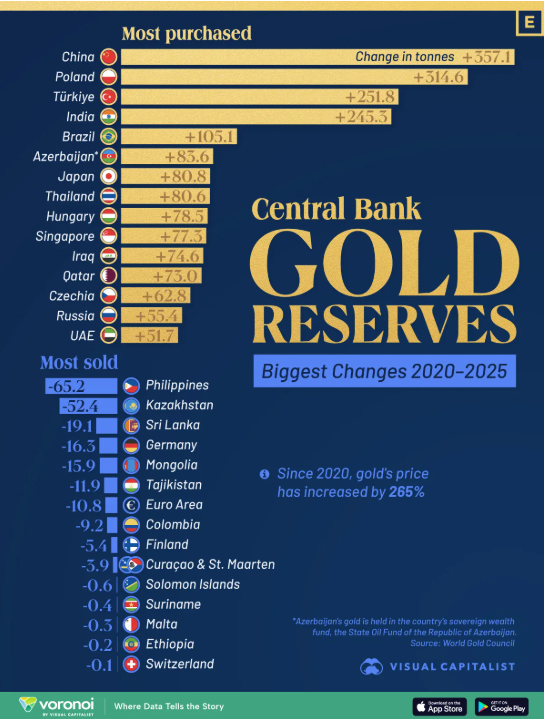
6. Central Banks Buying and Selling Gold 2020-2025
Visual Capitalist
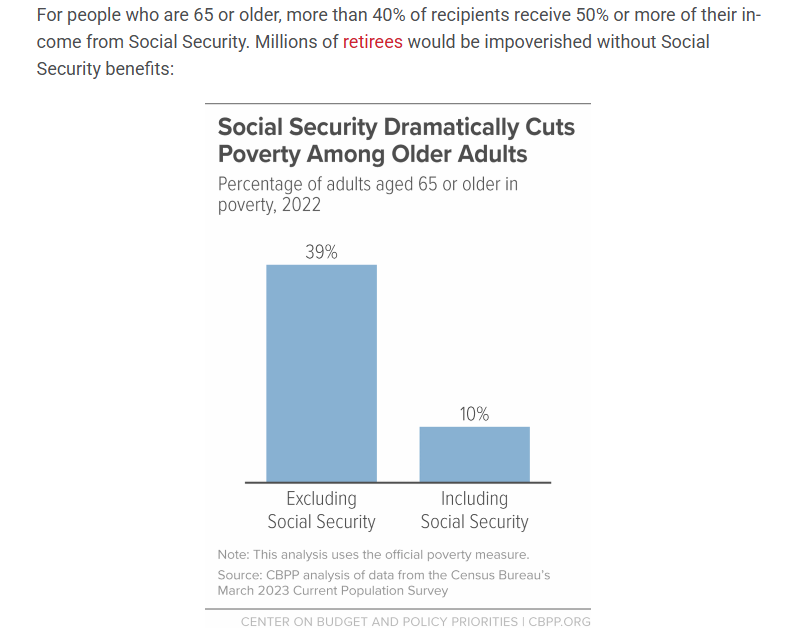
7. Social Security and Poverty-Ben Carlson
A Wealth of Common Sense
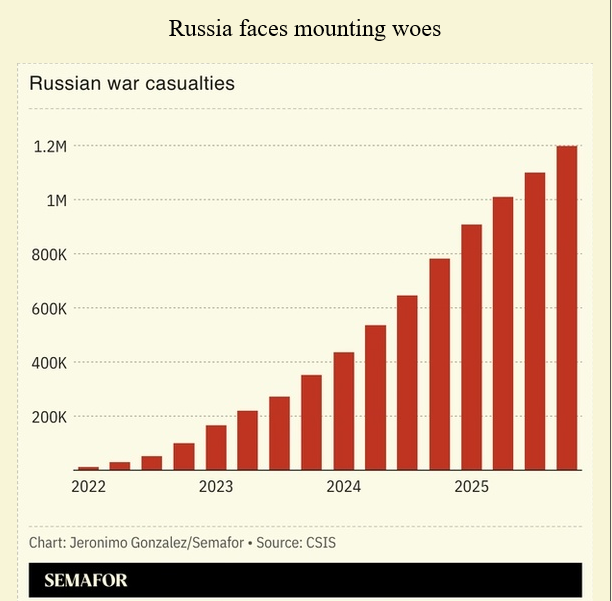
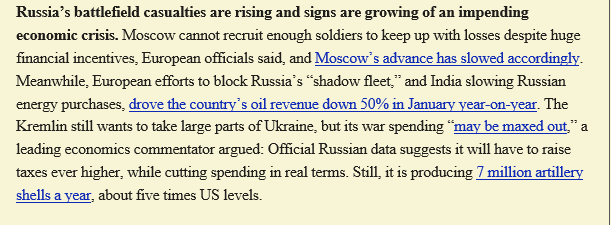
8. Russia Running Out of Soldiers
Semafor
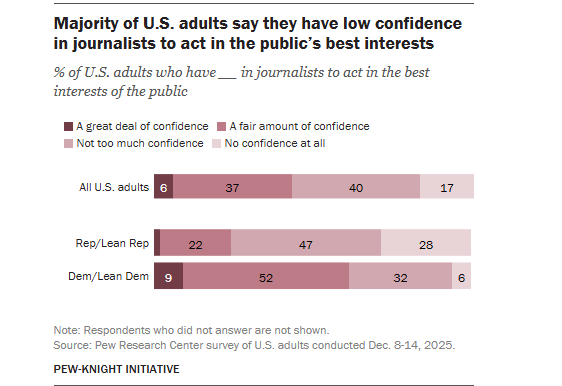
9. Majority of Americans Low Confidence in Journalists to Act in Public’s Best Interest
Pew Research Center
10. 26 Rules to Be a Better Thinker in 2026
What follows is my advice for what you’re going to need more than ever in this brave new world—26 rules for becoming a better thinker.
– Take another think. The problem with our thoughts is that they’re often wrong—sometimes preposterously so. Nothing illustrates this quite like what’s called an “eggcorn,” words or expressions we confidently mishear and then contort to match our misperception. “All for not” instead of all for naught. “All intensive purposes” instead of all intents and purposes. But the greatest eggcorn is doubly ironic: people who say “you’ve got another thing coming” are, in fact, proving the point of the actual expression, “you’ve got another think coming.” We need to be able to slow down and use a second think. Especially when we’re sure what we think is right. (And by the way, at least 50% of the time I have to ask ChatGPT to think again because it’s answers are obviously wrong).
– Take walks. For centuries, thinkers have walked many miles a day—because they had to, because they were bored, because they wanted to escape the putrid cities they lived in, because they wanted to get their blood flowing. In the process, they discovered an important side-effect: it cleared their minds and made them better thinkers. Tesla discovered the rotating magnetic field—one of the most important scientific discoveries in modern history—on a walk through a Budapest park in 1882. Hemingway took long walks along the quais in Paris whenever he was stuck and needed to think. Nietzsche—who conceived of Thus Spoke Zarathustra on a long walk—said: “It is only ideas gained from walking that have any worth.” I have never taken a walk without thinking, after, “I am so glad I did that.”
– Embrace contradiction. F. Scott Fitzgerald said, “The test of a first-rate intelligence is the ability to hold two opposing ideas in mind at the same time and still retain the ability to function.” The world is complicated, ambiguous, paradoxical. To make sense of it, you must be able to balance conflicting truths.. F. Scott Fitzgerald said, “The test of a first-rate intelligence is the ability to hold two opposing ideas in mind at the same time and still retain the ability to function.” The world is complicated, ambiguous, paradoxical. To make sense of it, you must be able to balance conflicting truths.
– But don’t confuse complexity with nonsense. Stupid people are especially good at having a bunch of contradictory thoughts in their head at once. So the first-rate mind Fitzgerald described isn’t just about tolerating contradiction—it’s really about the ability to examine and interrogate it. It’s asking, Does this actually make sense?
– Go to first principles. Aristotle taught that one must go to the origins of things, go all the way to the primary truth of the matter, instead of just accepting common observation or belief. Don’t just blindly accept what everyone else seems to say or believe. Go to first principles. Instead of engaging with an issue from a headline, a tweet, or a take, go to the beginning. Break things down and build them back up. Put every idea to the test, the Stoics said. The good thinker approaches things with a fresh set of eyes and an open mind.
– Think for yourself. Generally, people just do what other people are doing and want what other people want and think what other people think. This was the insight of the philosopher René Girard, who coined the theory of mimetic desire. He believed that since we don’t know what we want, we end up being drawn—subconsciously or overtly—to what others want. We don’t think for ourselves, we follow tradition or the crowd.
– Don’t be contrarian for contrarian’s sake. Peter Thiel, widely considered a “contrarian,” (and a big fan of Girard) once told me that being a contrarian is actually a bad way to go. You can’t just take what everyone else thinks and put a minus sign in front of it. That’s not thinking for yourself. So in fact, if you find yourself constantly in opposition to everyone and everything (or most consensuses) that’s probably a sign you’re not doing much thinking. You’re just being reactionary.
– Ask good questions. When Isidor Rabi came home from school each day, his mother didn’t ask about grades or tests. “Izzy,” she would say, “did you ask a good question today?” This doesn’t seem like much, and yet it is everything. After all, questions drive discovery. The habit of asking questions turned Rabi into one of the greatest physicists of his time—a Nobel Prize winner whose work led to the invention of the MRI. Questions are the key not just to knowledge but to success, discovery, and mastery. They’re how we learn and how we get better. And they don’t have to be brilliant, probing, or incisive. They can be simple: “What do you mean?” They can be inquisitive: “How does that work?” They can aim for clarity: “Sorry, I didn’t understand, can you explain it another way?” The point is to stay curious. To never stop asking questions.
– Watch your information diet. When I’m not feeling great physically — tired, irritable, sluggish — usually it’s because I’m eating poorly. In the same way, when I feel mentally scattered and distracted — I know it’s time to focus on cleaning up my information diet. In programming, there’s a saying: “garbage in, garbage out.” Aim to let in the opposite of garbage. Because that leads to the opposite of garbage coming out.
– Go deep. I thought I knew a lot about Lincoln. I’d read biographies, watched documentaries, interviewed scholars, visited the sites. I’d even written about him in my books. So when I sat down to write about him in Part III of Wisdom Takes Work, I thought I was set. I wasn’t even close. So I went deeper. I read Hay and Nicolay. Doris Kearns Goodwin’s 944-page Team of Rivals. Michael Gerhardt’s 496-page book on Lincoln’s mentors. David S. Reynolds’s 1088-page Abe. David Herbert Donald’s 720-page Lincoln. Garry Wills’s Pulitzer Prize-winning book on the Gettysburg Address. I spoke with the documentarian Ken Burns about him, and Doris too. I read Lincoln’s letters and speeches. I went, multiple times while writing the book, to the Lincoln Memorial. In the end, I spent hundreds of hours reading thousands and thousands of pages on the man. Basically, I “dug deeply,” as Lincoln’s law partner once said of Lincoln’s own approach to learning, in order to get to the “nub” of a subject. This is a skill you need. Whether you’re an author, politician, lawyer, entrepreneur, scientist, educator, parent—you have to be able to pursue an idea, a question, a thread of curiosity until you’ve gotten to the nub and wrapped your head completely around it.
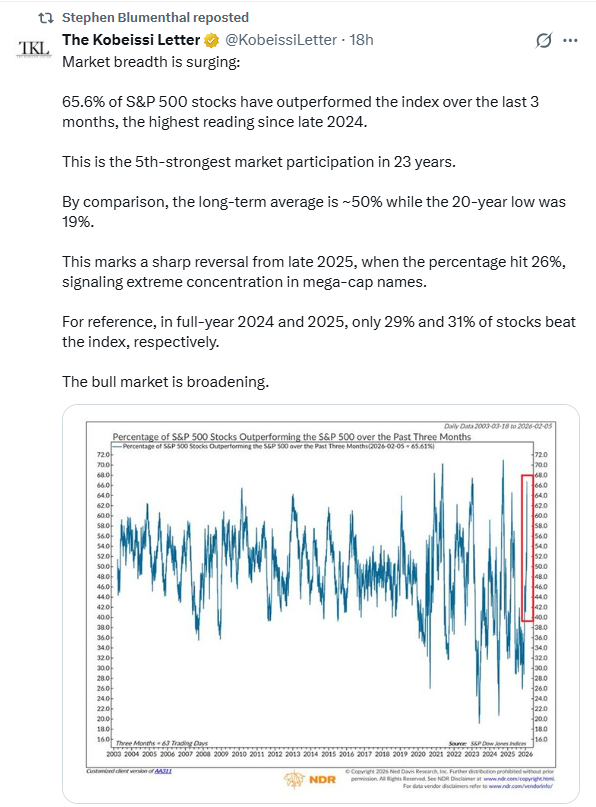
2. Market Breath Surging….65% of Stocks Outperforming Over Last 3 Months
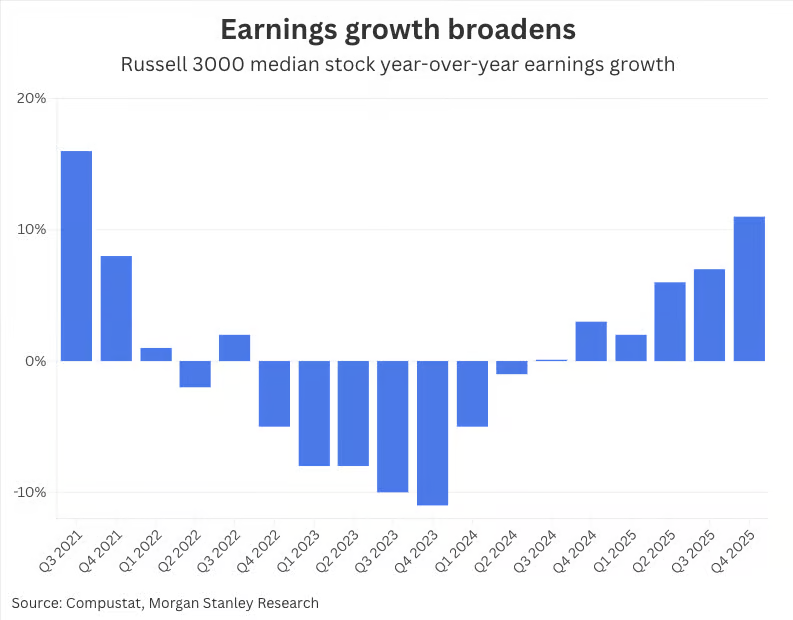
3. Small Cap Earnings Growth at Highest Level in 3 Years
R3K earnings growth. And finally, “earnings growth for the median Russell 3000 stock is at its highest level in four years. Fundamentals are in line with the stock market broadening.”
Daily Chartbook
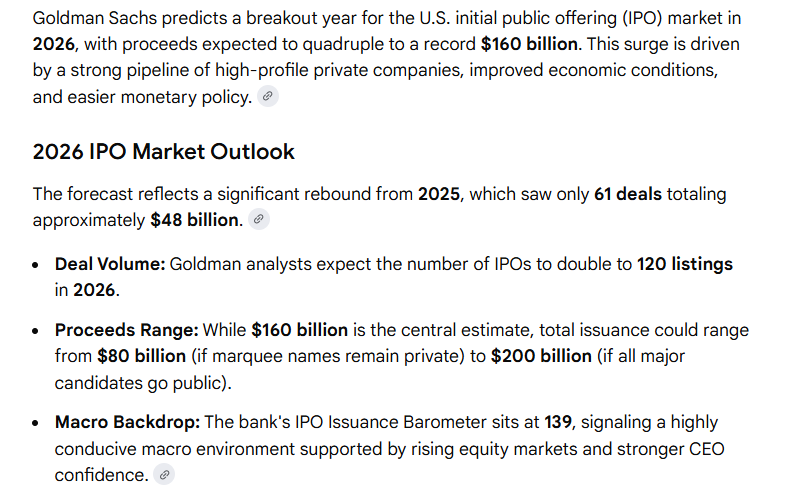
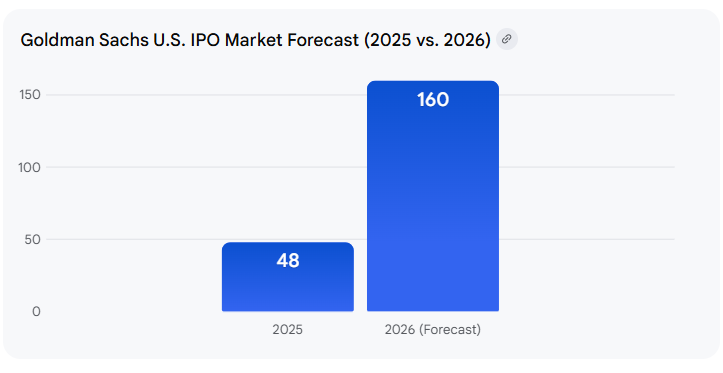
4. Goldman Predicting Record IPO Year 2026
Google
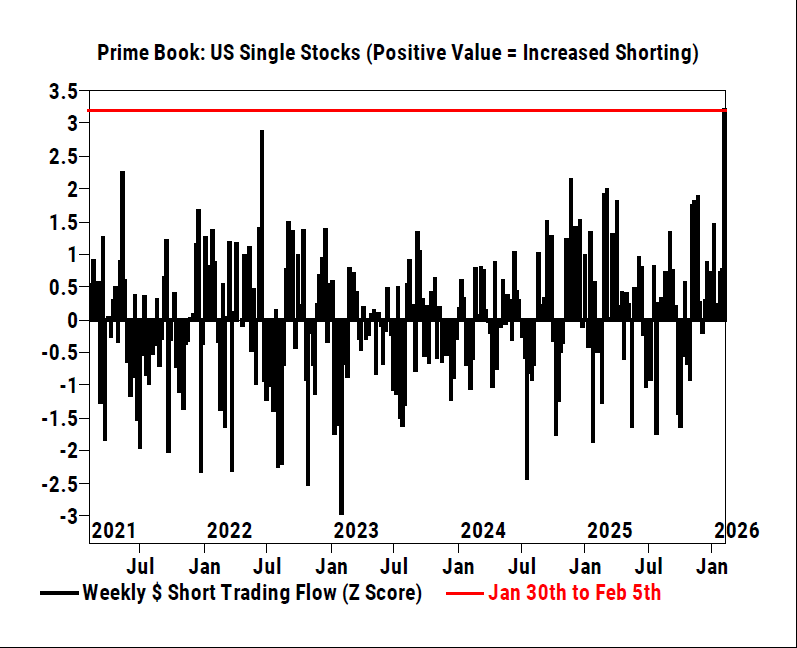
5. Huge Amount of Short Selling…Not Usually a Sing of Market Top
Hedge fund shorts. “Short selling across single stocks last week was the biggest on record going back to 2016”.
Goldman Sachs via @macrocharts
6. Copper Inventories at All-Time Highs
Bloomberg The US has quietly built up its biggest stockpile of copperin decades, distorting flows of the red metal to the rest of the world.
The influx of copper into American inventories has gathered momentum over the past year and added to upward pricing pressures. The higher prices have reverberated across the copper supply chain.
Bloomberg
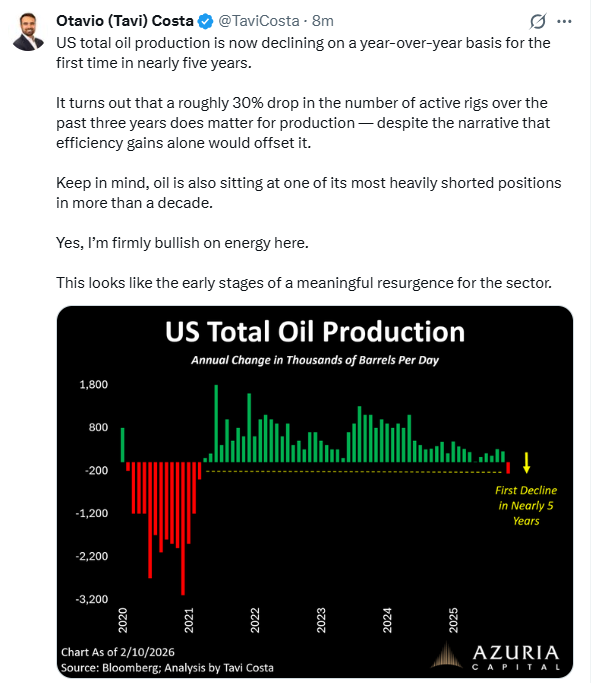
7. U.S. Total Oil Production Declining for the First Time in 5 Years
Otavio (Tavi) Costa
8. Polymarket Odds 57% that Digital Asset Clarity Act Passes
Perplexity
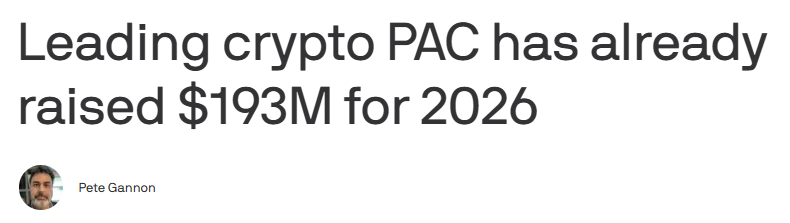
9. Leading Crypto Political PAC Raises $193M
Axios
10. 2 “Annoying” Habits That Actually Signal Intelligence
If you’re prone to these two “annoying” habits, you could be smarter than you think. Mark Travers Ph.D.
Key points
Mind wandering can support creative thinking and cognitive flexibility.
Talking to oneself can support self-regulation, planning, and metacognition.
When we idealize focus, discipline, and a silent mind, we overlook powers of the brain beyond concentration.
We often judge habits like a drifting mind or moments of spontaneous “zoning out” as flaws. To most people, these are considered signs of poor focus, weak discipline, or even cognitive decline.
However, what we often fail to factor in is that our perceptions are influenced by the culture of relentless productivity and tangible rewards that surrounds us. From this lens, these mental habits will obviously look like distractions that need to be corrected, rather than cognitive processes that simply need to be understood.
Psychological research tells us that, under the right conditions, these seemingly unproductive behaviors can reflect cognitive flexibility, creative problem-solving, and the brain’s ability to adaptively shift between modes of thought. In other words, rather than being mental glitches, they may be signs of an active mind doing important background work.
Here are two common behaviors many people dismiss or try to suppress, as well as what they really mean, when they can be helpful, and how to start approaching them with greater psychological nuance.
1. A Habit of Daydreaming
Mind-wandering, or the drifting of attention away from the present task toward self-generated thoughts, has long been considered a telltale sign of inattention. However, recent studies show that it can also support creative thinking and cognitive flexibility.
For example, a 2025 study involving more than 1,300 adults found that deliberate mind-wandering (that is, a person intentionally allowing themselves to daydream) predicted higher creative performance. Neuroimaging data suggested this effect was supported by increased connectivity between large-scale brain networks involved in executive control and the default mode network, a system associated with self-generated thought and imagination.
People with higher spontaneous mind-wandering tendencies also show better performance on task-switching paradigms, meaning they can shift mental sets more quickly, which is a clear sign of flexible thinking.
Another habit closely related to mind-wandering is an individual’s capacity for spontaneous thought. A 2024 study published in PNAS Nexus analyzed spontaneous thought samples from more than 3,300 participants using natural language processing. According to the results, unprompted thoughts tend to organize around goal-relevant information and support memory consolidation. In other words, this means that “idle” thinking often serves adaptive cognitive functions rather than being random mental noise.
It’s important to note, however, that mind-wandering isn’t a magic bullet. Its benefits will only take root when balanced with attention control. If you find your mind often drifting, and if you also have good focus and self-awareness, then you might be tapping into a mental mode that supports creativity, flexible thinking, and problem-solving.
2. A Habit of Talking to Yourself
Talking to yourself, whether silently in your head or softly out loud, might look odd or even neurotic from the outside. However, recent psychological research suggests that inner speech and self-talk can actually be used to support self-regulation, planning, and metacognition (the act of thinking about your own thoughts).
According to a 2023 study of university students published in the journal Behavioral Sciences, there is a considerable correlation between reported use of inner speech and measures of self-regulation and self-concept clarity. In other words, individuals who “talked to themselves” more often than others would report significantly clearer self-identity as well as better self-regulation.
Of course, this does not mean that self-talk directly signals higher intelligence. Instead, it suggests that inner speech may function as a cognitive scaffold, or as a way to organize complex ideas, sequence actions, and monitor goals.
This means that by externalizing thoughts internally (or quietly aloud), the brain may find it easier to reduce cognitive noise. As a result, it may also impose structure on abstract or emotionally charged problems more efficiently and effectively. So, if you catch yourself murmuring through your thoughts, it could be your brain’s way of scaffolding complex ideas, turning chaotic thinking into ordered plans or self-reflection.
However, as with mind-wandering, self-talk also benefits only in moderation. Excessive or negative self-talk, especially in the form of rumination or harsh self-criticism, can undermine focus and mental well-being. When used constructively, however, that same internal dialogue can transform half-thoughts into actionable plans.
What to Do if You Have These ‘Annoying’ Habits
If you have one or both of these supposedly “annoying” habits, then you must always remind yourself that there isn’t anything wrong with you; they’re both incredibly common and totally normal. However, despite their benefits, they aren’t necessarily guaranteed markers of genius, either.
In reality, the relationships between these habits and their associated productive behaviors are contextual and conditional. This means minds that wander with purpose, self-talk used for planning rather than rumination, and rest that is balanced with effort will correlate most strongly with enhanced thinking or creativity.
On the other hand, when these behaviors spiral into chronic distraction, anxiety, or disorganization, then they may risk becoming problematic. However, if an individual engages in them consciously and moderately, they can indeed be used as valuable tools. Here are three steps you can follow to use them adaptively:
Notice context. Pay attention to when and where you typically start mind-wandering or talking to yourself. Are you daydreaming during monotonous tasks? Do you talk to yourself when trying to focus on something critical? Try giving yourself a 10-minute idle moment first, then return to the task.
Use inner speech consciously. When planning or thinking through ideas, speak (silently or quietly) as if guiding yourself. That structure can help shape clarity.
Allow mental rest. Schedule micro-breaks for reflection. Sometimes, the best ideas come when the brain has space and freedom to wander.
When we idealize focus, discipline, and silence inside the mind, we overlook the powers of the human brain beyond sheer concentration. The next time you catch your mind drifting, hear a soft whisper of self-talk, or notice your gaze drifting out the window, don’t immediately judge it as laziness or lack of control. Sometimes, it’s just your mind thinking in a language beyond tasks and deadlines.
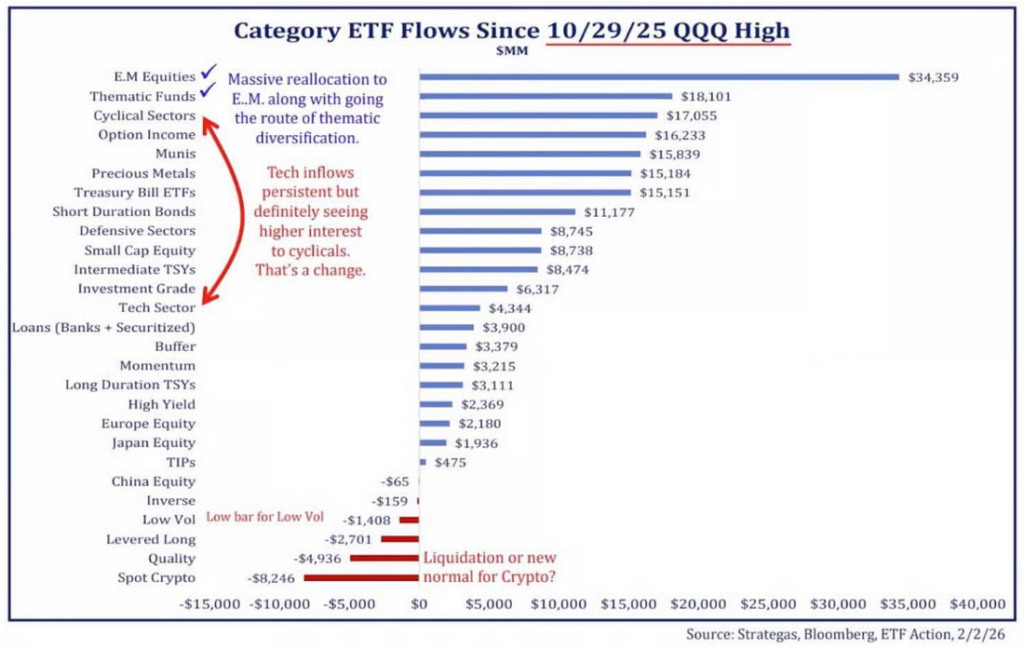
Since the Nasdaq peaked on October 29th, the money has been flooding into emerging markets, thematic funds, and cyclicals. ETF flow data shows a clear exodus from mega-cap tech into overlooked corners of the market.
Todd Sohn via Daily Chartbook
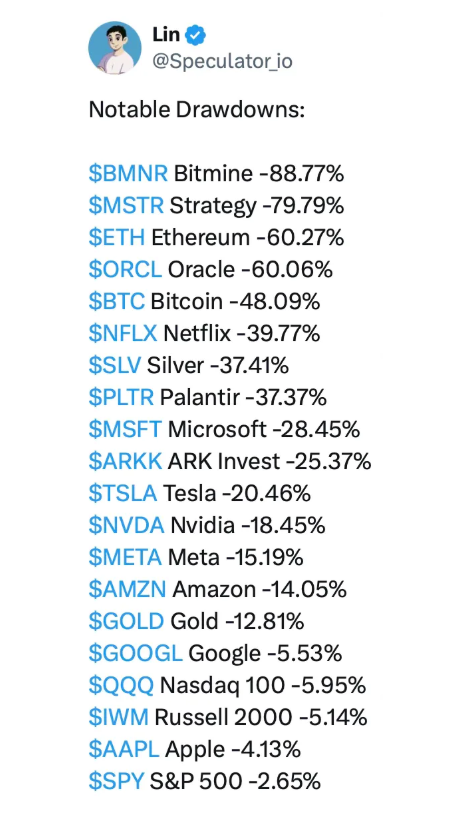
3. Notable Drawdowns
4. Big 4 Companies Spending $650 Billion 2026 on Capex
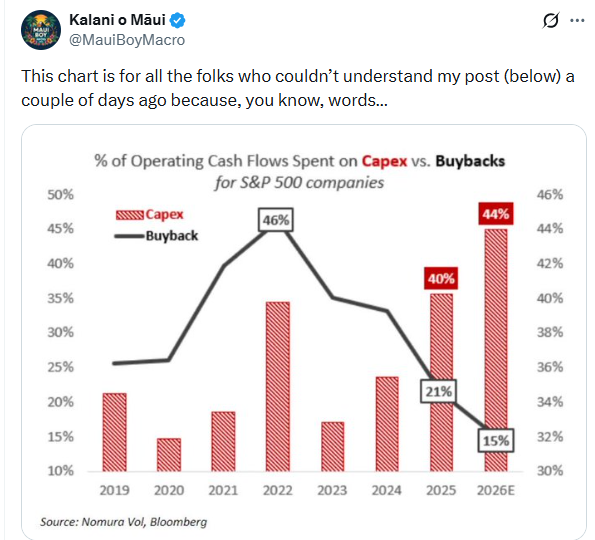
Dave Lutz Jones Trading ROTATION WATCH– Four of the biggest US technology companies together have forecast capital expenditures that will reach about $650 billion in 2026 — a mind-boggling tide of cash earmarked for new data centers and the long list of equipment needed to make them tick, including artificial intelligence chips, networking cables and backup generators.
The four companies “see the race to provide AI compute as the next winner-take-all or winner-takes-most market,” said Gil Luria, an analyst at DA Davidson. “And none of them is willing to lose.”
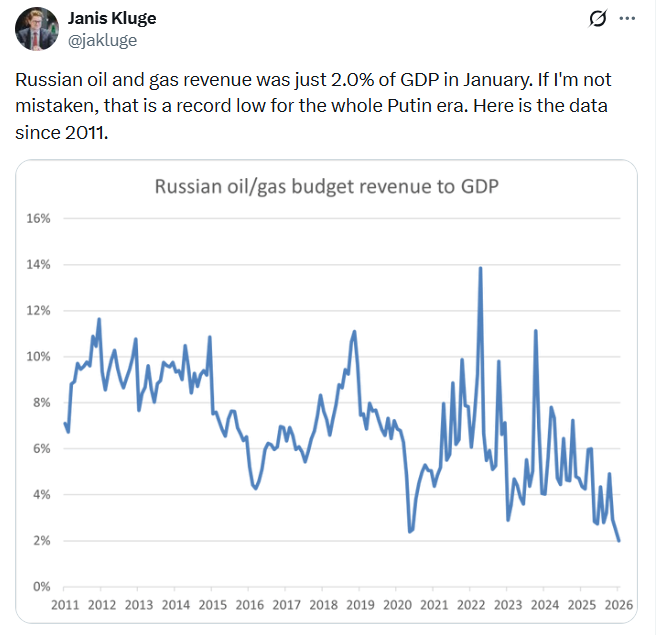
5. Russian Oil and Gas Revenue -50% in January
Janis Kluge
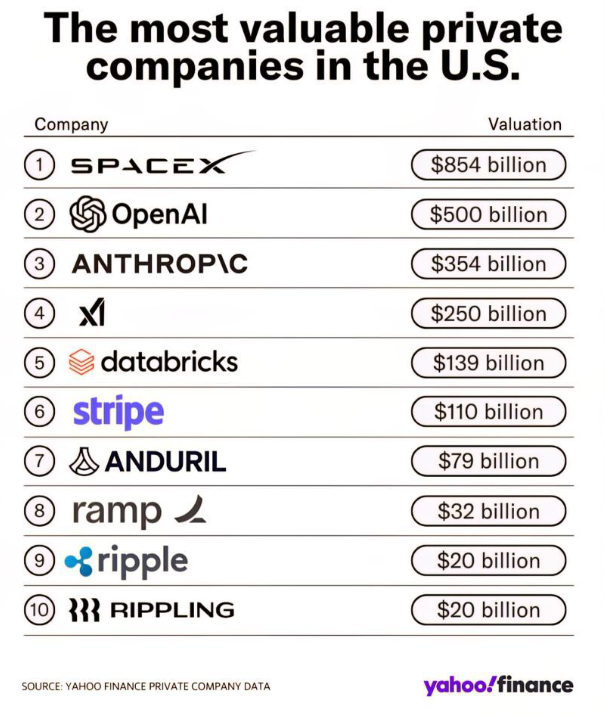
6. The Most Valuable Private Companies
7. The $20 Trillion Increase in U.S. Debt
King Report-US debt under Trump soared $8 Trillion or 40% from his January 2017 inauguration until Biden’s January 2021 inauguration. US debt soared $8 Trillion during Biden’s term, or 28.77%. US debt during Trump’s 2nd term has jumped $2.32 Trillion in ONE YEAR!
The King Report
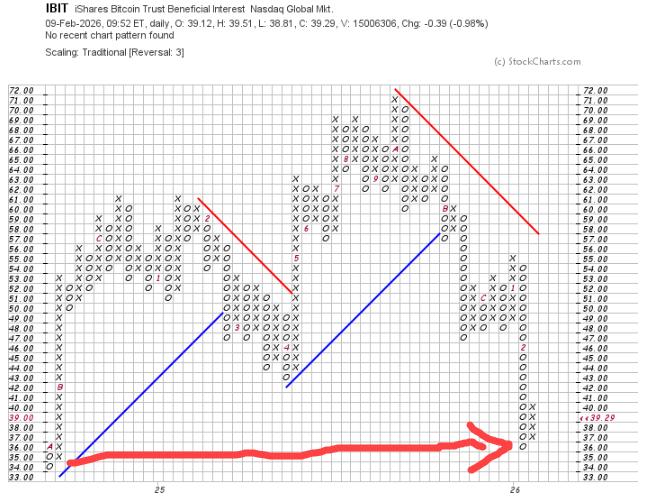
8. Bitcoin ETF Hits 2024 Levels of Support
StockCharts
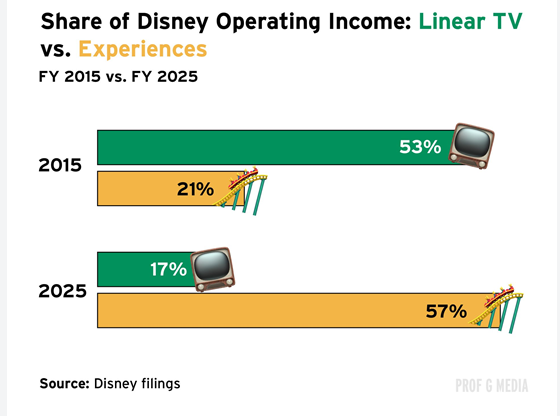
9. Disney Flip in Operation Income Over 10 Years-Prog G
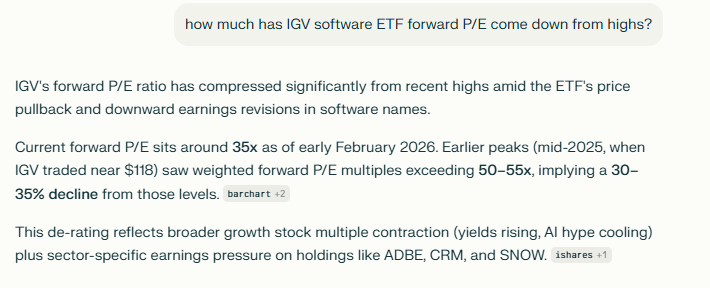
3. Software Forward PE Drop ….Forward P/E of Software ETF 55x to 35x
Perplexity
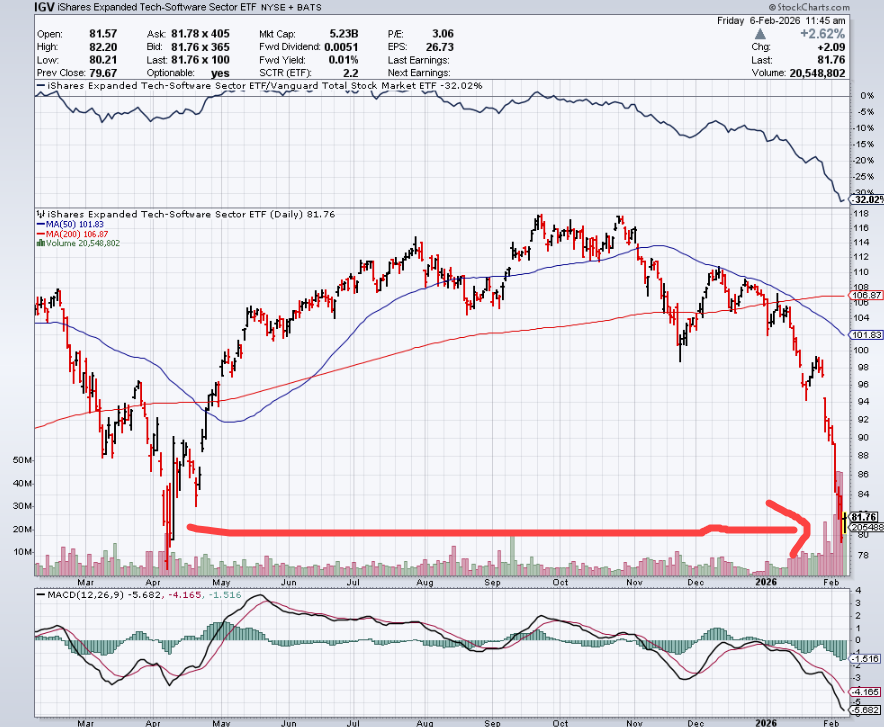
4. IGV Software ETF Right on Liberation Day Lows
StockCharts
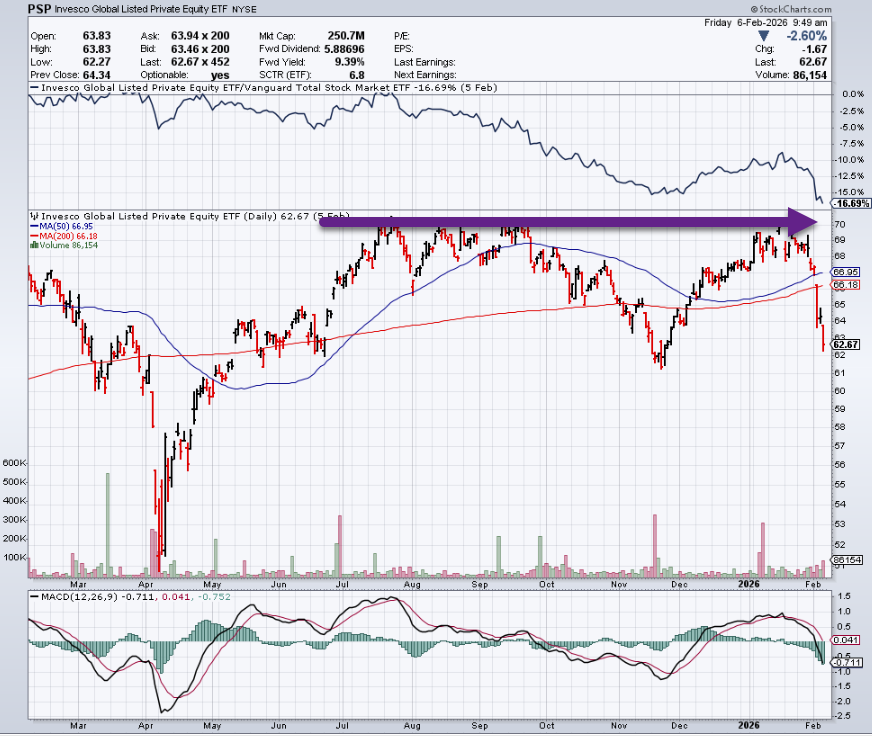
5. Private Equity ETF PSP Failed 4x at New Highs
StockCharts
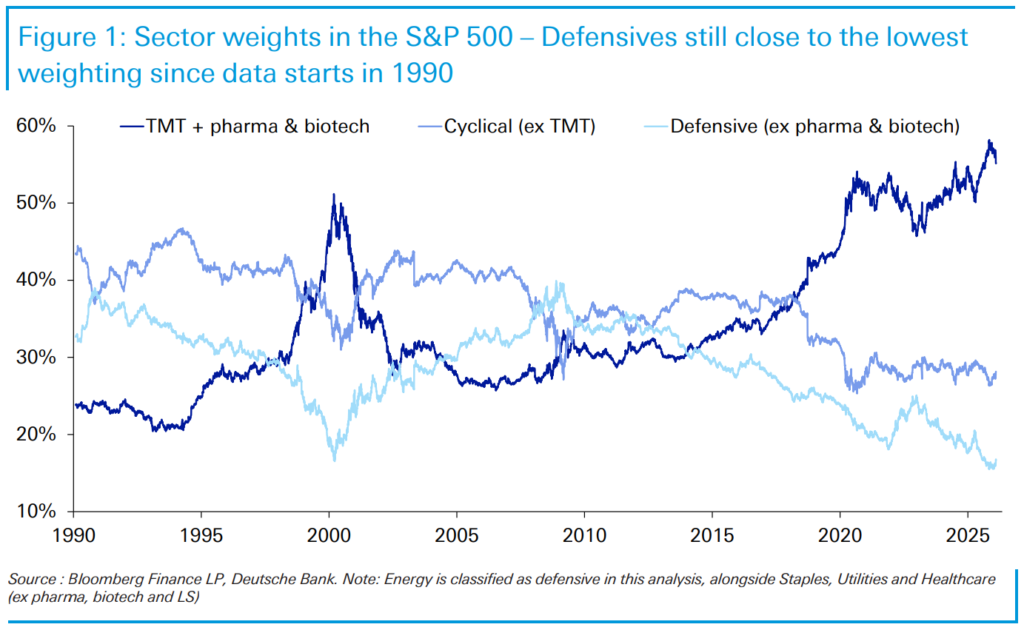
6. Defensives Still Close to Lowest Weighting in S&P 500 Since 1990
After a fascinating week in markets, today’s CoTD —updated from last week’s pack (link here)—shows that US defensive stocks remain close to the “cheapest” levels we’ve seen since our dataset begins in 1990. In other words, even with the recent rotation out of tech, the broader picture still shows limited impact when you zoom out.
For more colour on positioning and flows behind the recent equity move, see Parag Thatte’s latest weekly report (link here). Two themes stand out:
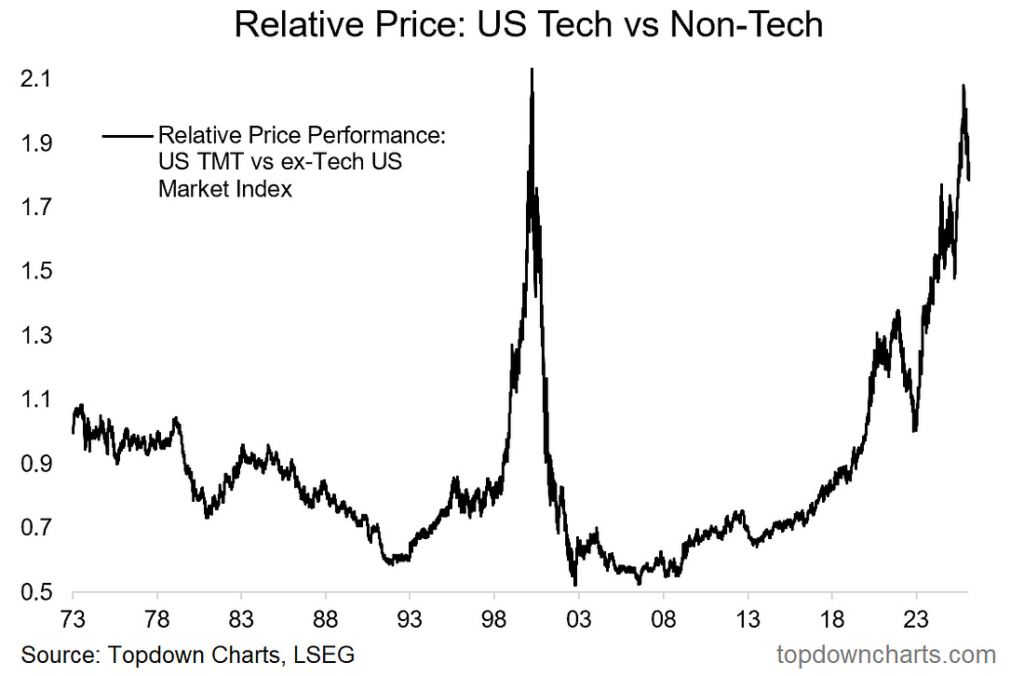
Tech bounced on Friday from the bottom of its 10-year relative channel versus the S&P 500. Notably, it was sitting at the top of that channel back in October when the rotation began.
The rotation away from tech began around the time Q3 earnings revealed a broadening of earnings growth—from a narrow set of sectors (mainly tech) to most sectors.
This second point is particularly interesting: improving earnings elsewhere may have helped create the conditions for the tech sell-off just as much as anything happening within tech itself. And while tech still shows the strongest earnings growth, today’s chart suggests that as other sectors improve, relative valuations become compelling enough for investors to reallocate.
Deutsche Bank
7. Murder Rate Per 100,000 People
Semafor
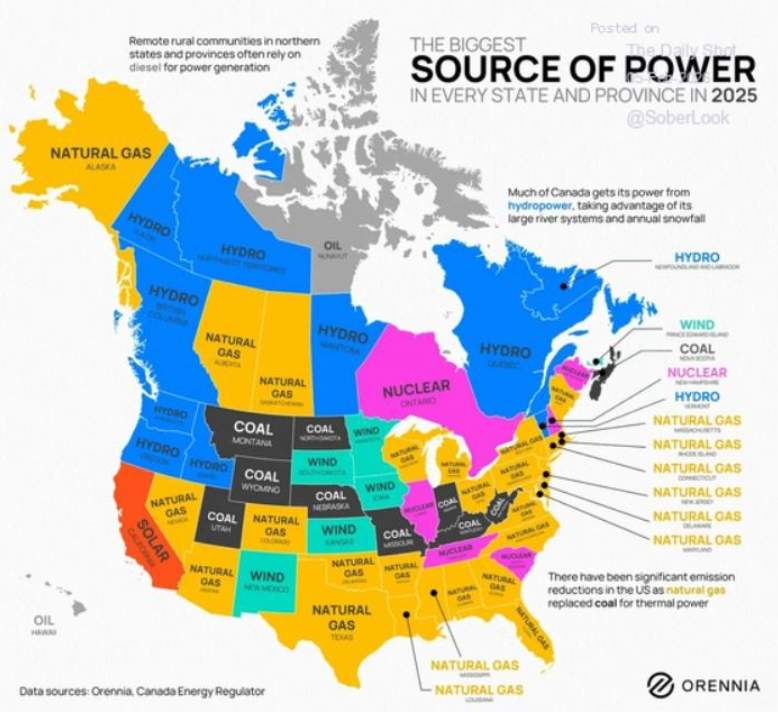
8. Source of Power by State 2025
Orennia
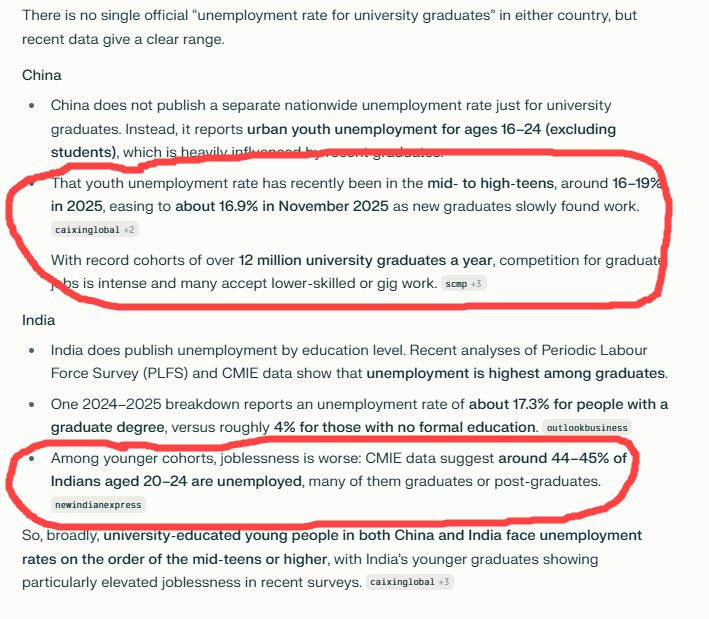
9. Unemployment Rate for College Grads in U.S. 2.5%-2.8%….Vs. China/India