
Part I-Can FAANG Stocks Lead Forever
The music has been playing for FAANG stocks 10 years. Who would ever sell a FAANG stock? This is somewhat of a consensus after a decade of massive outperformance and the market cap weighted S&P returns driven by this handful of stocks. I have no prediction on FAANG’s future, but market leadership rotates and a decade of outperformance is rarely repeated.
I called my custodian to check a borrow rate on Tesla with the intention to short the shares only to be greeted by laughter from the young person on the other end of the line. His reply, “there is plenty to borrow because no one shorts Telsa. No One Ever Shorts Tesla.” I guess then that no one shorts Apple, Amazon, Netflix, Facebook, or Microsoft. Can the large cap tech stocks that dominated performance from 2010-2020 repeat that performance again for another decade? Let us look at some of the former largest market cap names in S&P.
Three former “cannot lose” large cap stocks that faltered after becoming the largest companies in world are GE, Exxon, and IBM.
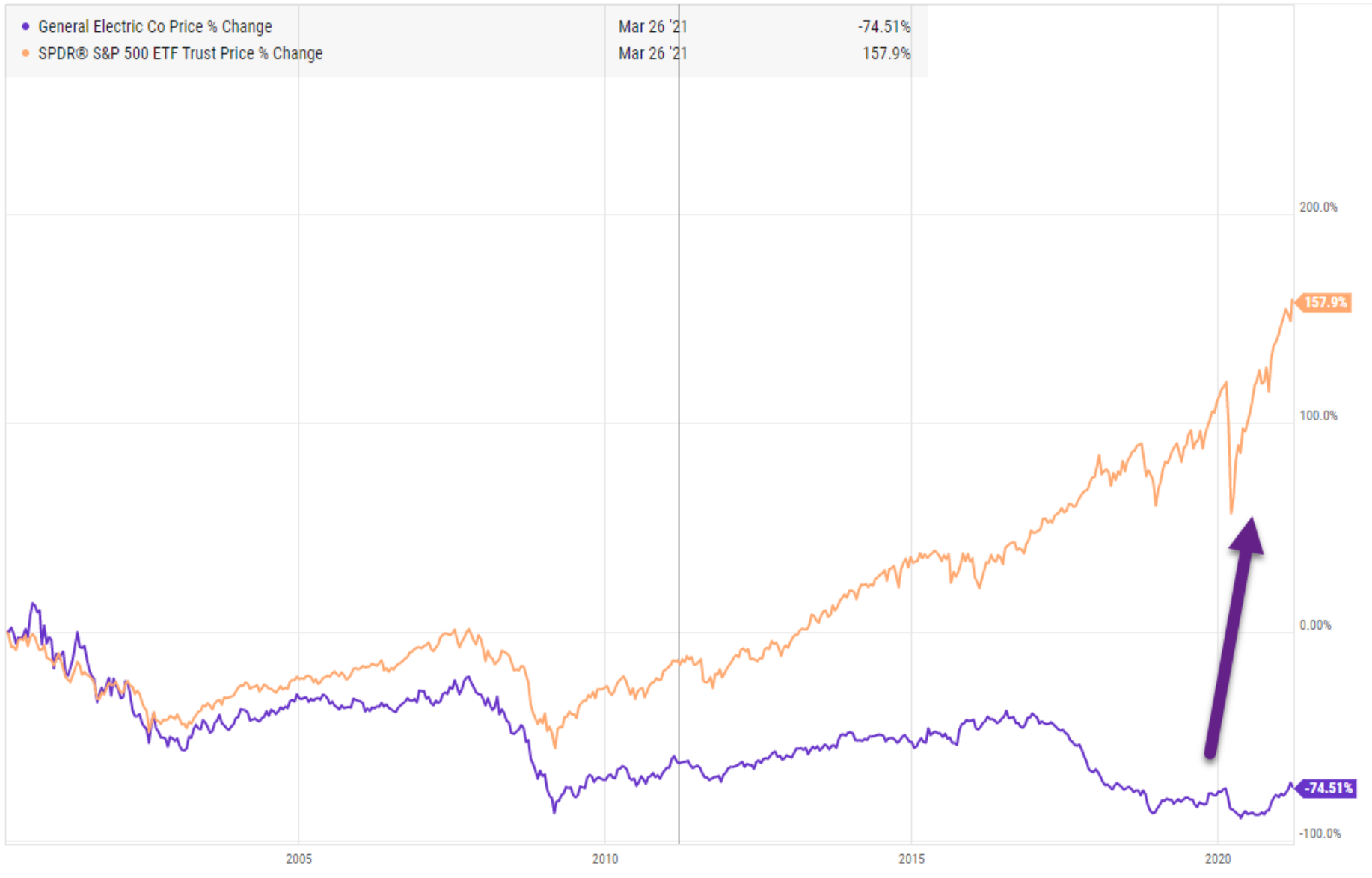
In August 2000, GE was the most valuable company in the world, with a market capitalization that peaked at $601 billion.
Here is GE vs. S&P since 2000…S&P +158% vs. GE -75%
“A long, long time ago
I can still remember how that music
Used to make me smile
And I knew if I had my chance
That I could make those people dance
And maybe they'd be happy for a while.”
-American Pie, Song by Don McLean
Source: Bloomberg
SILVERLIGHT ASSET MANAGEMENT, LLC
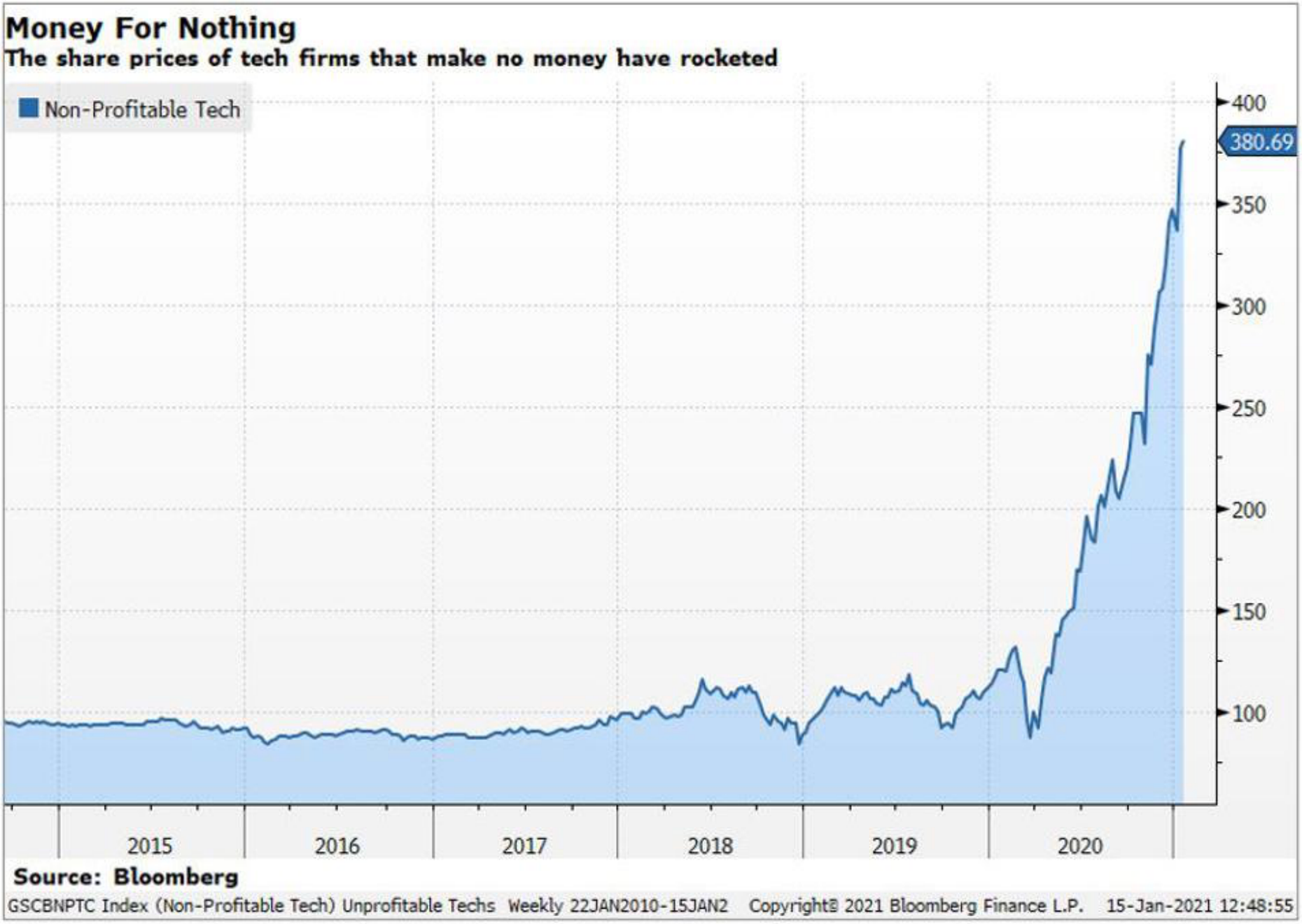
2.Explosion of technology stock “non-profits”
The share of tech firms that make no money quadruples during global pandemic.
These probabilistic return assumptions depend on current market conditions and, as such, may change over time.
IMPORTANT: The projections and other information generated by the Vanguard Capital Markets Model regarding the likelihood of various investment outcomes are hypothetical in nature, do not reflect actual investment results, and are not guarantees of future results. Distribution of return outcomes from the VCMM are derived from 10,000 simulations for each modeled asset class. Simulations are as of March 31, 2019. Results from the model may vary with each use and over time.
https://awealthofcommonsense.com/2021/03/owning-the-best-stocks-is-hard/
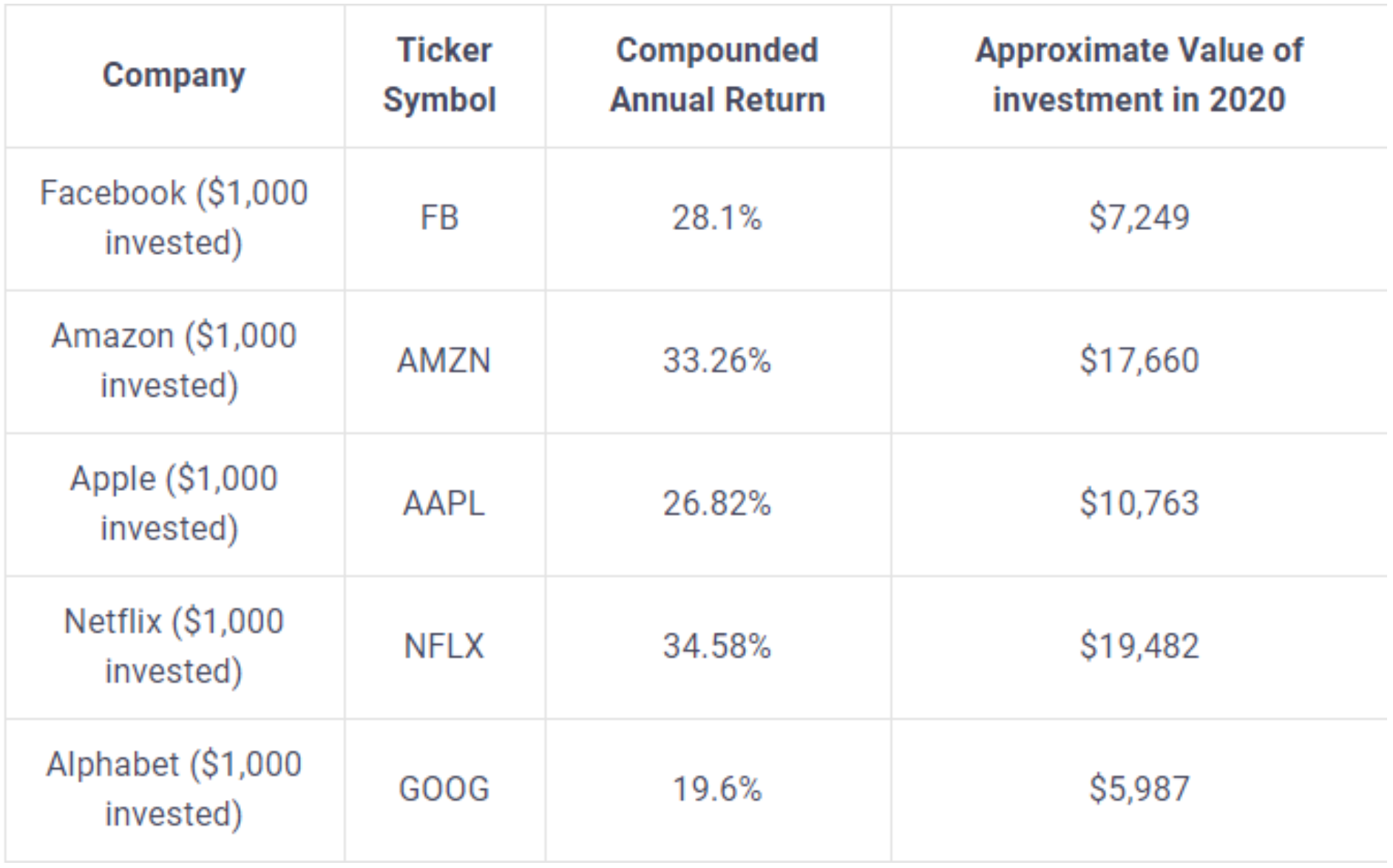
In February, Barron’s quoted a Columbia Business School study. From 1926 to 2017 only 4% of stocks were responsible for the market gains. Fewer than 40 companies compound over 20% on average for 10 successive years and they account for all the excess returns. We do not need to look far for who those compounders were over the last decade-FAANG. The question becomes, who will be the top compounders for the next decade?
There is no doubt that these companies are cash flow machines with wide moats but history tells us that companies do not stay on top forever.
Here is a grid on the last 10 years of compounding from FAANG stocks.
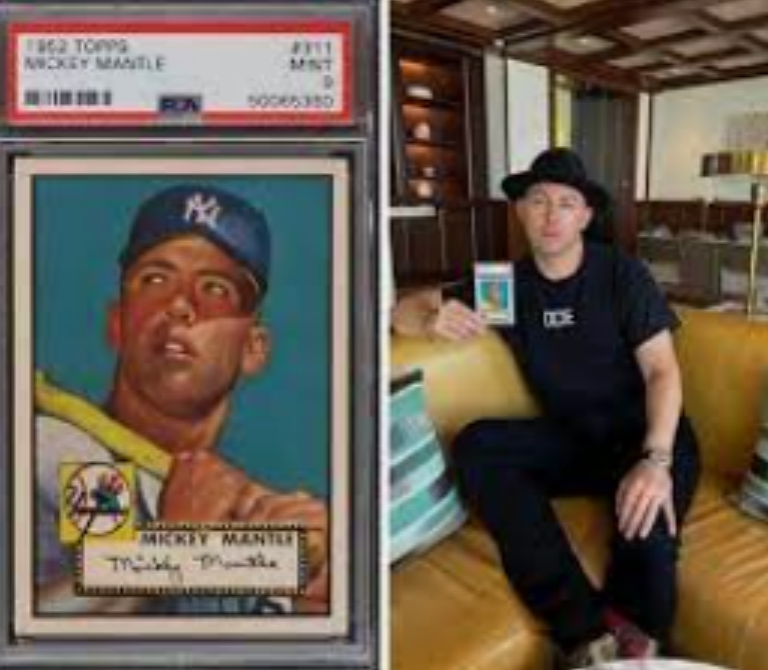
$5.2 million for Mickey Mantle Rookie Card
On December 7th, 1999, Barron’s published the infamous “What’s Wrong,Warren” cover eerily before the Nasdaq crashed 50% and Berkshire recovered years’ worth of underperformance.
The below graph plots the time period 6/30/98 through 2/29/00 for the Nasdaq where many dot-com and technology stocks traded, and the price of Berkshire Hathaway, Warren Buffett’s holding company, which consisted of value stocks:
Conclusion
Can this “wild cocktail” go on forever? Can literally everything keep going higher? I was a front-row observer in my previous role as a trader to the last two asset bubbles in America-internet stocks and housing. That was a classic bubble - all money flowed to one asset class until it bursts. This is a different song altogether as everything is going higher under a flood of government largesse, with the biggest bubble being government debt. In 3 months, the U.S. government increased the deficit by more than the last 5 recessions combined.
Today, government debt is manageable due to low interest rates costing us $350B per year. The ultimate question is around inflation, i.e. lumber prices spiked 188% in the last 6 months. How much is enough inflation before the Fed raises interest rates? Rates are rising naturally and have tripled off the bottom, but what is the level that becomes troublesome for the markets?
When rates rise, it hits bonds first, stocks second, and the economy third. We are seeing the bonds stage play out right now as Americans learn for the first time in over 30 years that you can lose money in bonds. Stocks and the economy are going to be much tougher to time as GDP is projected to hit 8% post-vaccination.
One of the longest rock songs of all time is “The Gates of Delirium” by Yes (21:55). Some of the asset classes mentioned in this letter are at The Gates of Delirium, especially since the players in those markets have never been in the game. Availability is going to be their kryptonite because what is available should not always be purchased.
At the head of the Gates of Delirium tour are SPACs, stocks trading at 15-20x sales, and profit-less tech (with some of the more esoteric assets close behind). Bubbles are easy to spot but impossible to time. Considering that Stanley Druckenmiller told us that this is the wildest cocktail that he has ever witnessed and Warren Buffett sold at the bottom (airlines) rather than bought, it is safe to say that making any bold predictions is a fool’s errand. But inflation and interest rates should certainly be on everyone’s watch list.
After 25 years, you become skeptical to most market predictions, but some things withstand the test of time - like reversion to the mean, momentum, and the markets pricing-in events before they happen.
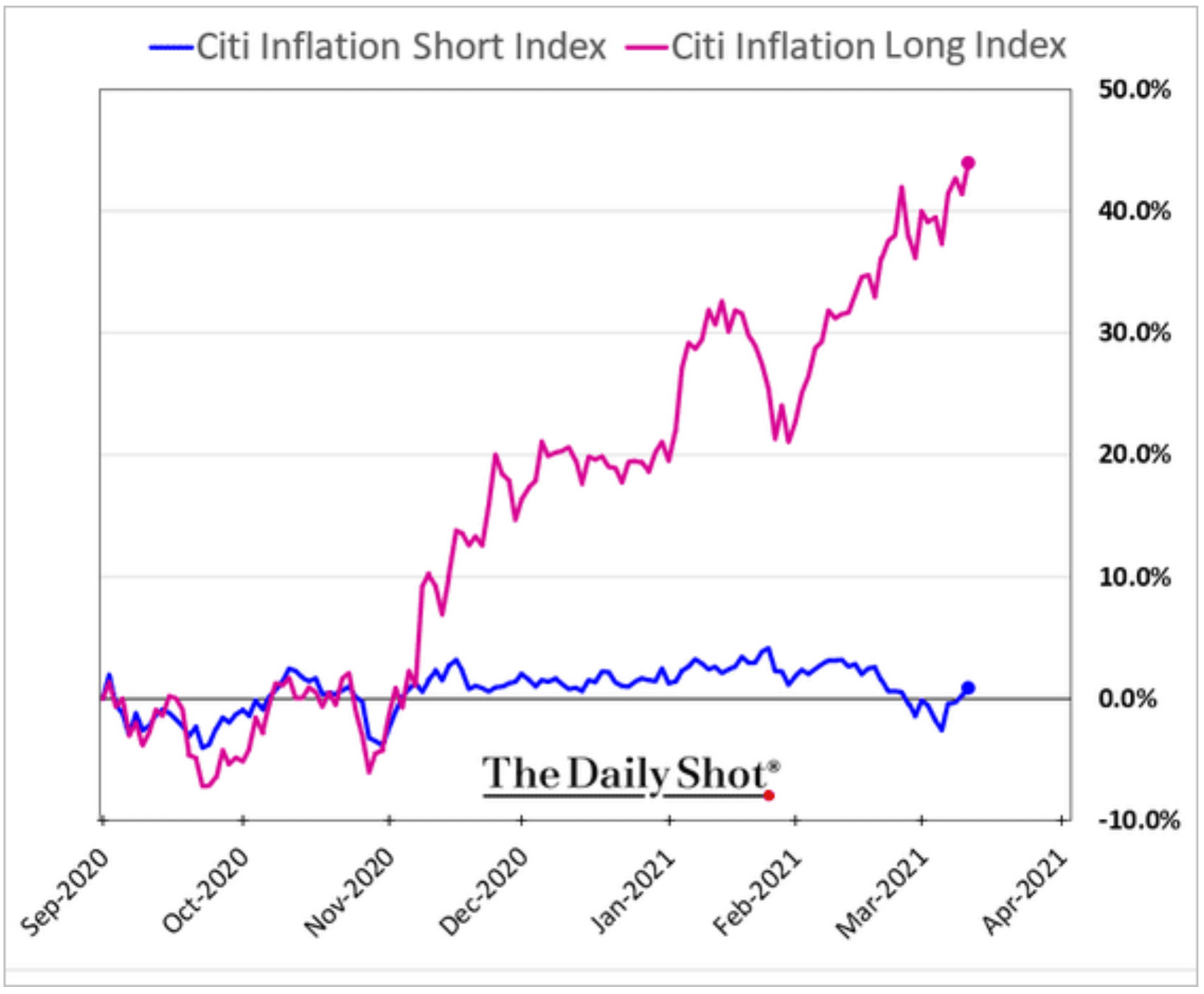
Here is the chart of stocks that do well when inflation is rising versus the stocks that do poorly when inflation is rising. Is the market pricing in the future? What will cause the music to die? 3% on the 10 year? Inflation above 3%?
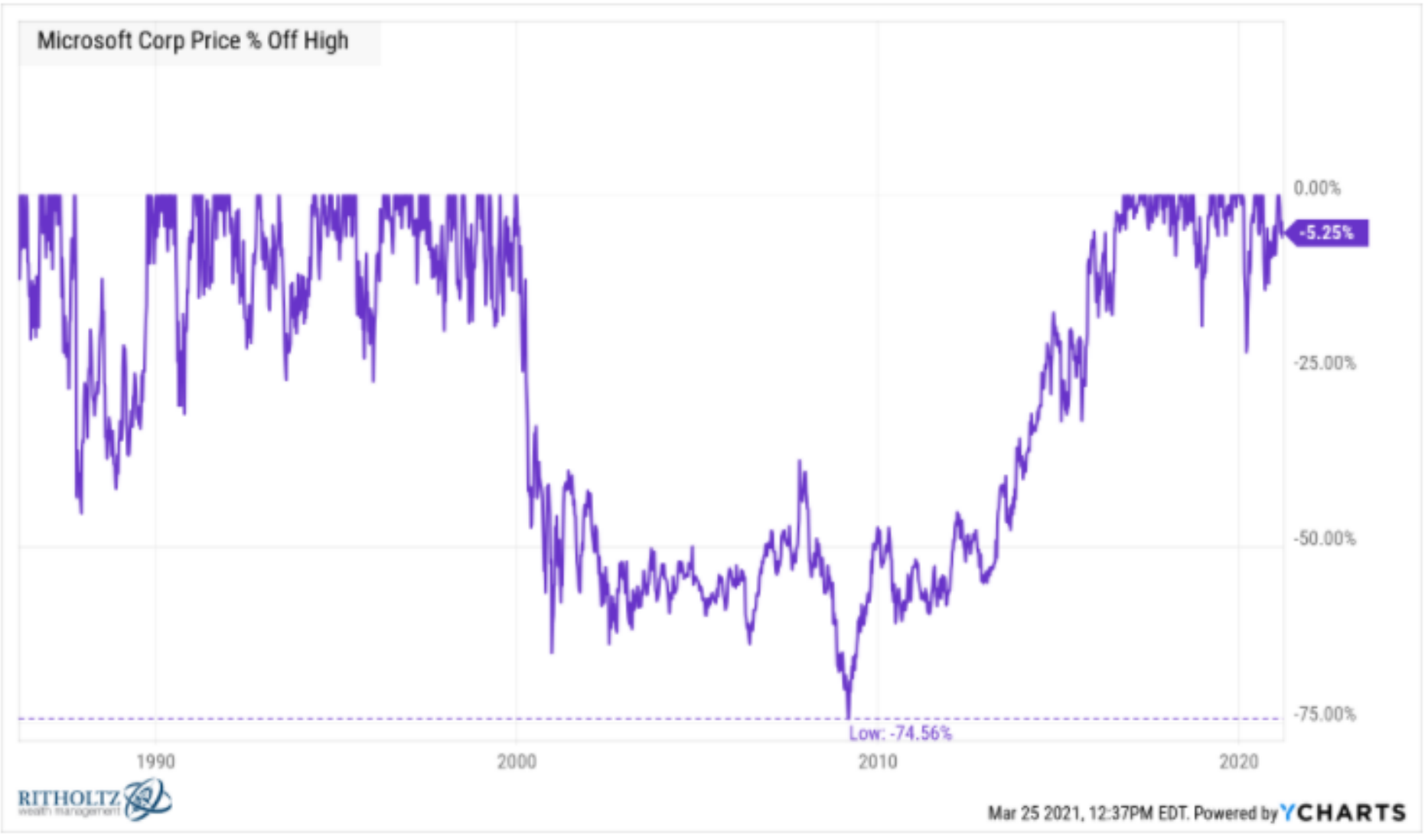
Even the stocks that compound at 20% plus for 10 years are impossible to buy and hold for most investors. Ben Carlson of Common Sense blog points to the pain of holding Microsoft through the years.
“The stock fell nearly 75% following the dot-com debacle and it took 17 years for the price to make it back to the levels of late-1999. Microsoft also fell 56% in the 2008 crash and has experienced six double-digit corrections since 2009 (including three drawdowns of 20% or worse).”

The Booming IPO Market Shows No Signs of Slowing. What Investors Need to Know. By Luisa Beltran
Barron’s--So far this year, 302 U.S. initial public offerings have raised $102.3 billion (as of March 10, 2021), according to Dealogic. That is up 763% from the 35 offerings valued at $11 billion for the same period in 2020. For all of 2020, there were 457 IPOs collecting $167.8 billion. Before that, the high-water mark for IPOs came during the dot-com bubble of 1999 when 547 offerings raised about $108 billion.
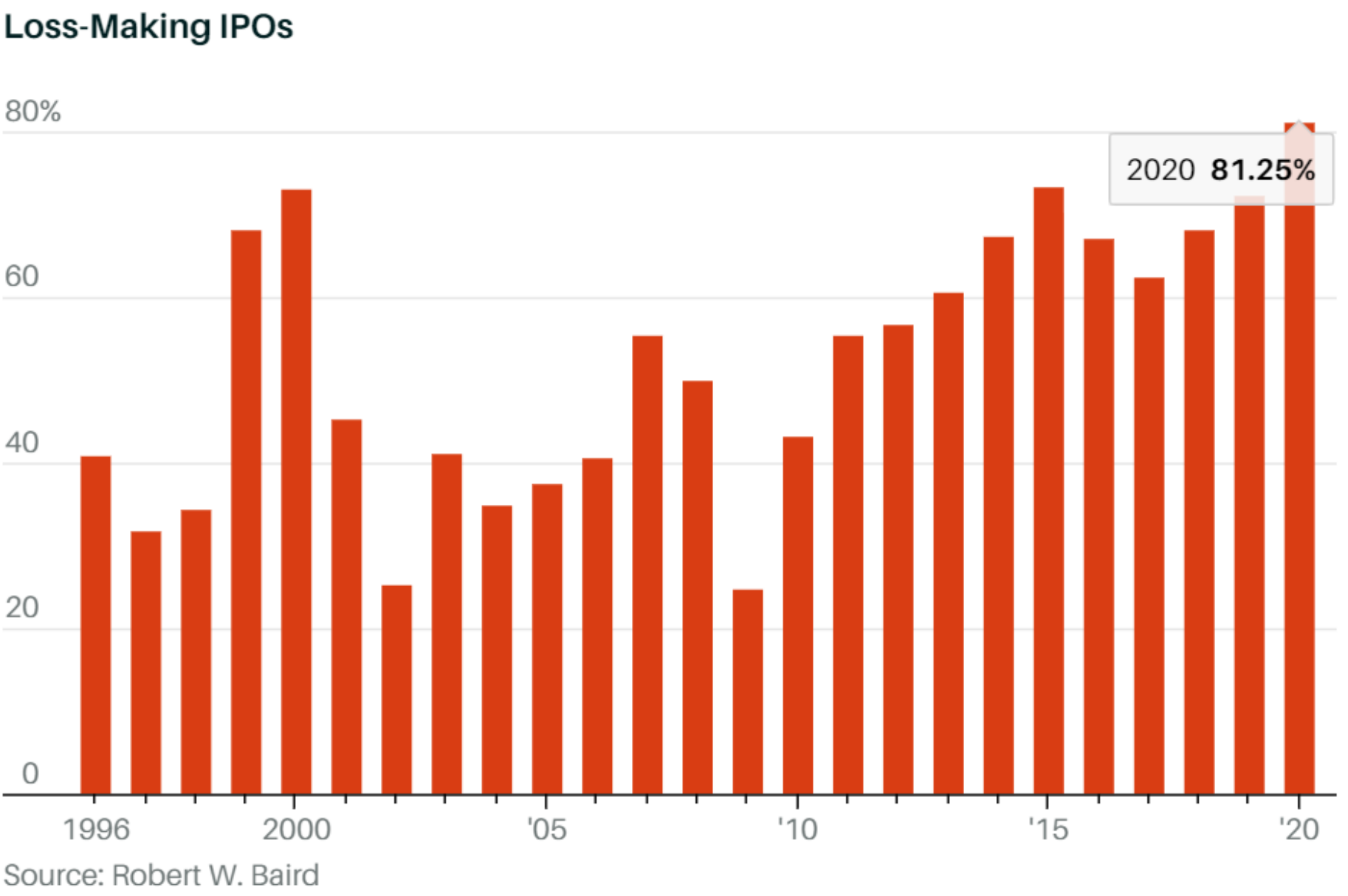
Ross Yarrow, managing director of U.S. equities at Robert W. Baird, looked at the first-quarter results for companies that went public last year and found that 81% were unprofitable. He also analyzed companies that went public in 2000, the peak of the dot-com bubble, and roughly 73% were unprofitable one quarter after the IPO.
If the current 2021 IPO pace keeps going, America will exceed 1999 in number of IPOs. Keep in mind that we already beat 1999 in number of IPOs that are losing money; this feat was attained in 2020.
Finally, the number of IPOs from 1995-2020 in the U.S. is on track for a new record.
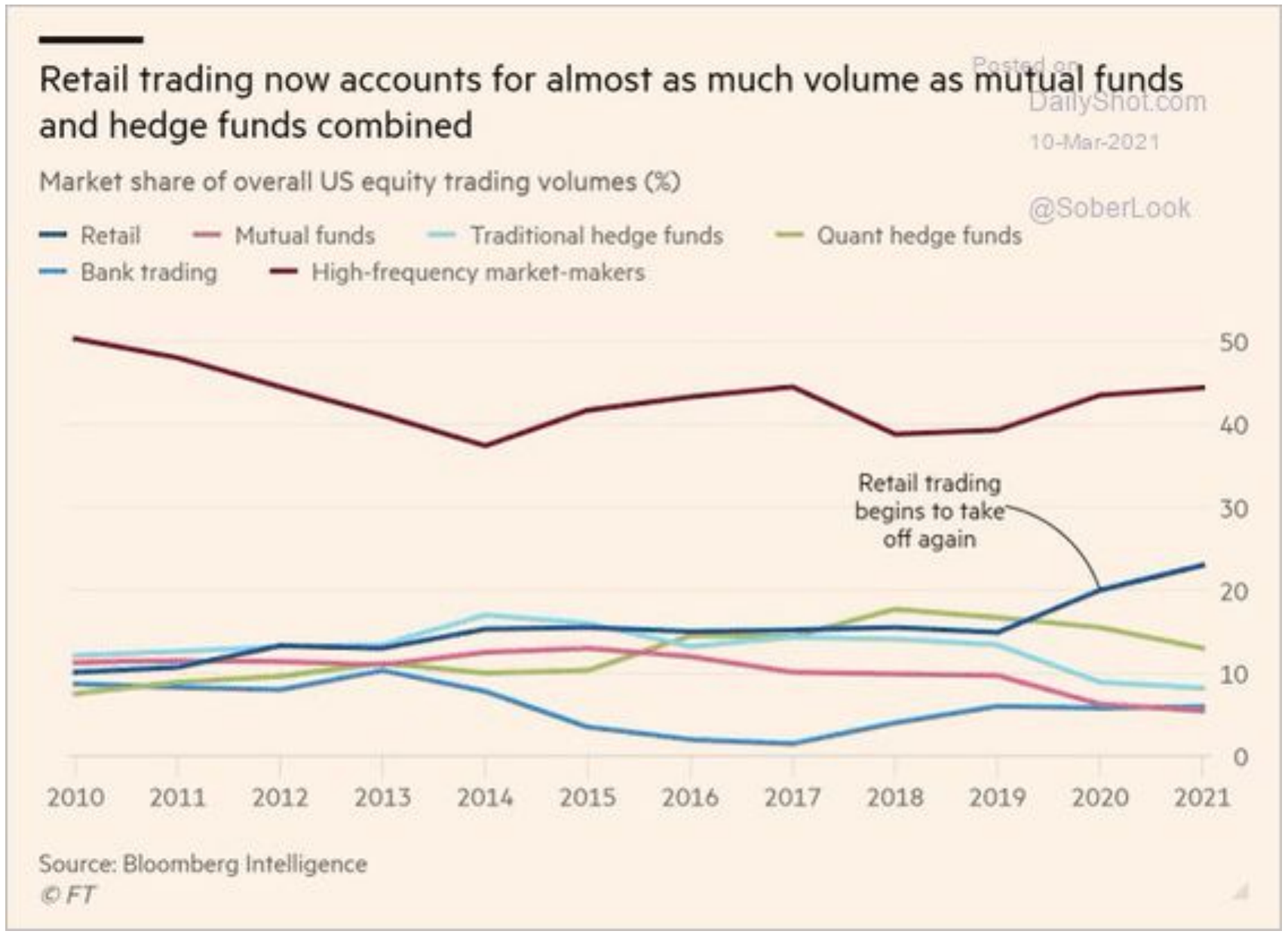
5. The Retail Trading Explosion…Joe Six Pack is now trading more than mutual funds and hedge funds combined.
This has never ended well. Period. End of story.
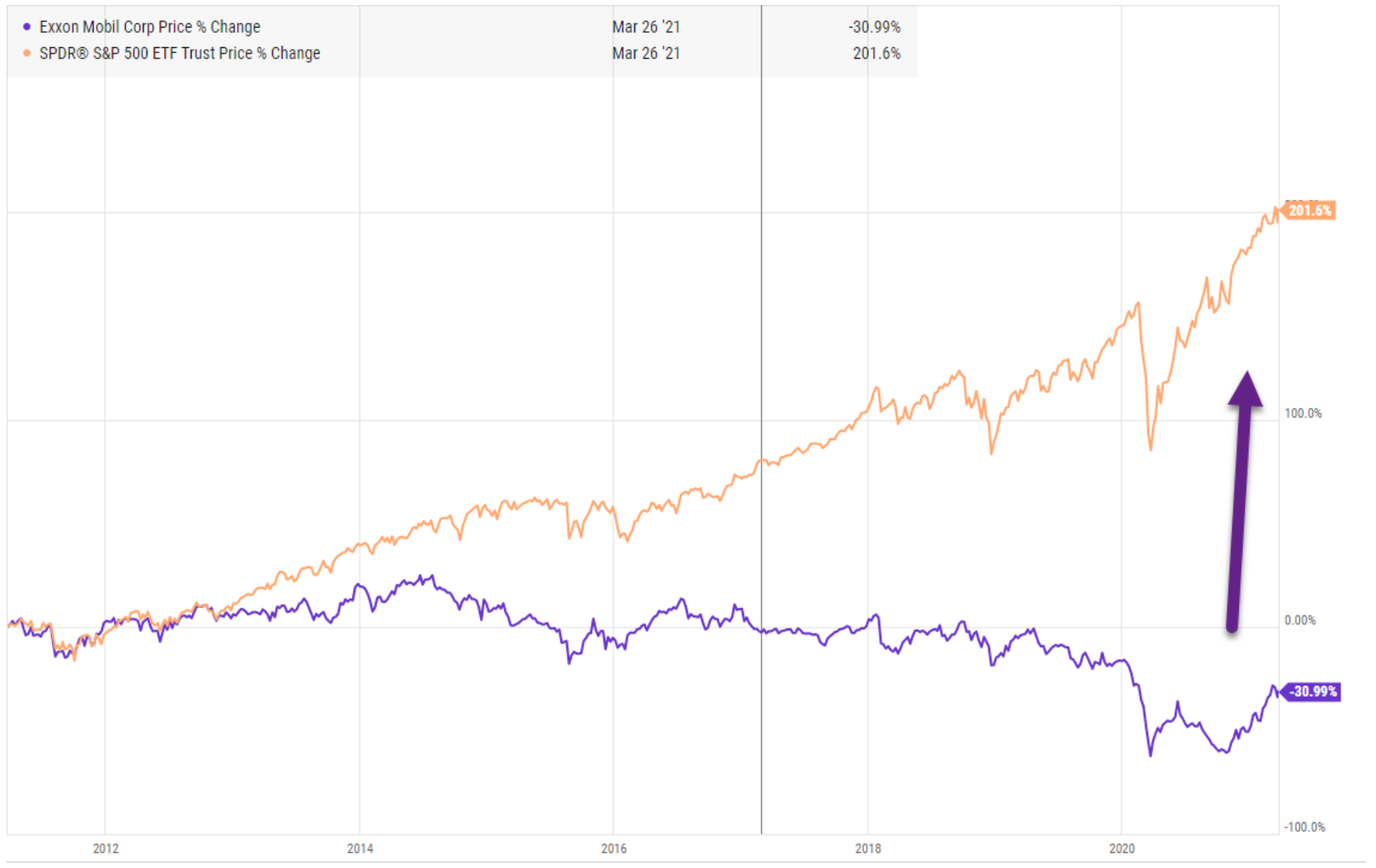
As recently as 2013, Exxon was the most valuable company in the world. How does XOM chart look vs. S&P in last 10 years? S&P +200% vs. Exxon -30%
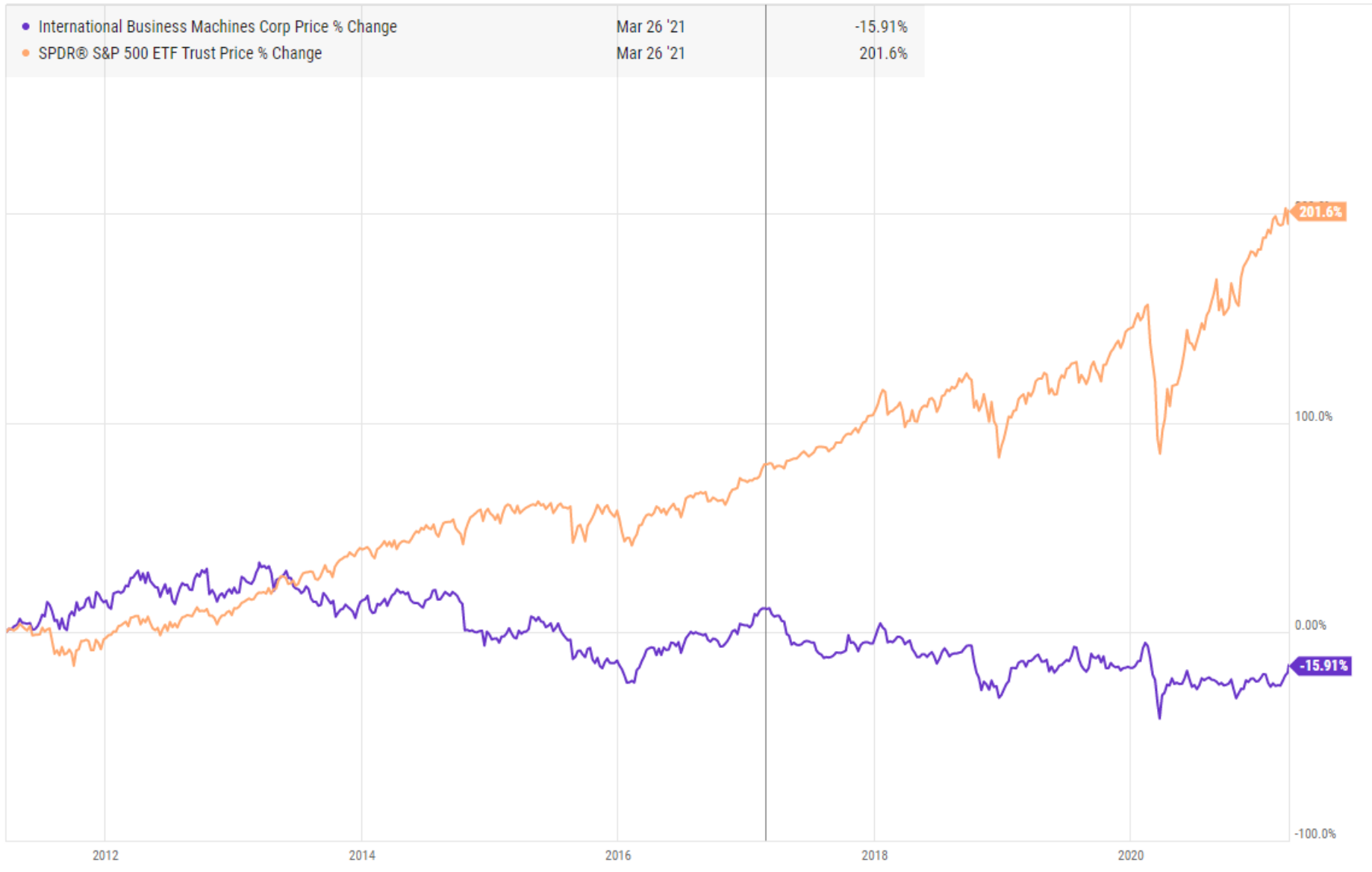
How about another stock that had a long-run as most valued company in the world-IBM? IBM’s all time high was 215.80 on March 14, 2013.
IBM vs. S&P for last 10 years S&P +200% vs. IBM -16%
Source: Bloomberg
https://www.zerohedge.com/markets/big-tech-trumps-small-caps-inflation-outlook-hits-13-year-high
Part II-Availability
“Machiavelli-He’s a famous writer from 500 years ago. Availability, that’s what he always said…”
An under-appreciated philosophers in American history was Sonny from The Bronx Tale who followed Machiavelli’s thesis on “availability”. Right now, America is experiencing massive availability of 2 things: cash and credit. It is hard to decipher one from another as we witness everything inflating under the massive fiscal and monetary largesse of the U.S. government that seems to have no end in sight. Remember, the Fed creates bubbles.
Stan Druckenmiller managed his hedge fund since 1978 without any losing years. In a recent interview with Goldman he said, “Buckle up. I have been doing this as chief investment officer since 1978. And this is about the wildest cocktail I've ever seen in terms of trying to figure out a roadmap.”
https://www.youtube.com/watch?v=K_u2AI7ZWAk
To summarize Mr. Druckenmiller’s “wild cocktail” - there is too much money chasing too few assets. Here are the 10 areas money is chasing…
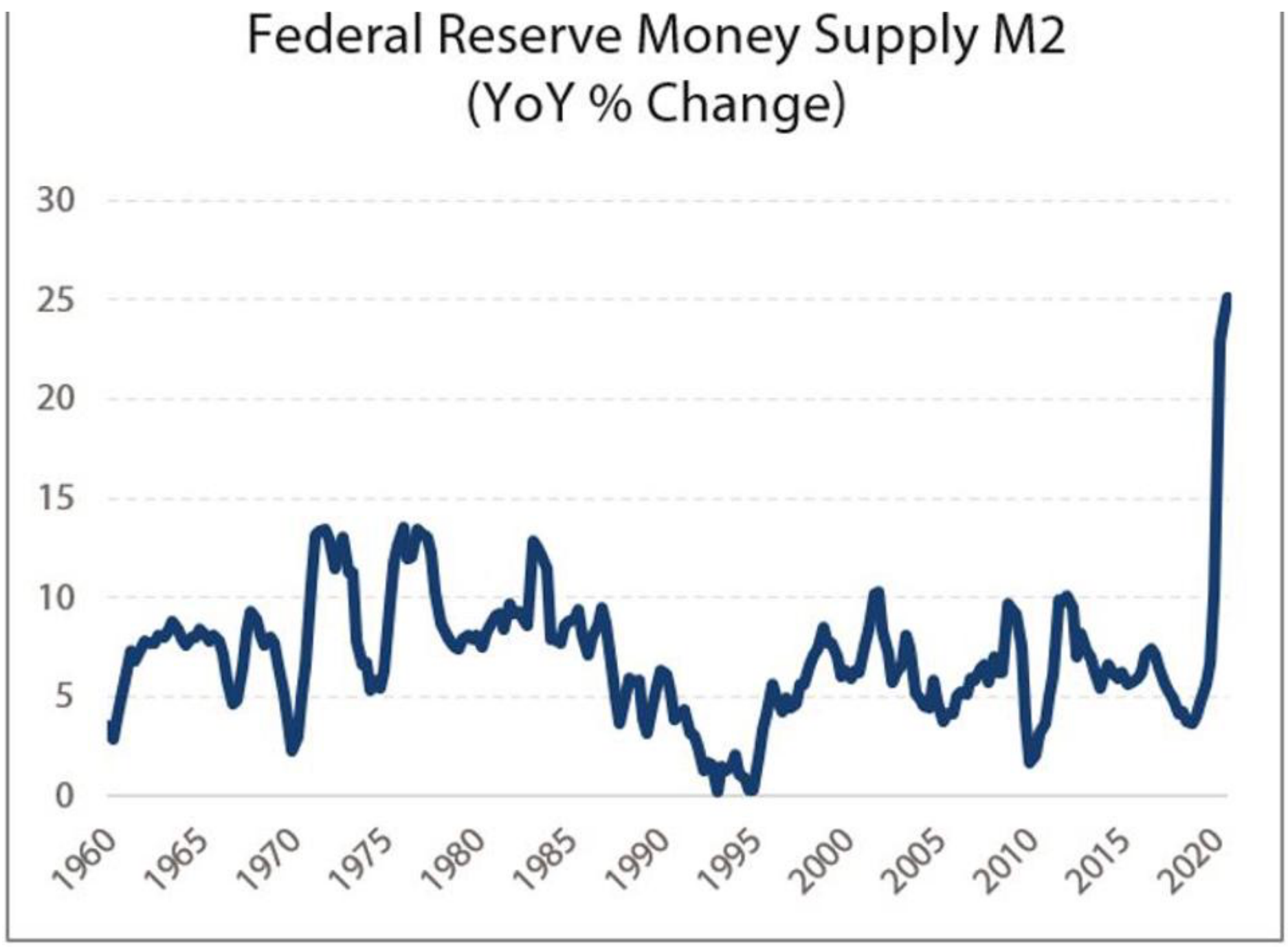
1.Huge explosion in money supply leads to surges in financial assets. Basically, the FED creates bubbles.
It is no coincidence the bull market in profitless techs started when the Fed dramatically increased its balance sheet. As money supply surges, so do financial assets. It is literally raining Benjamin’s.
Did We Work Ring the Bell for a Top in SPACS?
For Wall Street veterans, celebrity SPACS – a renewed explosion of a backdoor IPO process -is the ultimate sign of the end. And now the bell has finally rung with the announcement of We Work choosing to go the SPAC route.
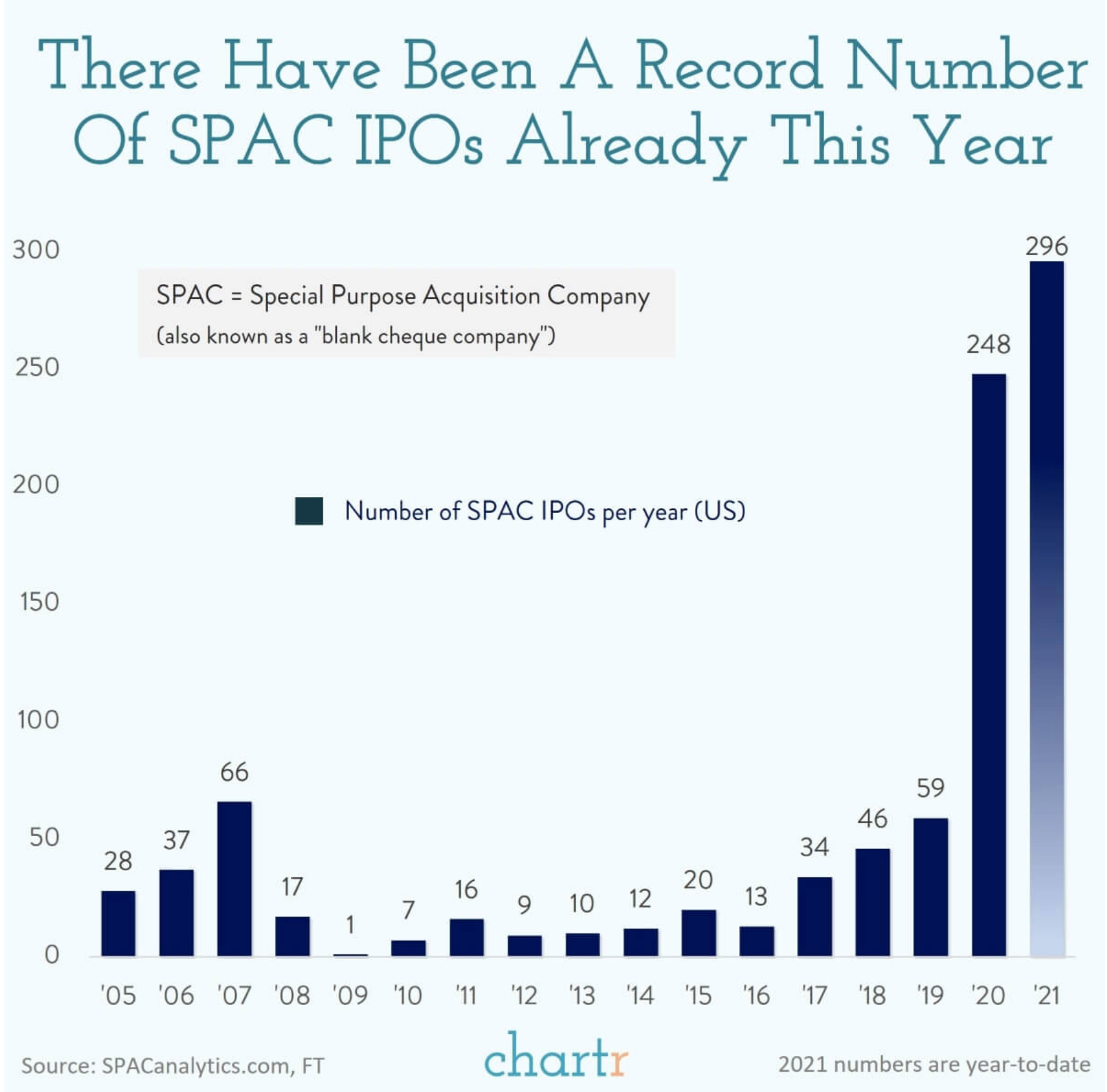
In my year-end 2020 letter I spoke about the IPO market being hot but not nearly as enthusiastic as 1999. In 2021, we are on track to surpass the number of IPOs issued in 1999.
From my last quarterly letter, “The total number of IPOs in 2020 is less than half the 1999 levels but the street has a 2021 pipeline that could make a run at the internet bubble highs in number of deals per year.”
State of play: according to CB Insights, tthere are over 500 “unicorns” - upstart companies that are valued at $1 billion or more by venture capitalists. More than half of those are based in the U.S. and around two dozen are valued at more than $5 billion. The newfound retail euphoria for stock trading will lead to investment bankers convincing Unicorn clients to “not miss the window” for monetizing your company into public markets.
The phenomenon of SPACs has pulled forward future IPOs in the same fashion that the Covid epidemic pulled forward many technologies. In 2021, the IPO market has witnessed a 763% Increase- 302 IPOs 2021 vs. 35 by this Time 2020.
4.The Money Losing PO Explosion.
Advisor Perspectives Blog https://www.advisorperspectives.com/commentaries/2021/03/19/millennial-airline-investorsare-up-double-since-buffetts-departure
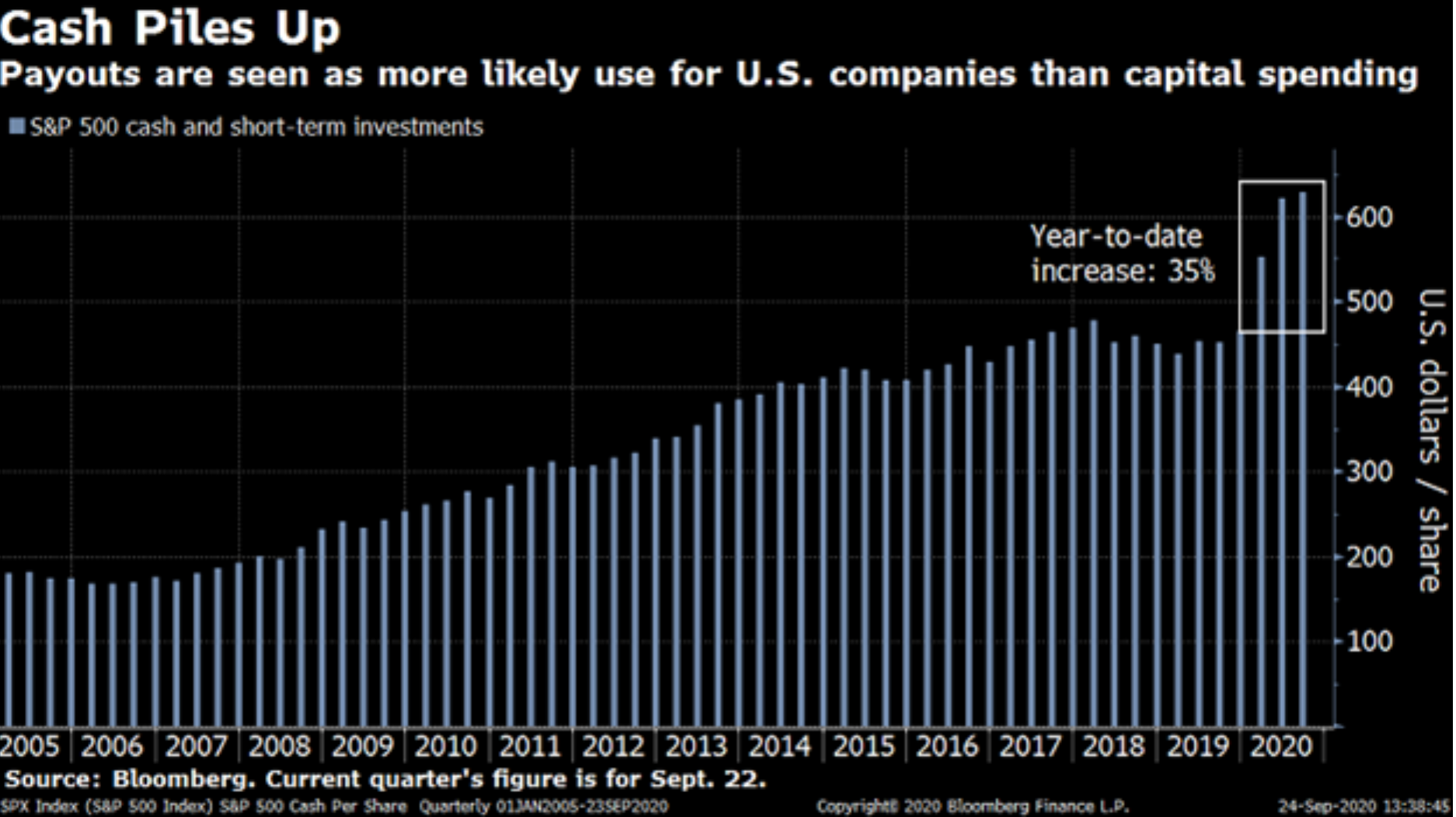
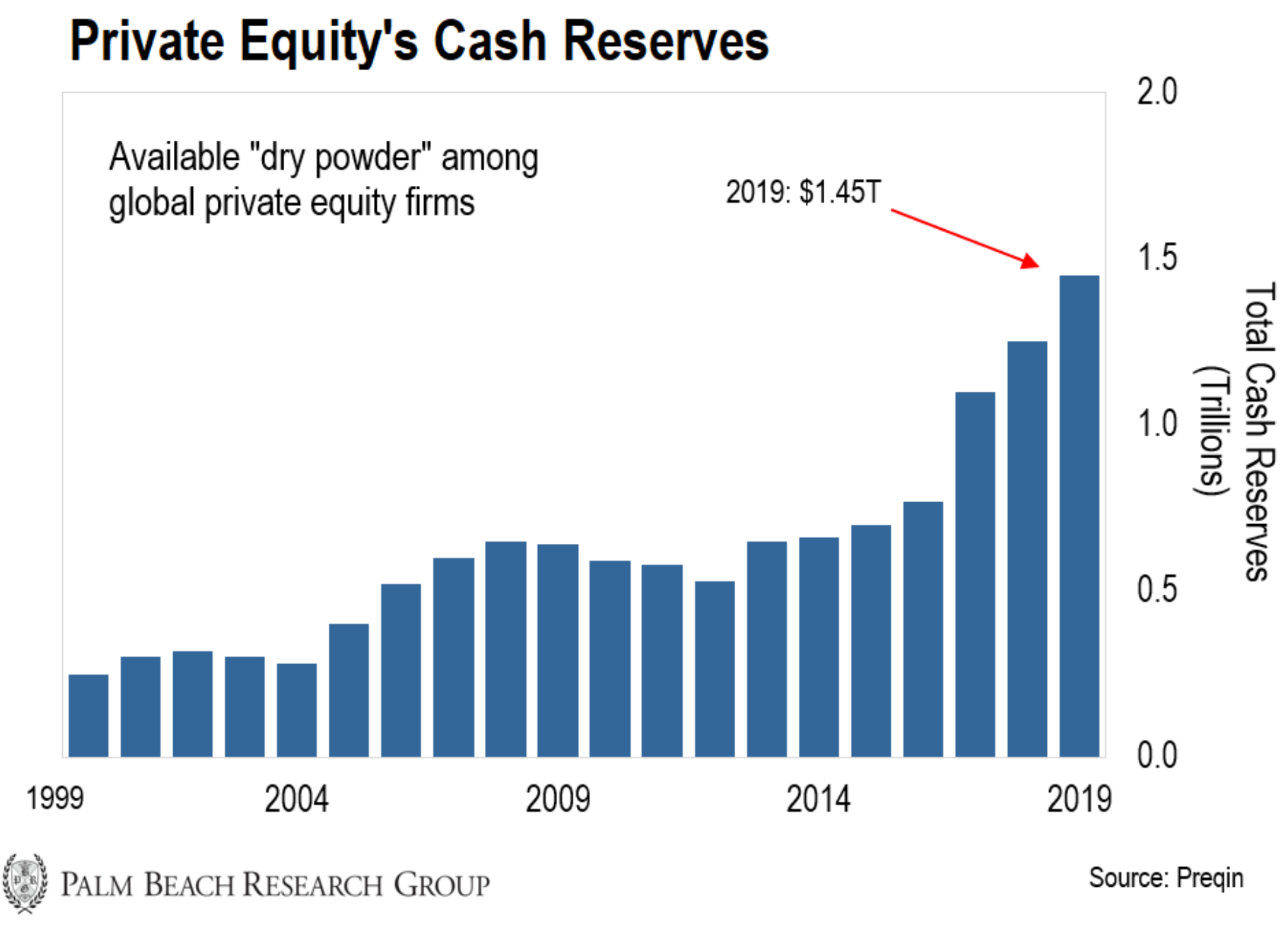
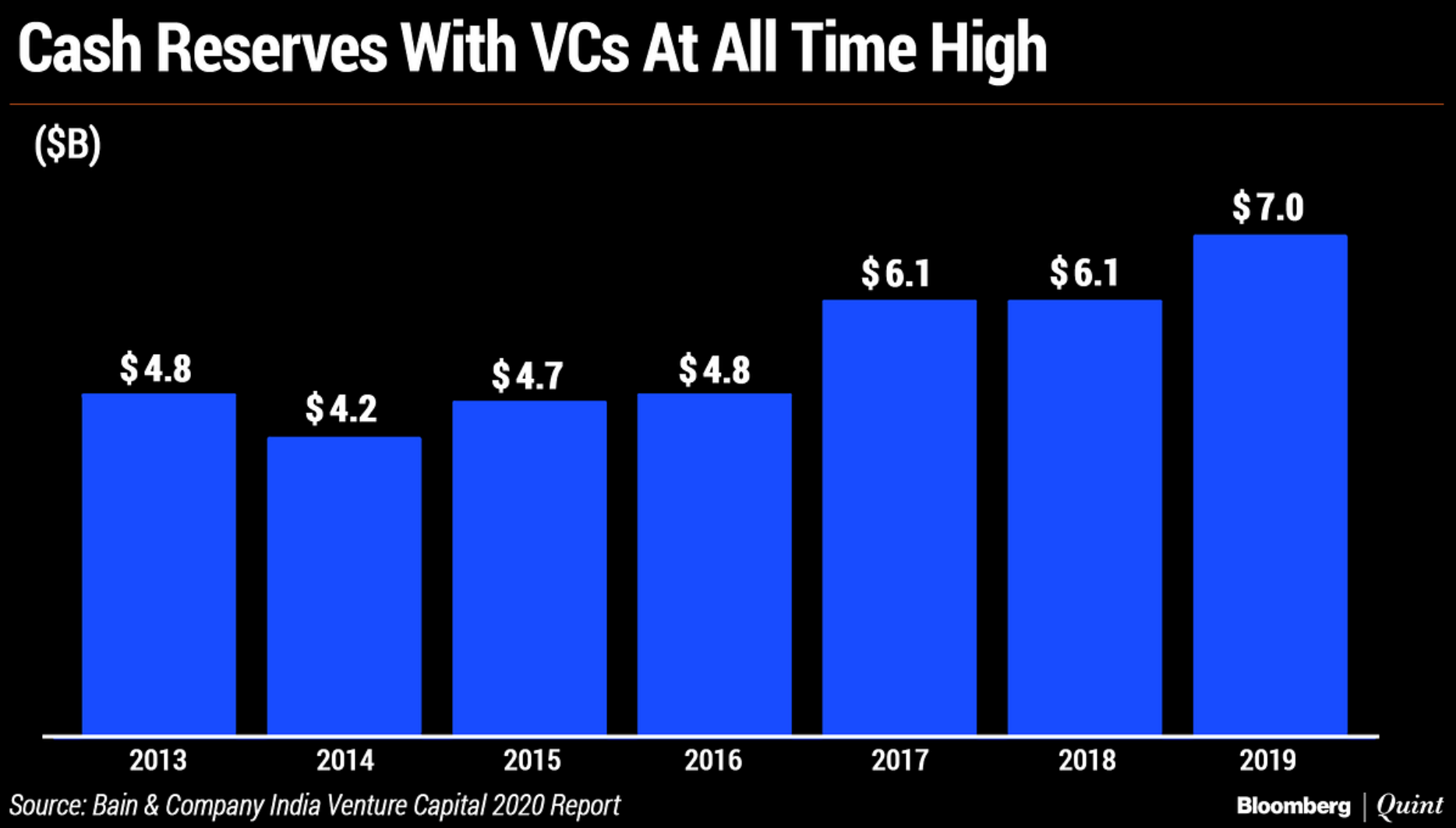
6.The Cash Reserves Explosion for S&P, Private Equity and Venture.
All this money can only flow to one thing-deals, deals and more deals.
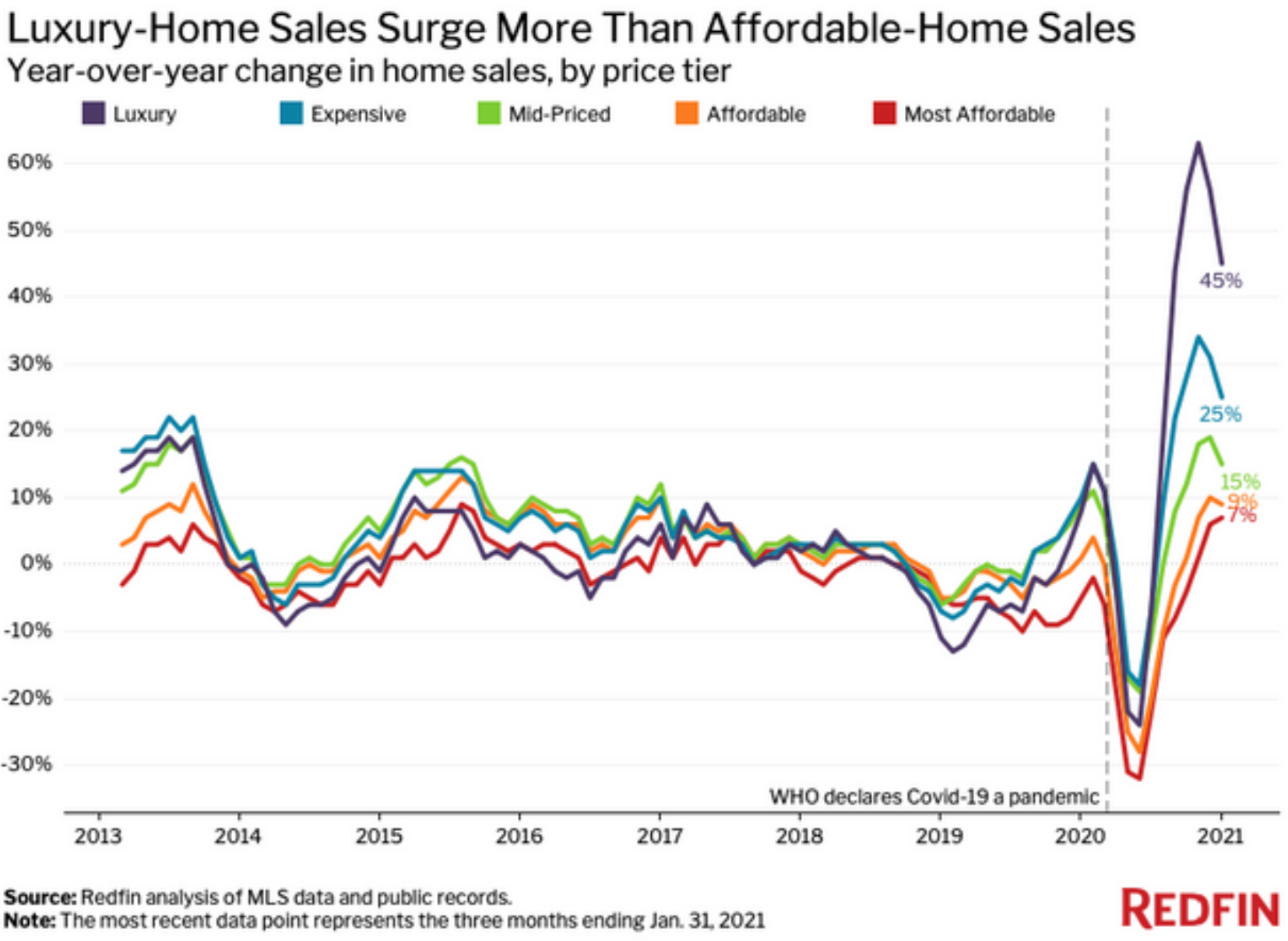
Housing is a luxury? Here’s what the K-shaped recovery means for real estate By Andrea Riquier
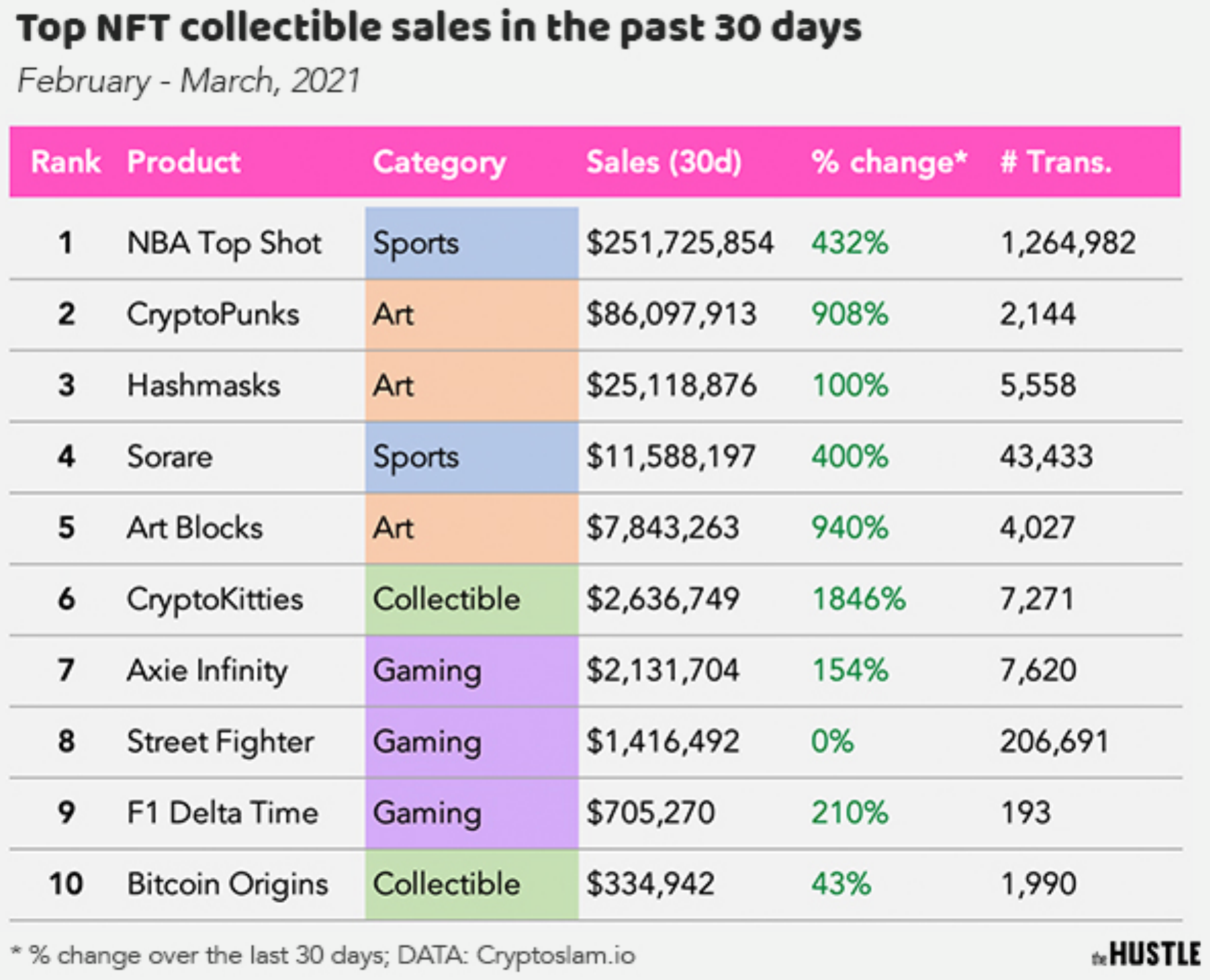
9. NFT and Sports Memorabilia Explosion.
The gains in NFT and sports cards make most stock gains look
pedestrian.
NFT 200% to 1800% gains in 30 days.
Leveraged loans are up 50 percent since 2015
Leveraged loans, which are issued by overleveraged companies with insufficient cash flows, are part of what Wolf Richter recently called the “gigantic pile of risky corporate debt that is now being brutally repriced as concerns over credit risk (the risk of default) are finally bubbling to the surface.” According to Richter, the S&P/LSTA US Leveraged Loan 100 Index, which tracks the prices of the largest leveraged loans, has plunged by 20 percent since February 22nd.
According to Richter, leveraged loans “are traded in slices like securities or are packaged into highly rated Collateralized Loan Obligations (CLOs). But for years, investors had the hots for them, driven by their relentless chase for yield, in a world of interest rate repression.”
These companies, noted Richter, were often acquired by private equity firms through leveraged buyouts, which means they loaded up those companies with lots of debt. In addition, “PE firms extracted special dividends from their companies,” which were funded by leveraged loans. That’s a form of asset stripping and it leaves the company “more leveraged, more precarious and more likely to topple. But who cares? Those were the good times and the chase for yield was on,” lamented Richter.
Read more on Groww: https://groww.in/blog/faang-stocks-performance-over-the-last-decade/
In every market cycle since the beginning of time, there has been new technologies that investors felt would lead forever. Unfortunately historical returns of those stocks revert to the mean.
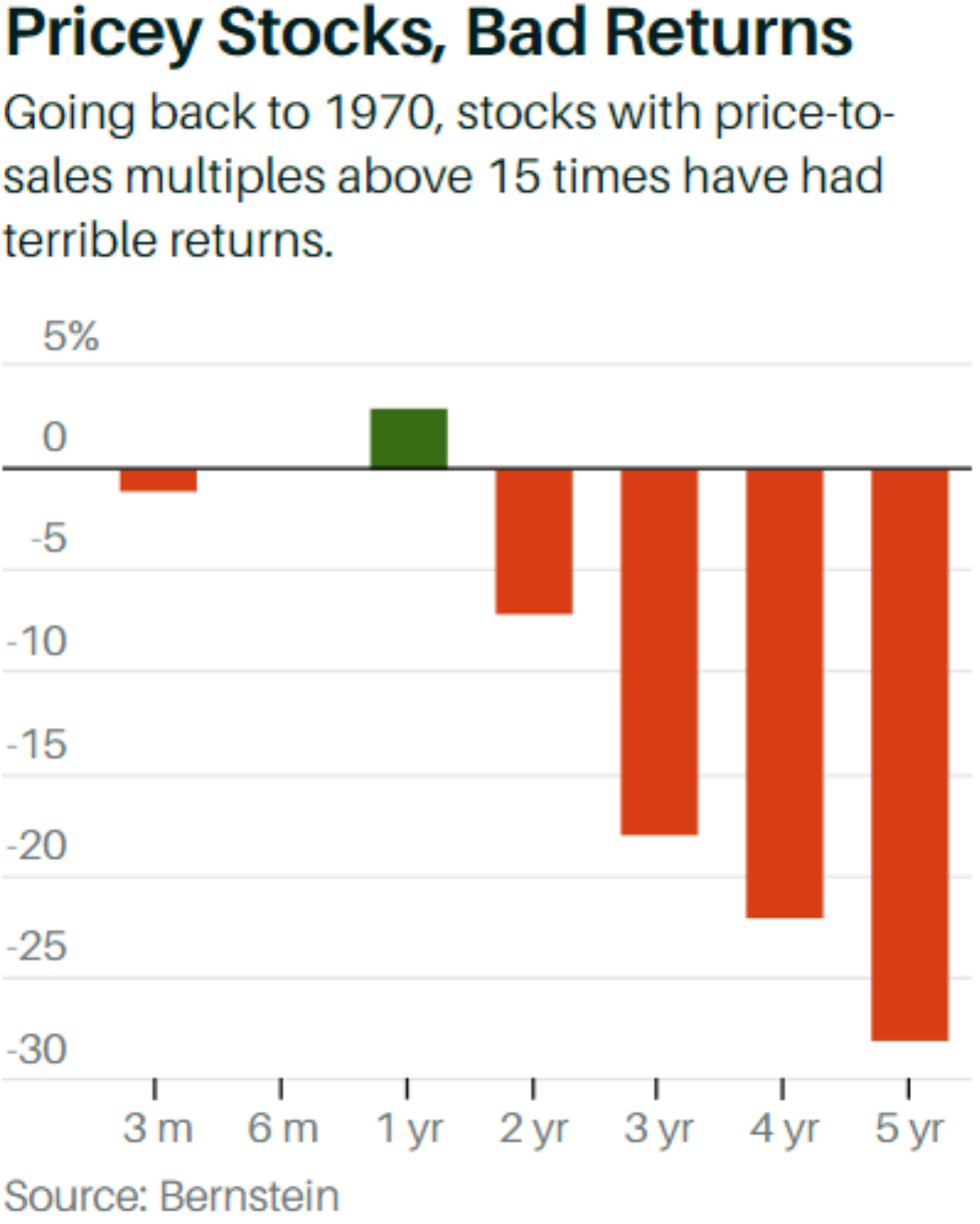
Barron’s quoted Toni Sacconaghi, a longtime technology analyst at Bernstein. He looked at the returns of stocks carrying price-to-sales multiples of 15 or higher. From 1970 to 2020, those trading at 15-plus sales spent the next three- and five-year periods with average returns of minus 18% and minus 28% respectively. At 20 times sales, the three- and five-year returns are even worse. In fact, the higher the valuation, the worse the long-term returns.
https://www.barrons.com/articles/tech-stocks-havent-looked-this-pricey-since-the-dot-combubble-51616803992?mod=past_editions
These numbers are particularly worrisome when you consider how widespread the high-price phenomenon has become. Sacconaghi counts 366 tech stocks currently meeting the 15-plus sales-multiple criteria, up from 25 in 2017. It is the highest total since 2000, when a staggering 1,540 traded above 15 times sales. We know what happened to the market after that.
The 2000 reminders extend to profits. Sacconaghi points out that 38% of tech companies are unprofitable today, a slightly higher percentage than the 36% at the tech bubble’s peak in March 2000.
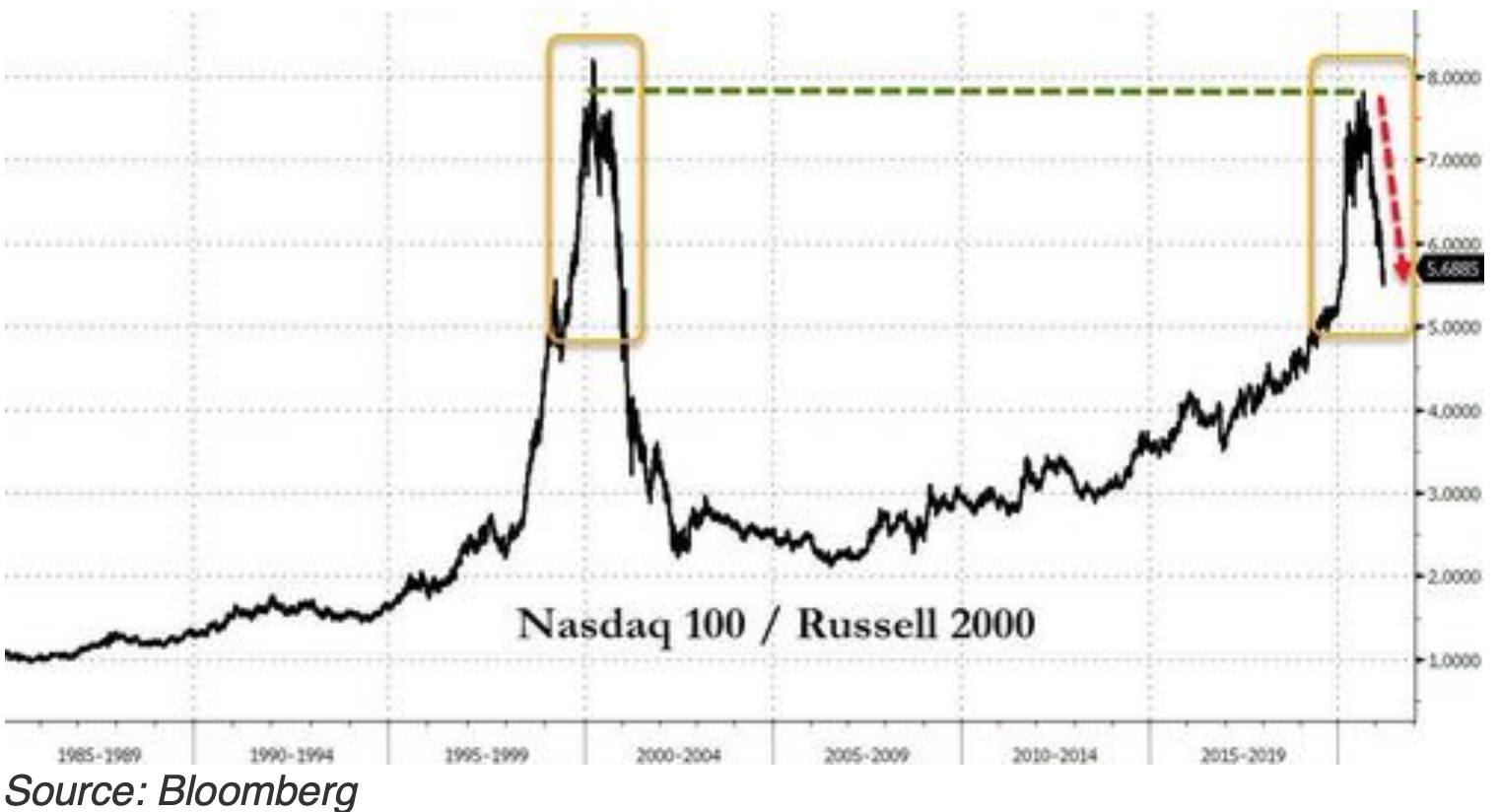
When investing, valuations are important. We just witnessed a year where technology massively outperformed and a decade where large cap growth outpaced all other asset classes by a wide margin. This leaves us to ponder charts like below where disparities in performance hit record levels before a reversion to the mean begins.
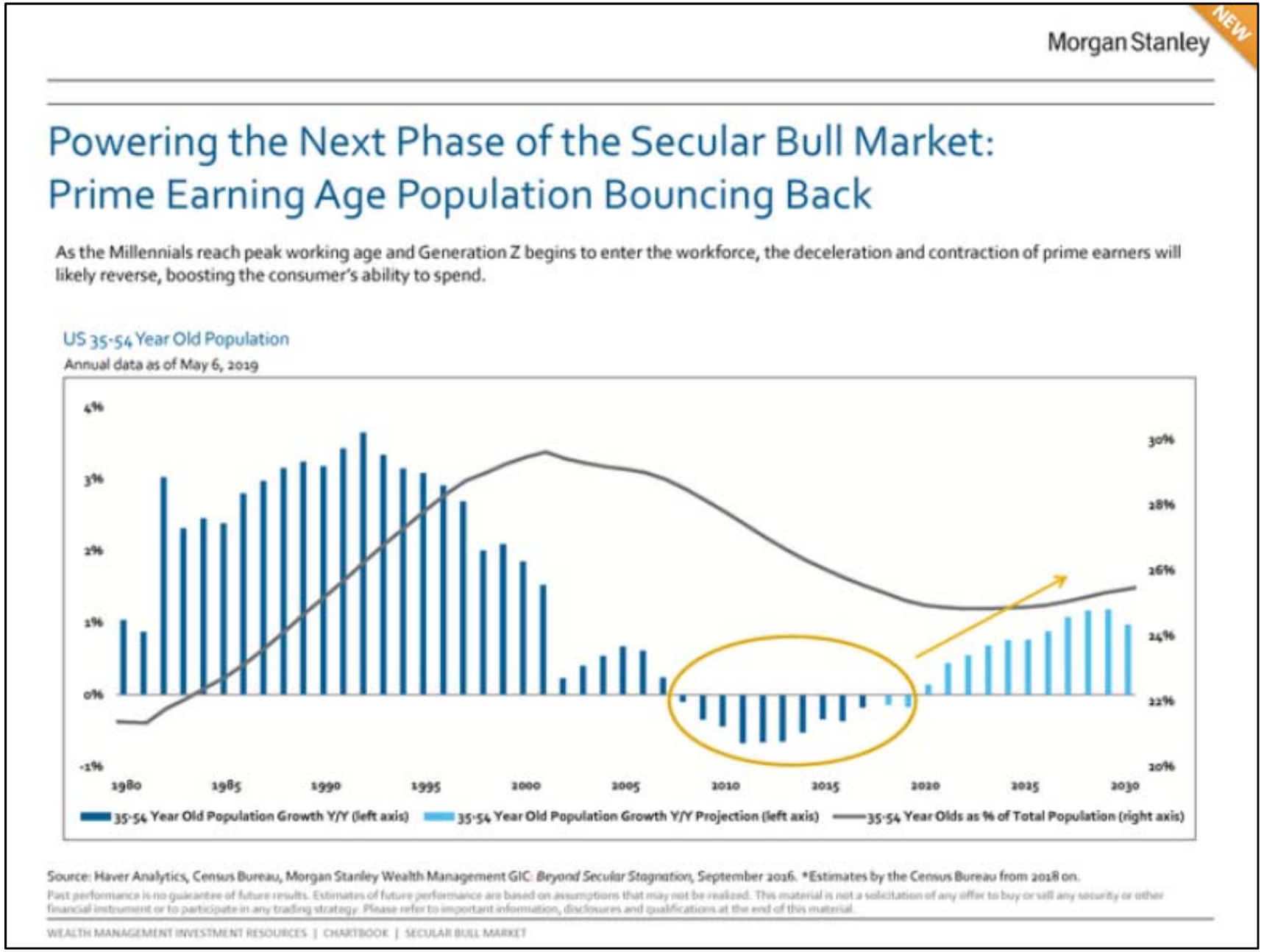
This chart compares the spread in valuations between the Nasdaq 100 technology index and the Russell 2000 small cap stock index. As you can see on the chart, the previous record was set at top of 2000 internet bubble. This is not a prediction that will follow that exact pattern, it’s an observation that leadership changes and usually in a quicker fashion than most investors expect.
Nasdaq 100 vs. Russell 2000 (small cap) Hit 1999-2000 Levels Before Reversal
3.The SPAC Explosion….763% Increase in IPOs.
This is America the music never dies, but it does hit pause, leaving some investors feeling financially deceased.
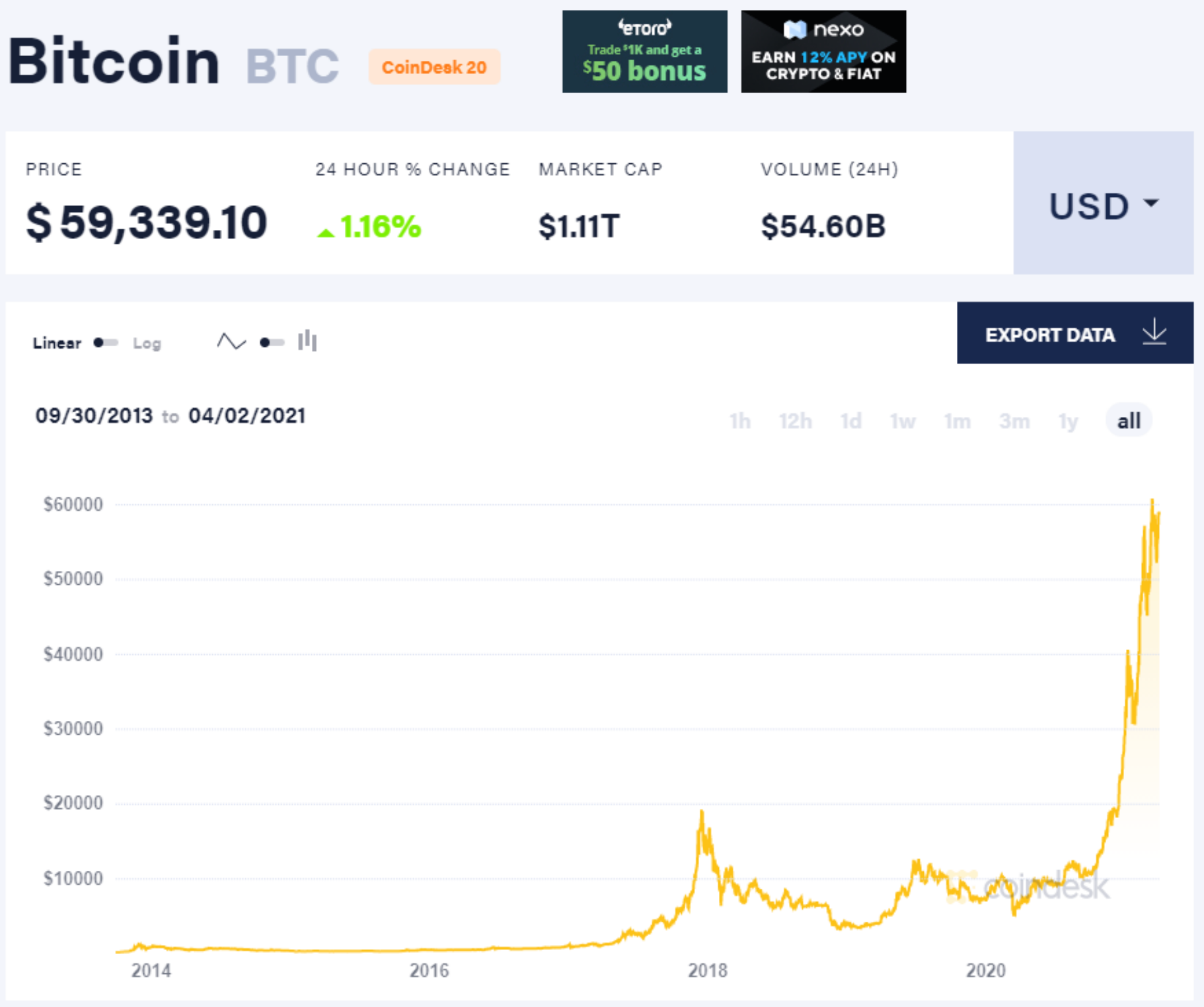
7. The Bitcoin Explosion-$10,000 to $60,000 in One Year.
During the Great Financial Crisis Charlie Prince, Former CEO of Citigroup, delivered one of the most famous quotes in Wall Street history about Citigroup's continued commitment to leveraged buy-out deals, despite the fears of reduced liquidity due to the sub-prime meltdown. Charlie said "As long as the music is playing, you’ve got to get up and dance."
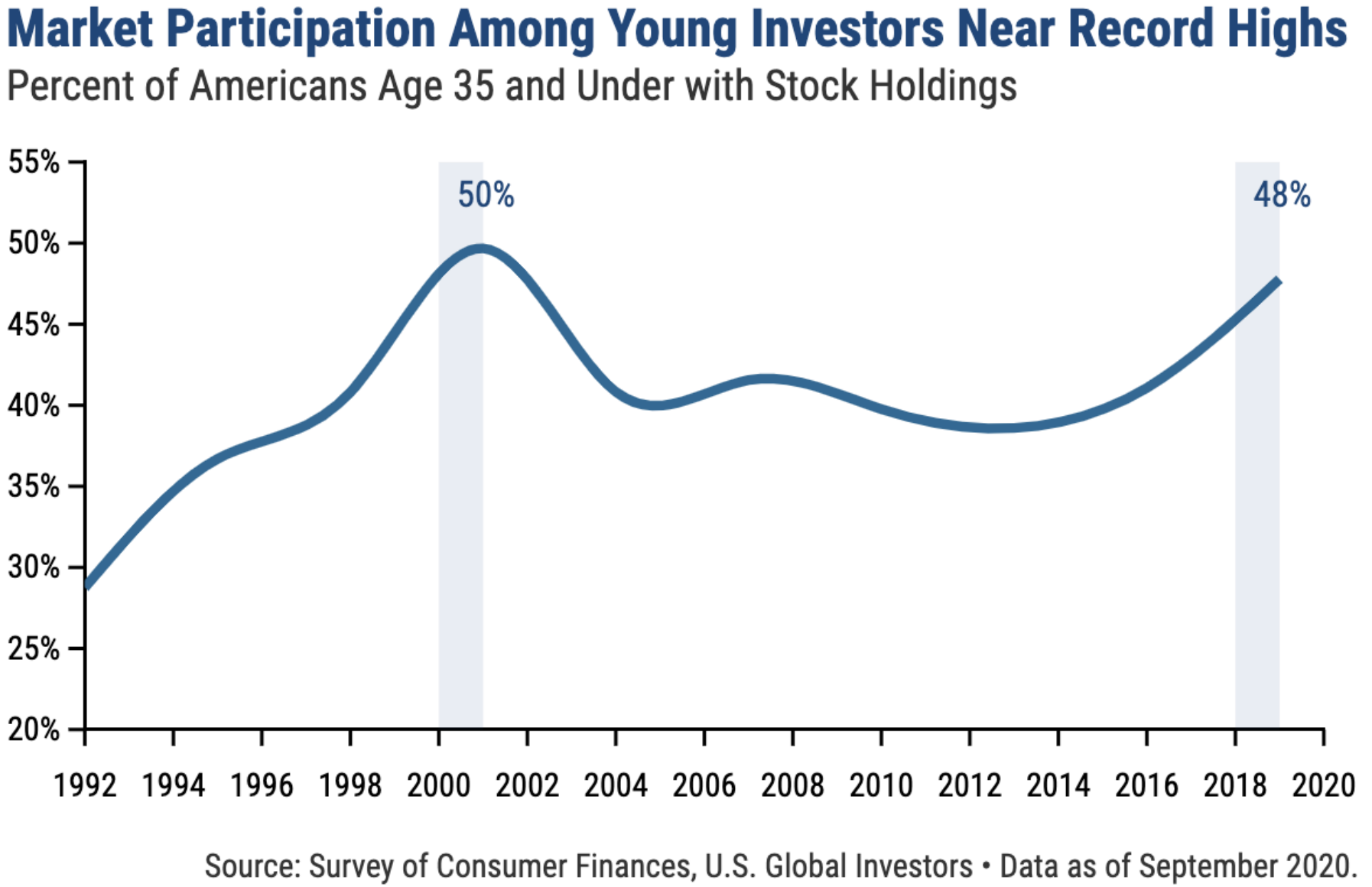
Retail investors have sat out stock trading for almost 20 years, but the Covid shutdown reinvigorated their animal spirits to record levels across multiple asset classes. Now Wall Street is dancing the happy dance! There is too much money chasing too few assets, driving up the prices in stocks, homes, bitcoin, art, baseball cards and anything else that someone can monetize.
We are officially in “keep playing until the music stops” mode, where timing is a delicate binary event that will leave some citizens feeling opulent, some feeling destitute, and some feeling mugged. The creative destruction of capitalism is going to play out in blockbuster fashion by the time the Fed’s largesse wears off. The Fed creates bubbles. It is a driver of the creative destruction that comes along with living in a capitalistic country. The good dramatically outweighs the bad, but the outcome always separates winners and losers in dramatic fashion.
https://www.ozarkradionews.com/sports/mickey-mantle-card-shattersrecord-sells-for-5-2m
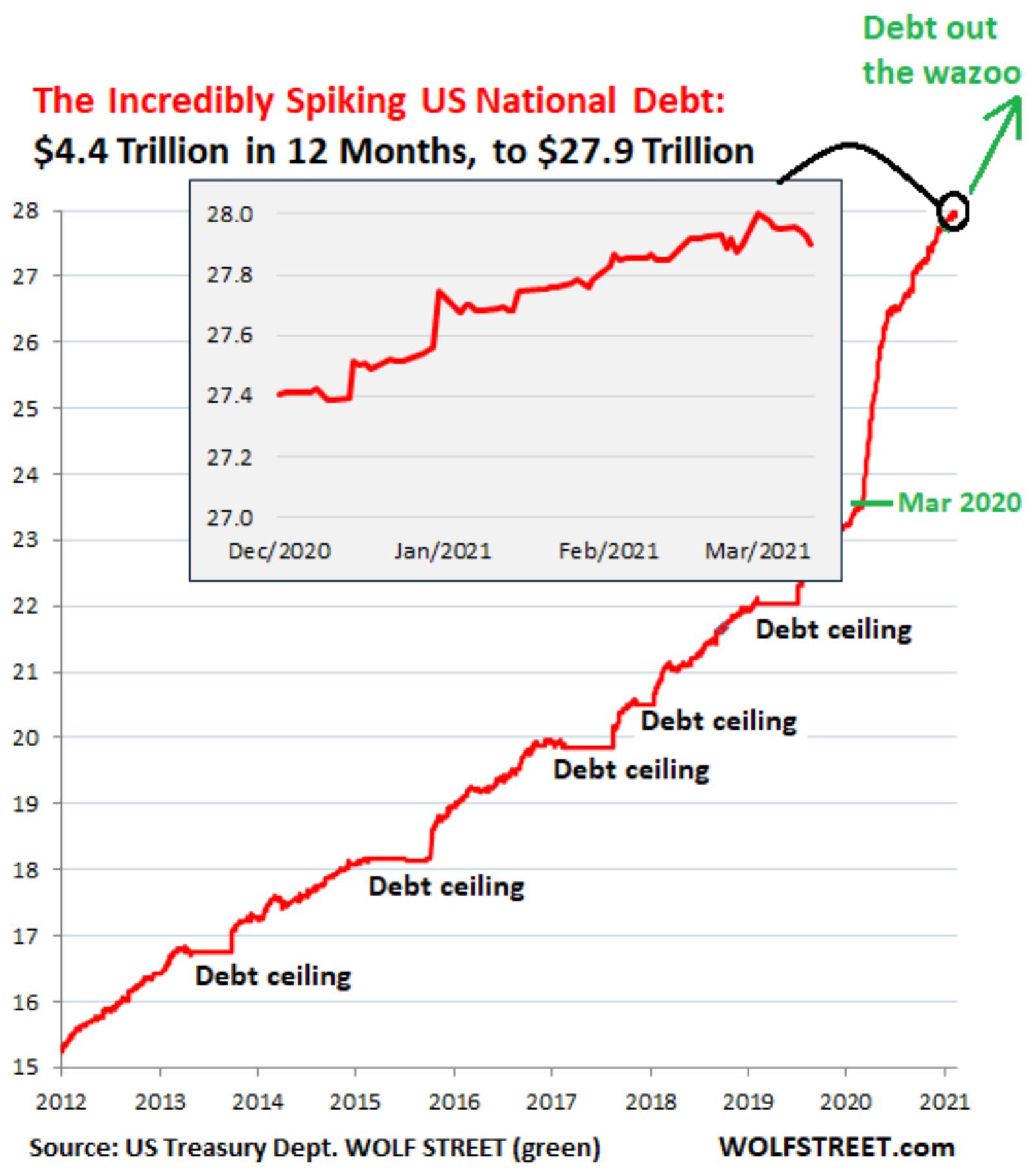
10. And Last but not Least. The Mother of 2020-2021 Explosions -U.S.National Debt.
Last time I checked this must be paid back by taxpayers.
But February made me shiver
With every paper I'd deliver
Bad news on the doorstep
I couldn't take one more step
I can't remember if I cried
When I read about his widowed bride
Something touched me deep inside
The day the music died