Introduction
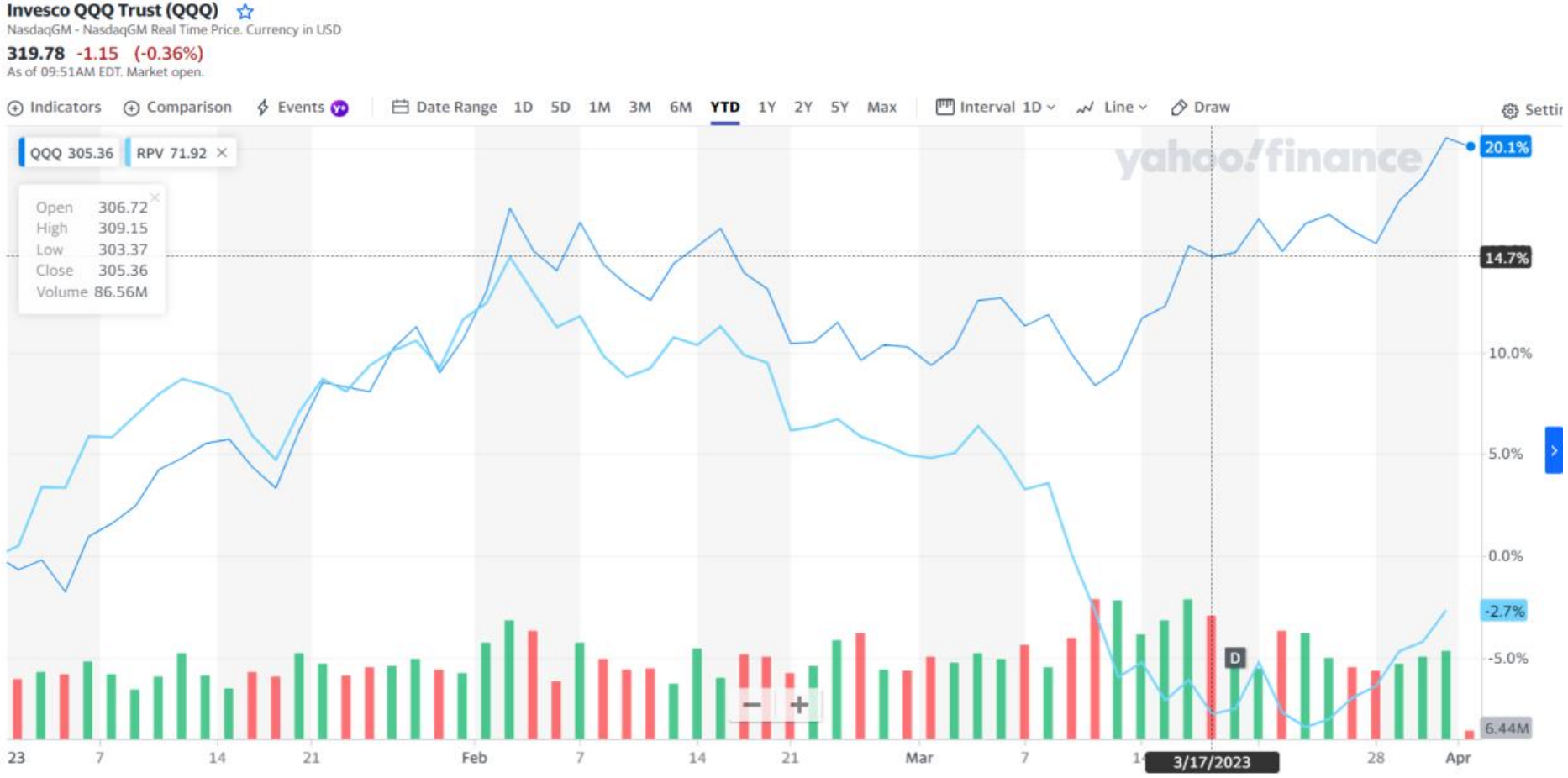
In last quarter’s letter, I wrote about the Fed popping bubbles in IPOs, SPACs, Disruptor stocks, Bitcoin, and FAANG+ stocks. Whew! That is a lot of work, but little did I know that the Fed was not done. The three S’s of banking closed within months of each other: Silvergate Bank, Signature Bank, and Silicon Valley Bank. All three banks had heavy exposure to Crypto and technology companies, so of course Bitcoin rallied 72% and the QQQ Nasdaq 100 crushed all other markets with 20%+ 3-month return.
The bank collapse sent investors rushing to technology stocks and Bitcoin as “safe havens.” Banks are a big part of value stock portfolios, so investors moved out of banks and into tech stocks. Also, money moved out of more economic dependent value sub-sectors on fear of recession and into tech stocks. Finally, Bitcoin became an alternative to banking, as trust eroded for the deposit system.
The media is bombarding citizens with comparisons to the great financial crisis in 2008. According to Alpine Macro, to put the 2023 banking crisis in perspective compared to 2008, the housing mortgage market at that time was $11 trillion or 77% of GDP. Regional banks’ current commercial-backed real estate loans account for only 7% of present-day GDP. https://alpinemacro.com/
All this was sparked by the Fed raising interest rates by 1700% in one year after a long cycle of zero-cost borrowing for American citizens. The Fed hit like a hurricane upending all investable asset classes with more to come.
Neil Young - Like a Hurricane –
“You are like a hurricane
There's calm in your eye
And I'm gettin' blown away
To somewhere safer where the feeling stays
I want to love you but I'm getting blown away”
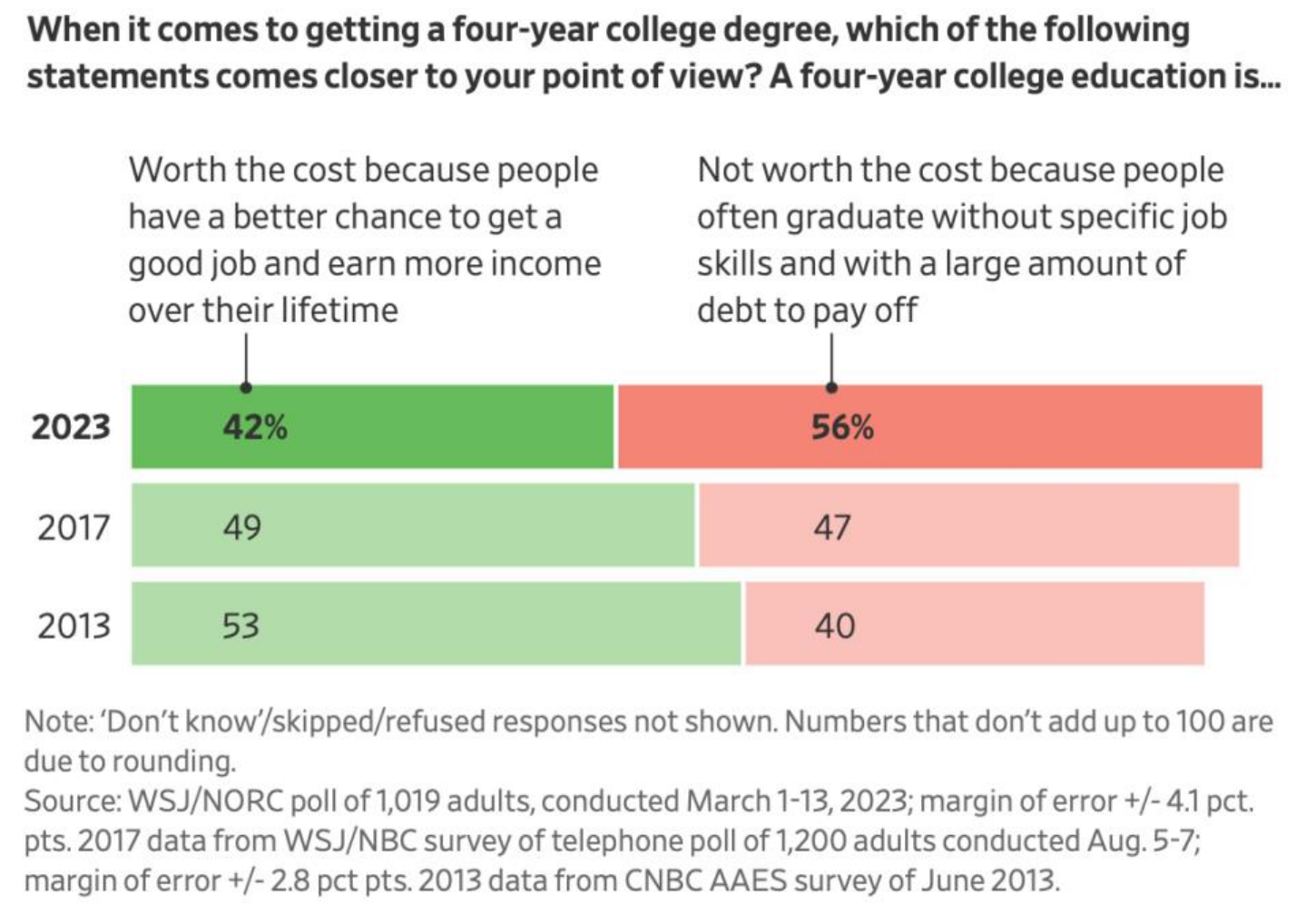
If we have a country, the more educated the better, but the reality is most citizens are losing respect for college. American institutions are breaking down at the same time as China and Russia are realigning the geopolitical order.
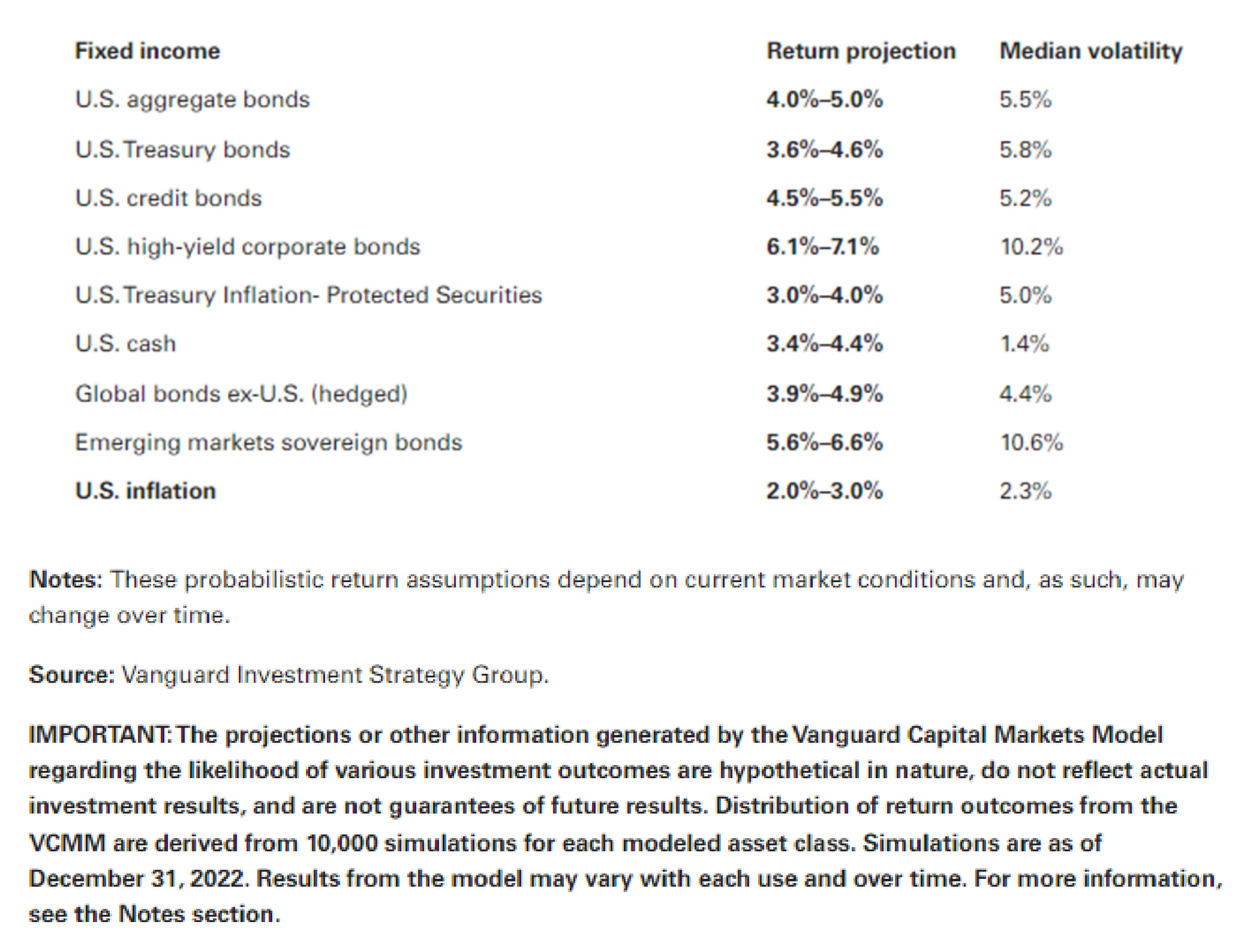
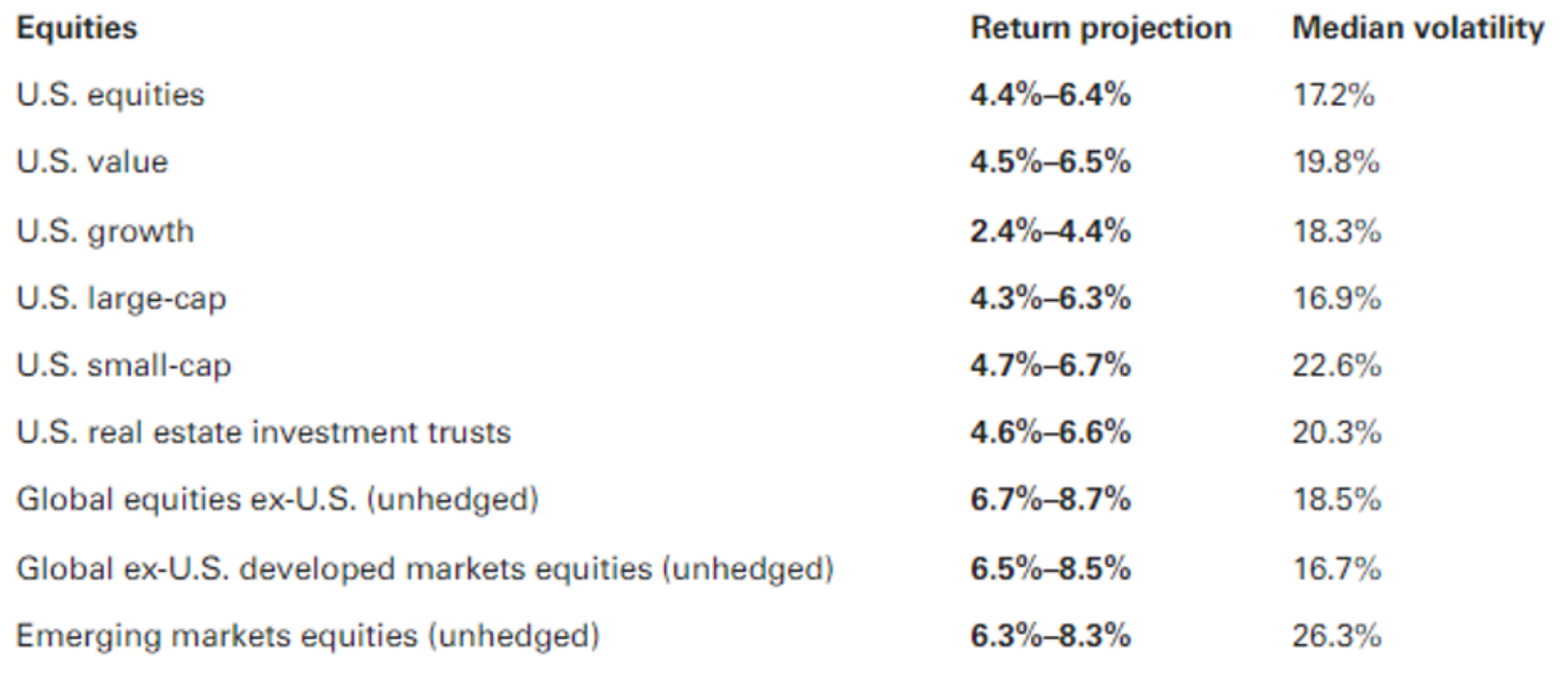
These probabilistic return assumptions depend on current market conditions and, as such, may change over time.
IMPORTANT: The projections and other information generated by the Vanguard Capital Markets Model regarding the likelihood of various investment outcomes are hypothetical in nature, do not reflect actual investment results, and are not guarantees of future results. Distribution of return outcomes from the VCMM are derived from 10,000 simulations for each modeled asset class. Simulations are as of March 31, 2019. Results from the model may vary with each use and over time.
https://www.wsj.com/articles/accounting-fraud-indicator-signals-coming-economic-trouble-506568a0
Part III - Cash Bubble? Where will it go? Depends on interest rates.
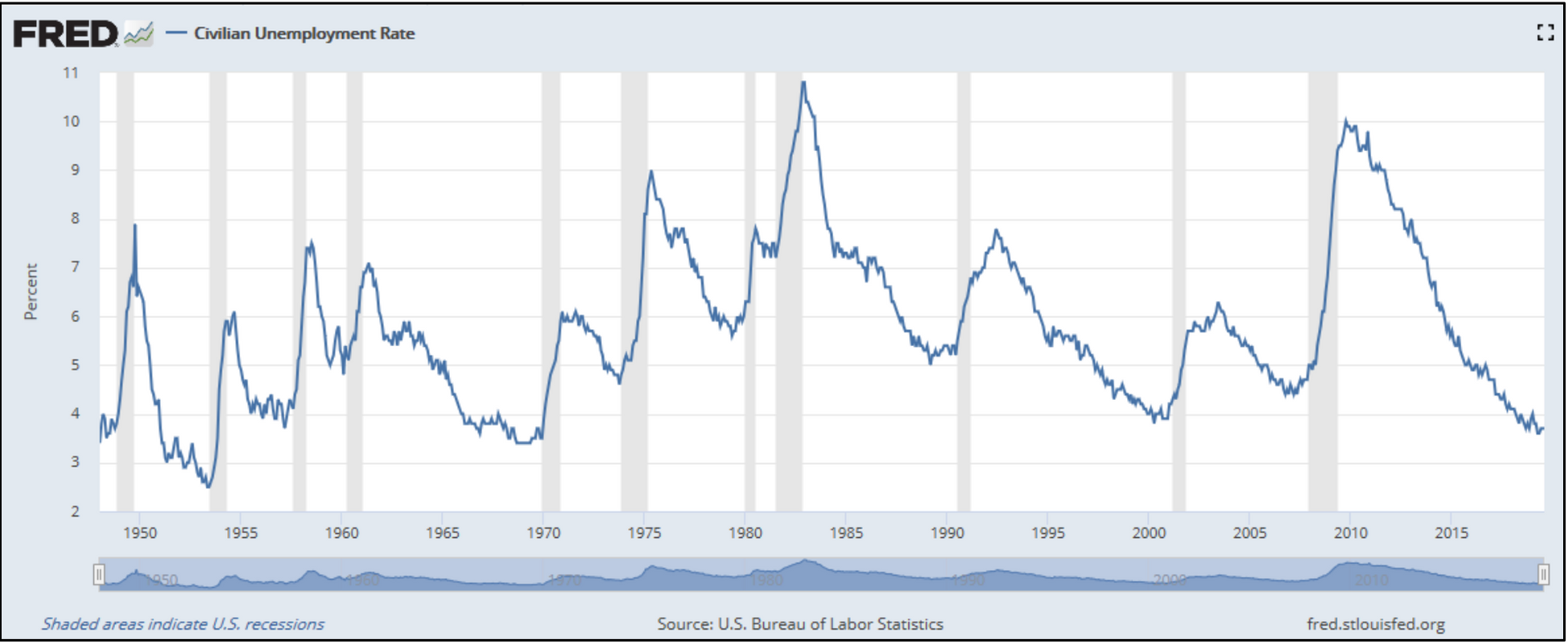
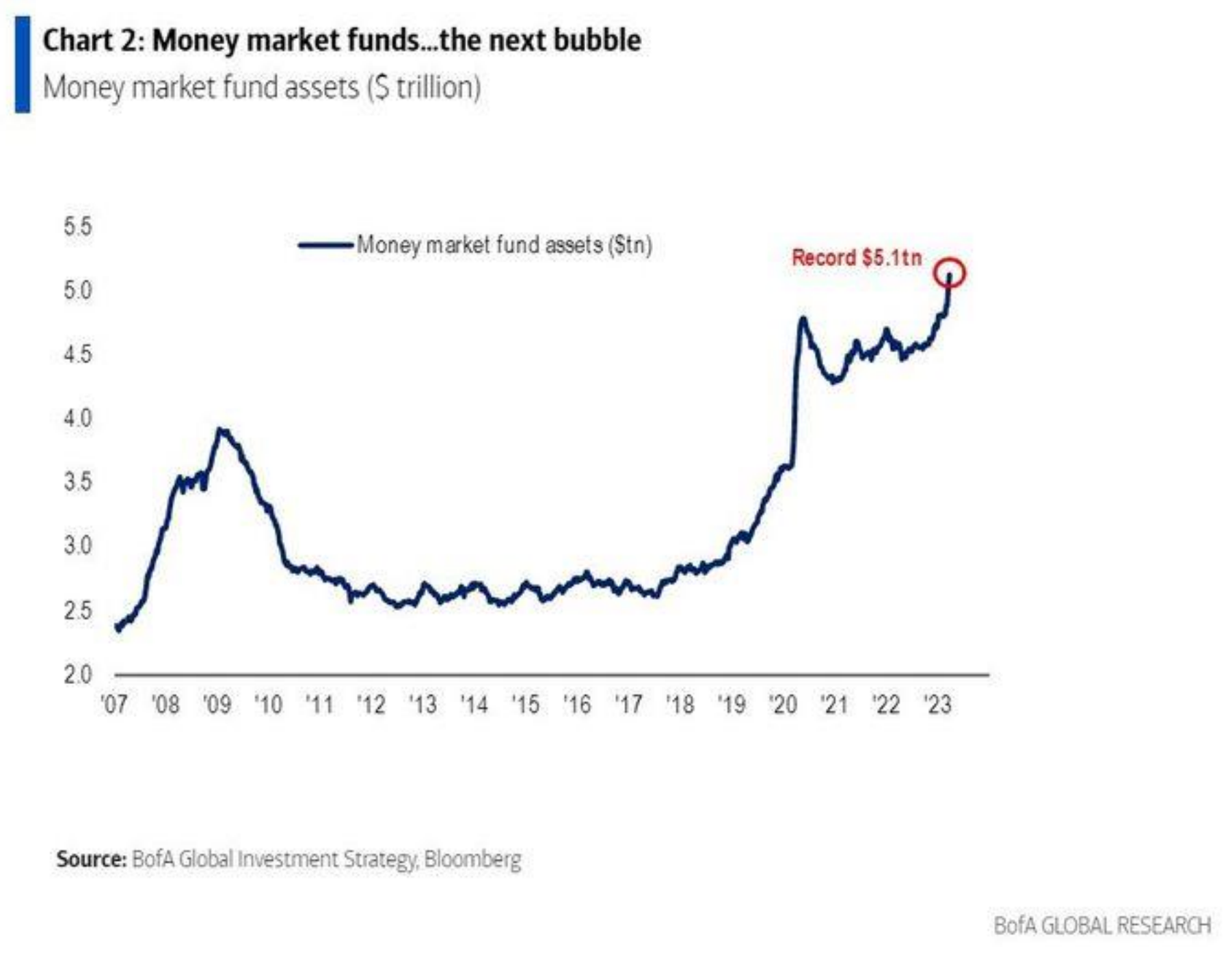
Even though money still flowing to speculative stocks, money market assets hit record levels. Remember the Fed flooded the economy with so much money during Covid that asset classes were labeled “the everything bubble.” Unemployment is still low, savings rates are ticking back up, inflation is falling, and money markets are paying over 4% up from zero.
As mentioned in my last letter, bonds will start acting like bonds again and safe money will now be available through traditional fixed income. The logical question is where all this liquidity will end up? That will depend on the direction of interest rates.
B of Global Research
- They point out that assets under management for money funds have now exceeded $5.1 trillion, up over $300 billion over the past four weeks. They also counted the biggest weekly flows to cash since March 2020, the biggest six-week inflow to Treasuries ever, and the largest weekly outflow from investment-grade bonds since Oct. 2022. The last two times money-market fund assets surged — in 2008 and in 2020 — the Federal Reserve slashed interest rates.
On December 7th, 1999, Barron’s published the infamous “What’s Wrong,Warren” cover eerily before the Nasdaq crashed 50% and Berkshire recovered years’ worth of underperformance.
The below graph plots the time period 6/30/98 through 2/29/00 for the Nasdaq where many dot-com and technology stocks traded, and the price of Berkshire Hathaway, Warren Buffett’s holding company, which consisted of value stocks:
https://kailashconcepts.com/ Kailash Concepts
Was the Nasdaq 100 20% rally in the first quarter a repeat of the above or a new bull market in tech? A big portion of the answer will come from the direction of interest rates. The Fed came in like a hurricane upending markets across the world, but we have not begun to feel the effects of higher interest rates working their way across the system. As rates settle into a new range, it will have a profound effect on new business initiatives going forward and be exacerbated by the recent regional bank speed bump that will reduce lending to small business owners. Below are Vanguard’s projected 10-year returns that I include at the end of every letter. The interesting data point is treasuries and high-quality corporate bonds have higher projected returns than growth stocks at one-quarter of the volatility.
Like Neil Young says “I want to love you but I’m getting blown away.”
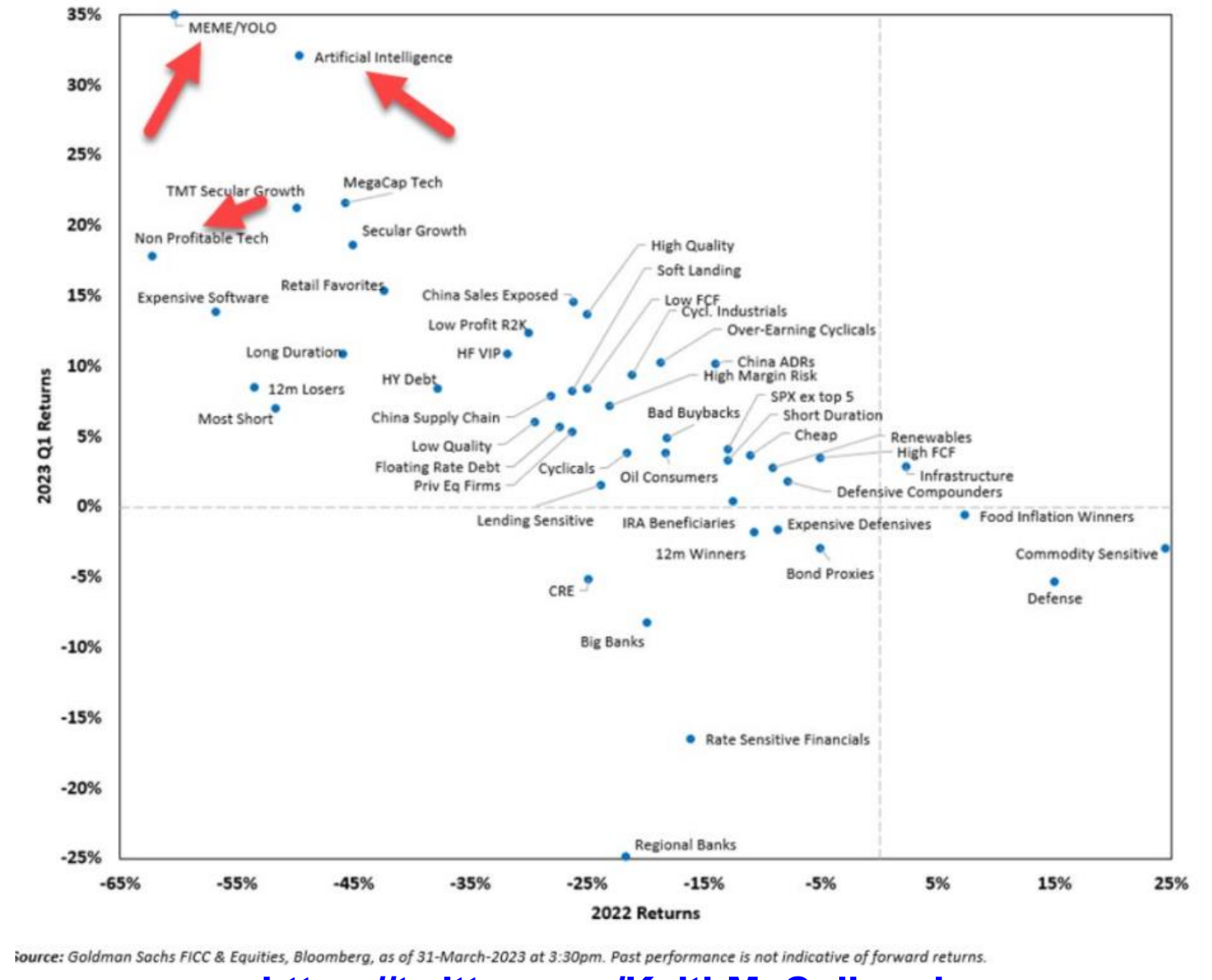
The Goldman chart below summarizes best performers for 2023 in top left corner: Meme/Yolo, artificial intelligence, and non-profit technology stocks. Meme/yolo stocks driven by retail trading speculation in online communities. AI is the new buzzword in tech space so any related stock increasing in value and non-profit tech stocks led to downside in 2022.
https://www.advisorperspectives.com
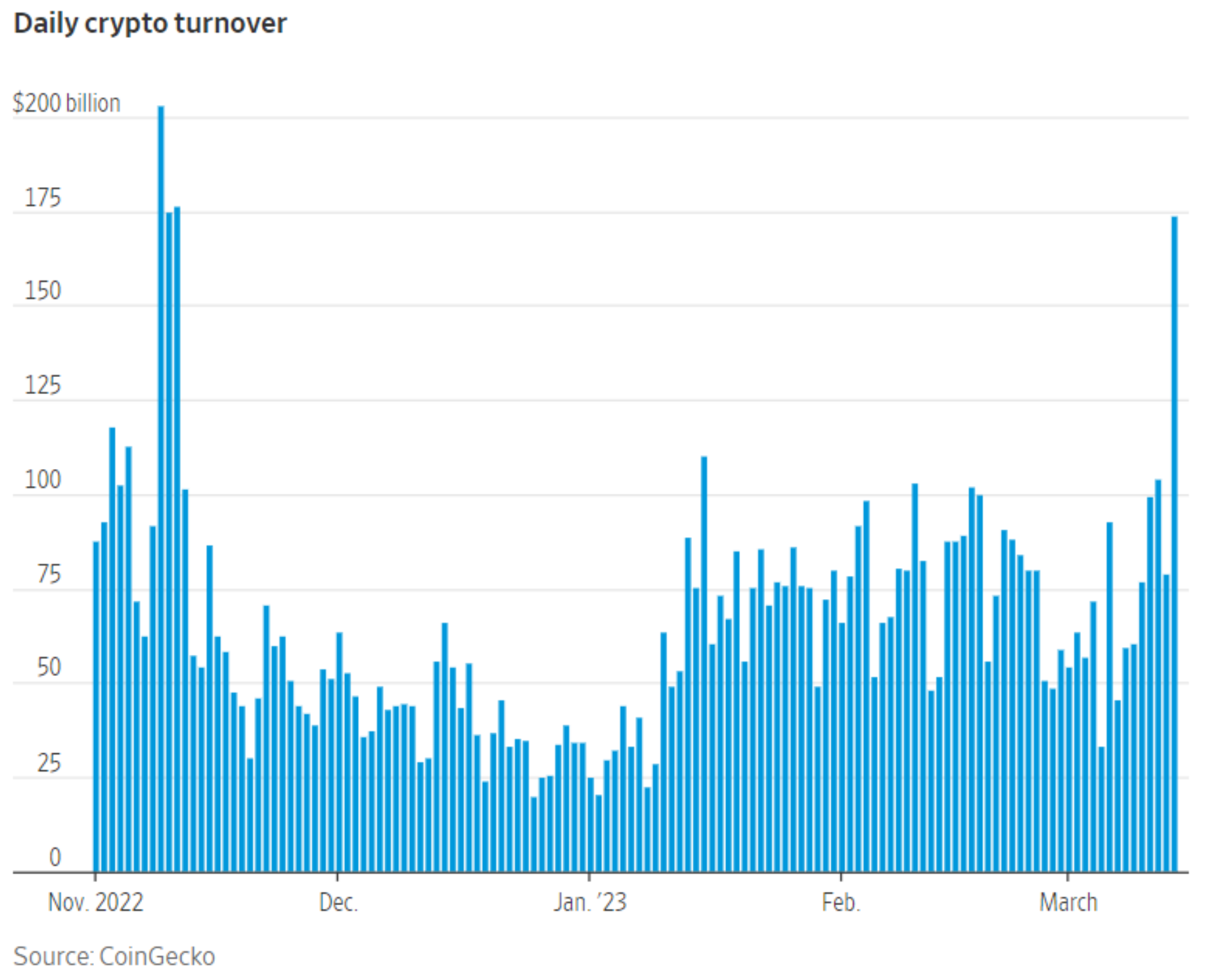
Speculators also returned to Crypto market with vengeance. March was the Highest Crypto Turnover Since FTX Collapse. Bitcoin is +60%+ year to date as a rally off lows got a steroid shot from banking crisis, reinvigorating crypto believers “don’t trust the government” mantra.
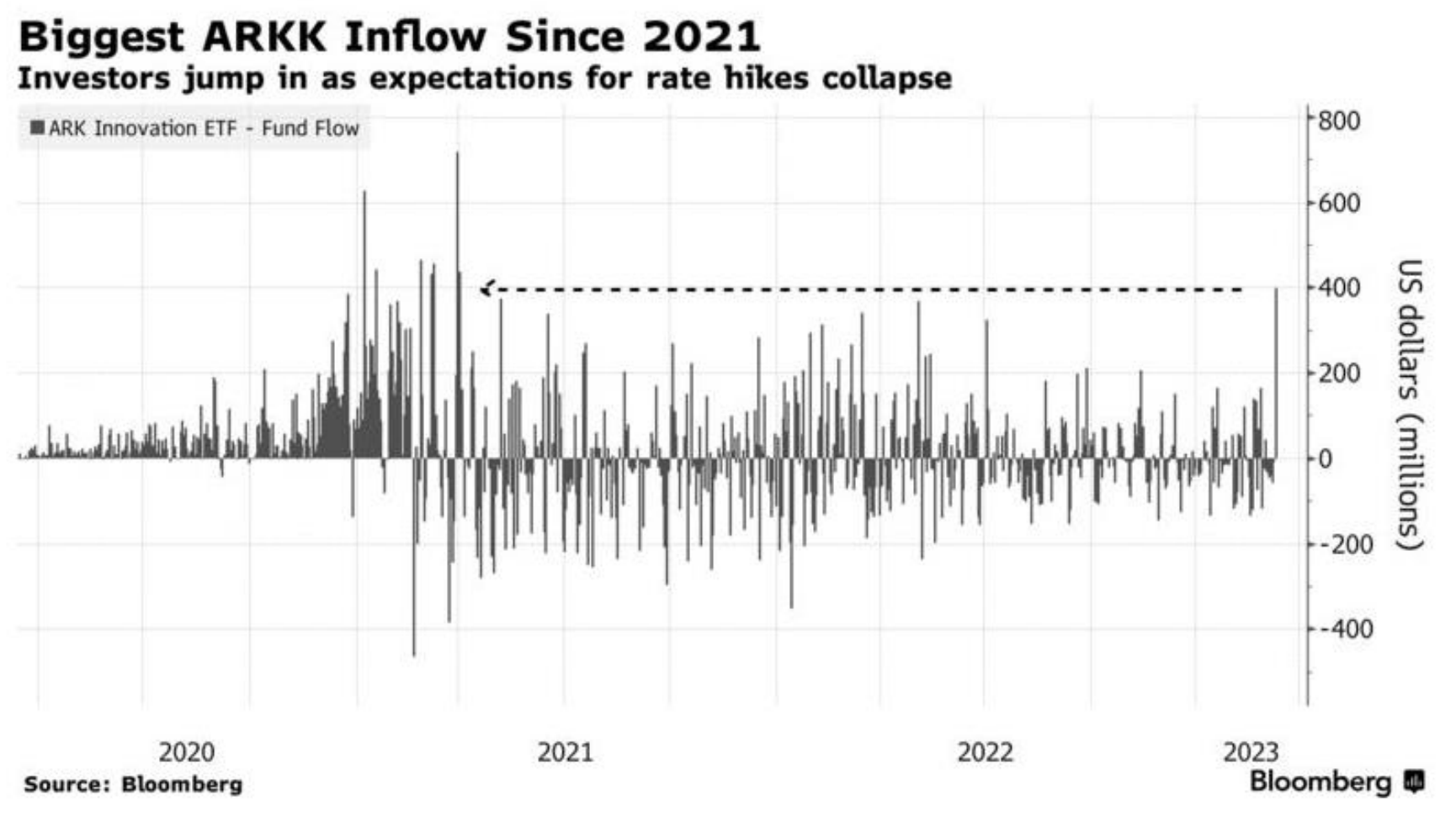
The poster child of the speculation bubble is Cathie Wood’s ARKK fund. It attracted $20 billion in assets in 2021 before imploding over -60% during the 2022 crash. Post the internet bubble, dozens of technology focused mutual funds like ARKK closed for good, but Q1 20223 ARKK recorded huge inflows close to $400m. Is it a new bull market or a speculative bear rally?
Part IV - The Future of America
Readers of my blog or letters recognize that I never write about politics, nor do I plan on starting so do not take any of the following as political commentary. Warren Buffett states that in his close to 75-year investing career, there has never been a bad time to invest in America and I agree wholeheartedly. In saying that, some polls this month disturbed me for the first time ever about America’s future.
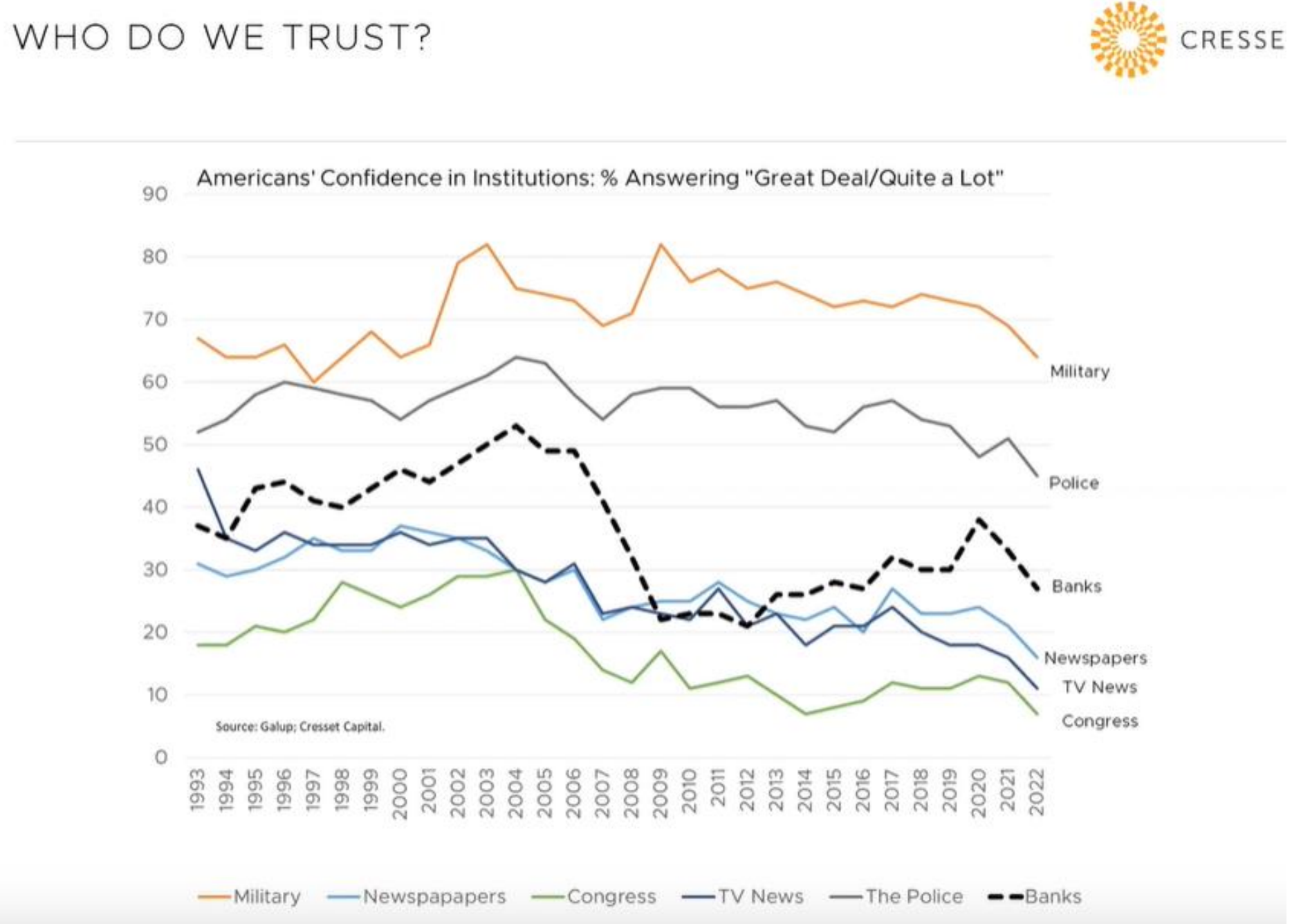
Who Do Citizens Trust? Am I shocked that U.S. Congress went from 30% trust to single digits, not really but I am concerned that every line on this chart is pointing downwards.
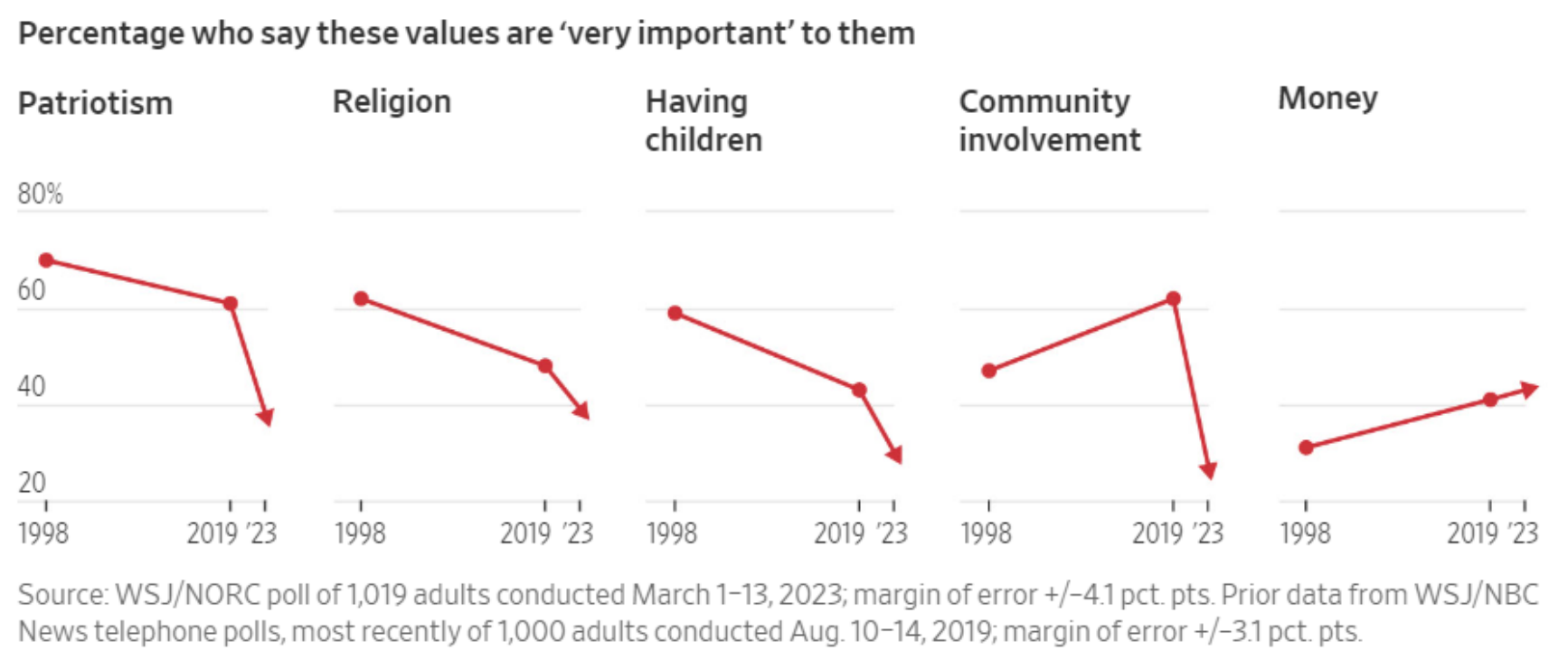
In a similar fashion, I don’t feel great about the consistent move down across the board below. If we don’t have children (20%) or community involvement (20%), we don’t have a country.
Leveraged loans are up 50 percent since 2015
Leveraged loans, which are issued by overleveraged companies with insufficient cash flows, are part of what Wolf Richter recently called the “gigantic pile of risky corporate debt that is now being brutally repriced as concerns over credit risk (the risk of default) are finally bubbling to the surface.” According to Richter, the S&P/LSTA US Leveraged Loan 100 Index, which tracks the prices of the largest leveraged loans, has plunged by 20 percent since February 22nd.
According to Richter, leveraged loans “are traded in slices like securities or are packaged into highly rated Collateralized Loan Obligations (CLOs). But for years, investors had the hots for them, driven by their relentless chase for yield, in a world of interest rate repression.”
These companies, noted Richter, were often acquired by private equity firms through leveraged buyouts, which means they loaded up those companies with lots of debt. In addition, “PE firms extracted special dividends from their companies,” which were funded by leveraged loans. That’s a form of asset stripping and it leaves the company “more leveraged, more precarious and more likely to topple. But who cares? Those were the good times and the chase for yield was on,” lamented Richter.
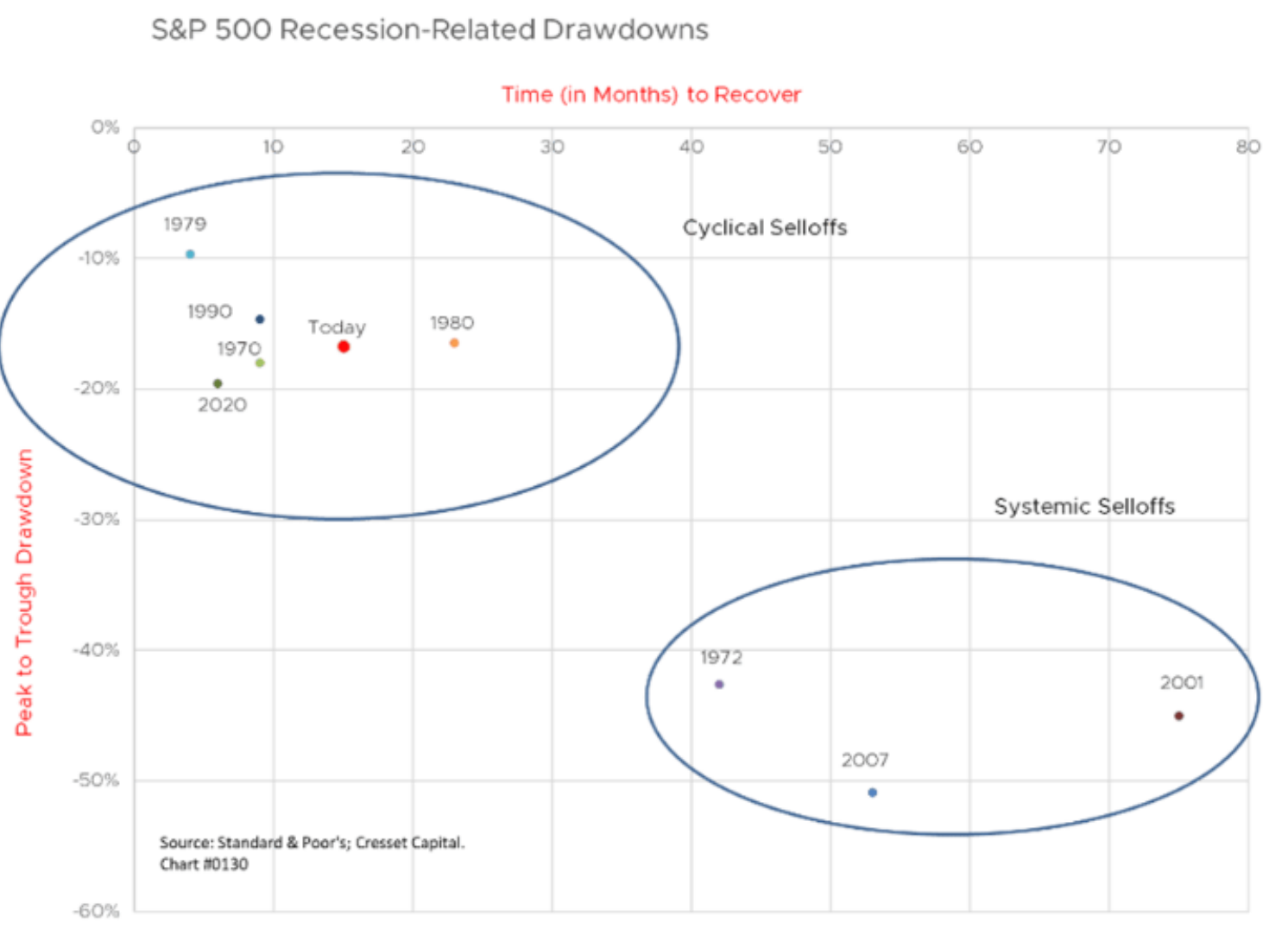
Was 2022 a cyclical bear market? A cyclical bear market is a typical -20% correction due to normal market volatility that lasts for months. A secular bear market signals more structural problems in the economy and last for years before stocks bottom -40%. The 1999 internet bubble and the great financial crisis of 2008 were the secular busts of modern times. As mentioned in previous letters, today’s market is like the internet bubble.
Jack Ablin Cresset — Good Picture of S&P Corrections Cyclical vs. Secular.
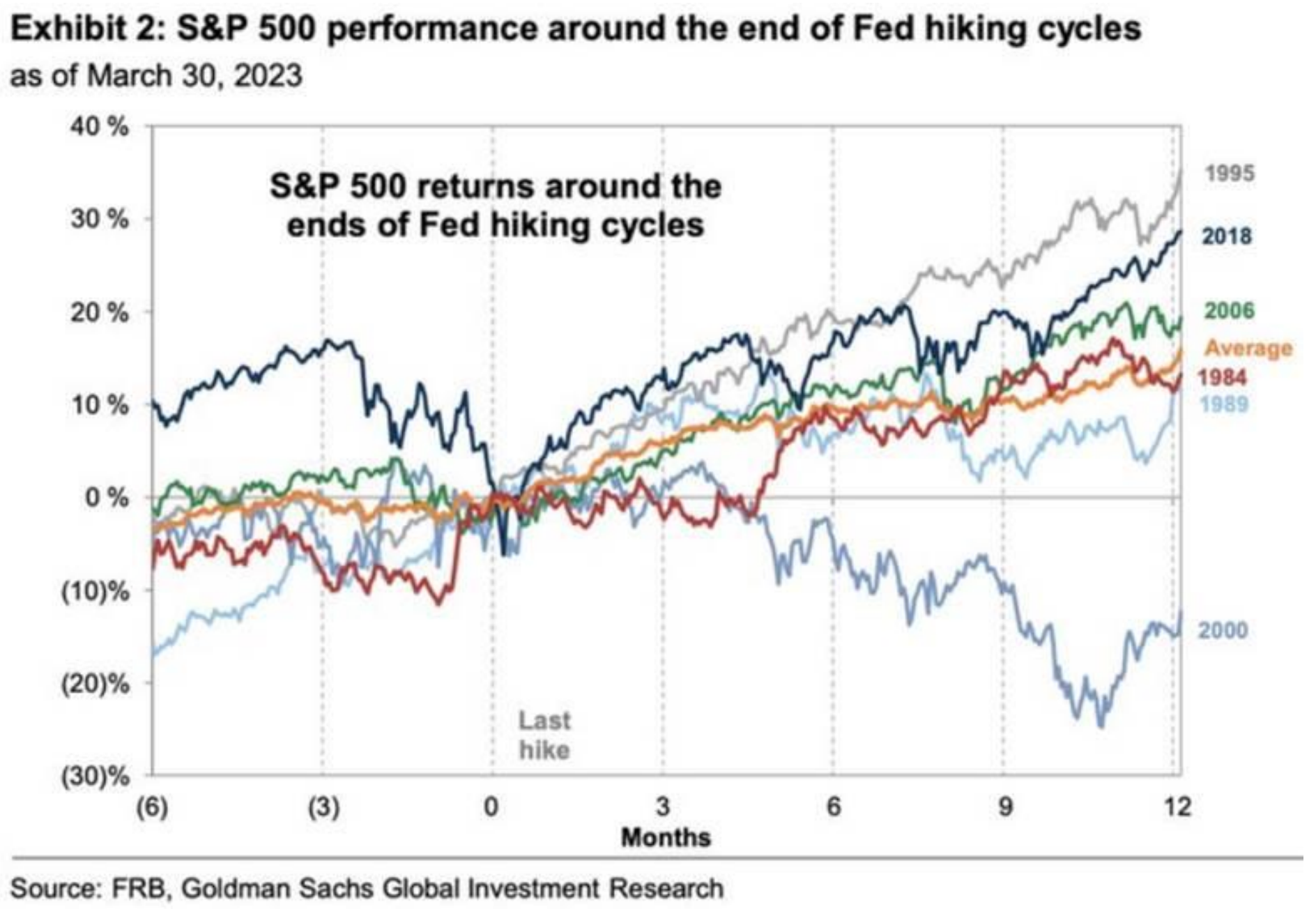
The chart below shows S&P 500 forward historical returns near the end of rate hike cycles that look bullish. It is interesting that the only year where stocks continued lower post-Fed rate hikes was the 2000 internet bubble crash. In 2000, the S&P dropped another -20% after the Fed finished raising interest rates.
Conclusion
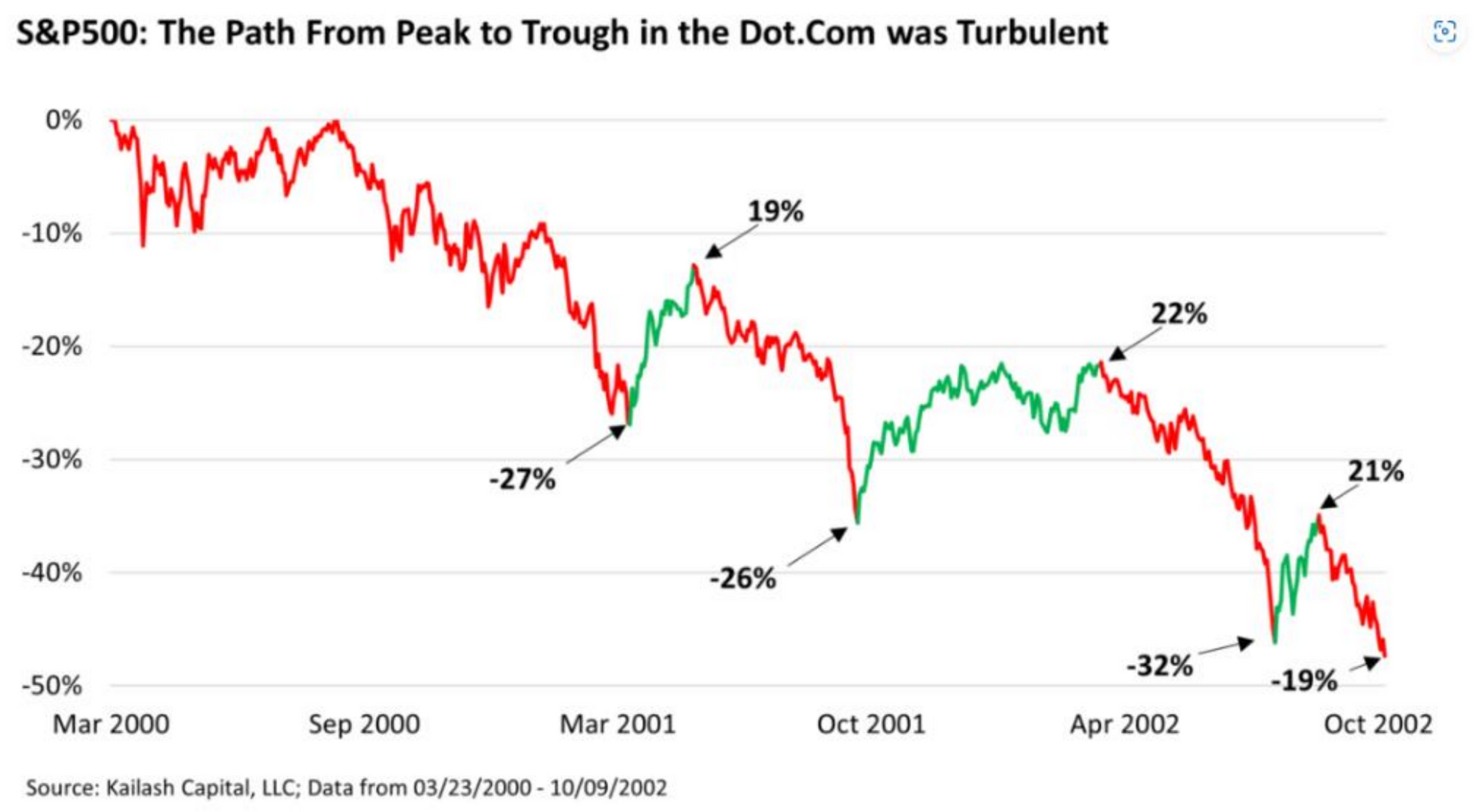
I do not envy the Fed’s current predicament. With the massive amount of cash in money markets, a continued reduction in interest rates could spark another speculative bubble. As last year’s market most resembles 1999-2000, it is important to remember that during the internet bubble, tech stocks had three 20% plus rallies before the ultimate bottom in 2002.
Disclosures
Lansing Street Advisors is a registered investment adviser with the SEC. To the extent that content includes references to securities, those references do not constitute an offer or solicitation to buy, sell or hold such security as information is provided for educational purposes only. Articles should not be considered investment advice and the information contain within should not be relied upon in assessing whether or not to invest in any securities or asset classes mentioned. Articles have been prepared without regard to the individual financial circumstances and objectives of persons who receive it. Securities discussed may not be suitable for all investors. Please keep in mind that a company’s past financial performance, including the performance of its share price, does not guarantee future results. Material compiled by Lansing Street Advisors is based on publicly available data at the time of compilation. Lansing Street Advisors makes no warranties or representation of any kind relating to the accuracy, completeness or timeliness of the data and shall not have liability for any damages of any kind relating to the use such data. Material for market review represents an assessment of the market environment at a specific point in time and is not intended to be a forecast of future events, or a guarantee of future results. Indices that may be included herein are unmanaged indices and one cannot directly invest in an index. Index returns do not reflect the impact of any management fees, transaction costs or expenses. The index information included herein is for illustrative purposes only
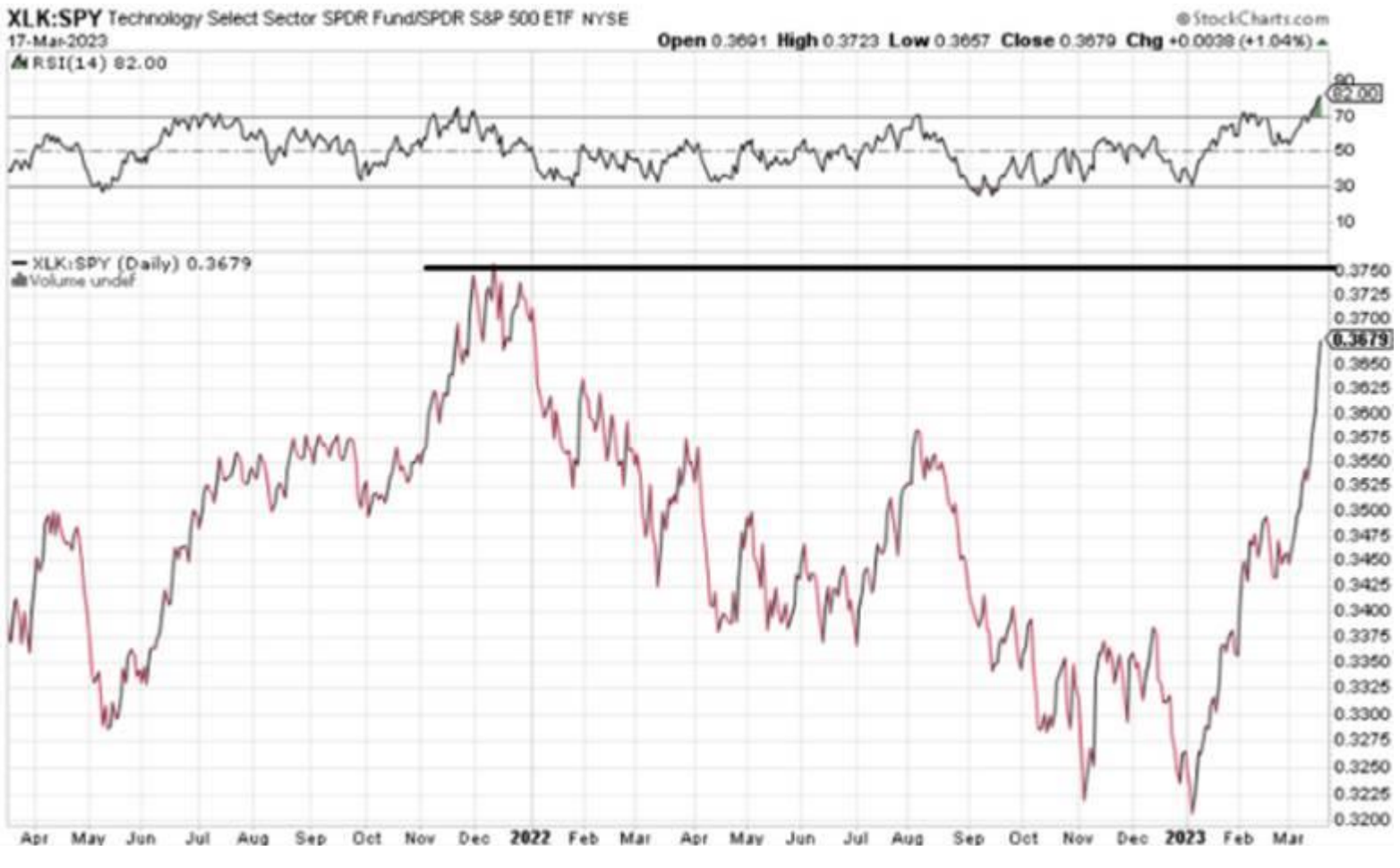
The tech sector has reversed nearly all of its 2022 underperformance in less than 3 months...
The chart below shows the technology sector (XLK) vs. the S&P - we moved right back up to December 2021 levels erasing the crash of last year. The yield curve hit close to record inversion and recession fears moved back to the forefront, which pushed value stocks lower.
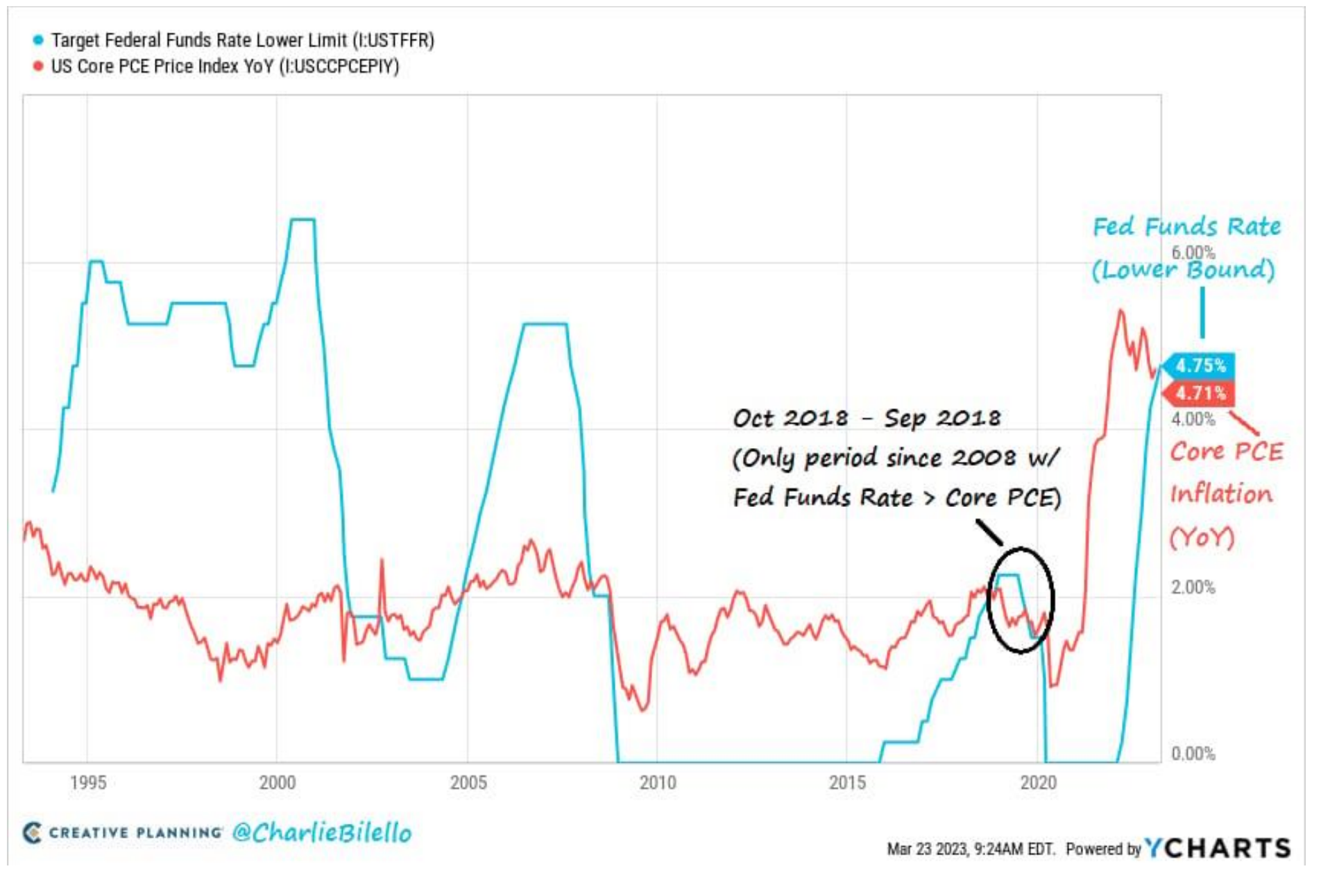
One sign that the Fed is almost done. Fed fund rate is now above core PCE (the Fed’s preferred measure of inflation).
@Charlie Bilello In looking at the recent inflation data, the Fed seems to finally have room to pause.
Importantly, the Fed Funds Rate is now above Core PCE (the Fed’s preferred measure of inflation), suggesting that monetary policy is now entering a contractionary stage.
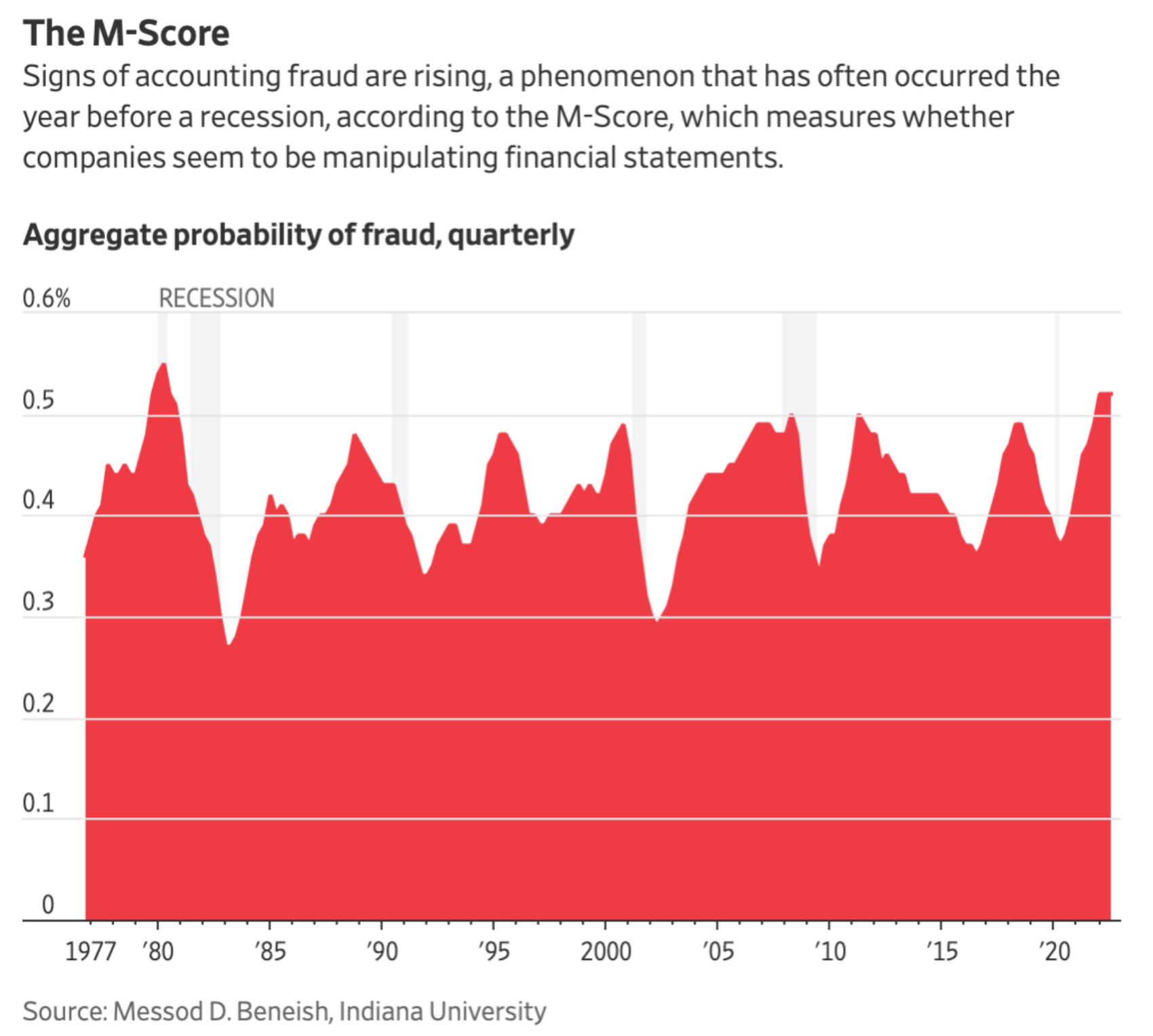
At the same time as speculation re-enters the hurricane, signs of accounting fraud are on the rise. Manipulation of corporate earnings has returned to record levels.
WSJ Josh Zumbrun Manipulation of earnings from Corporate America is on the rise, an ominous omen for the U.S. economy. That is the conclusion of new research on accounting fraud, using a technique that flagged Enron as an earnings manipulator several years before the energy company’s spectacular 2001 implosion.
“We think this is a measure of misinformation in the economy,” said Dr. Beneish.
The new aggregate measure
was published in a December paper, and the latest data—compiled in March and shared with The Wall Street Journal—shows that the collective probability of fraud across major companies is the highest in over 40 years.
https://twitter.com/KeithMcCullough
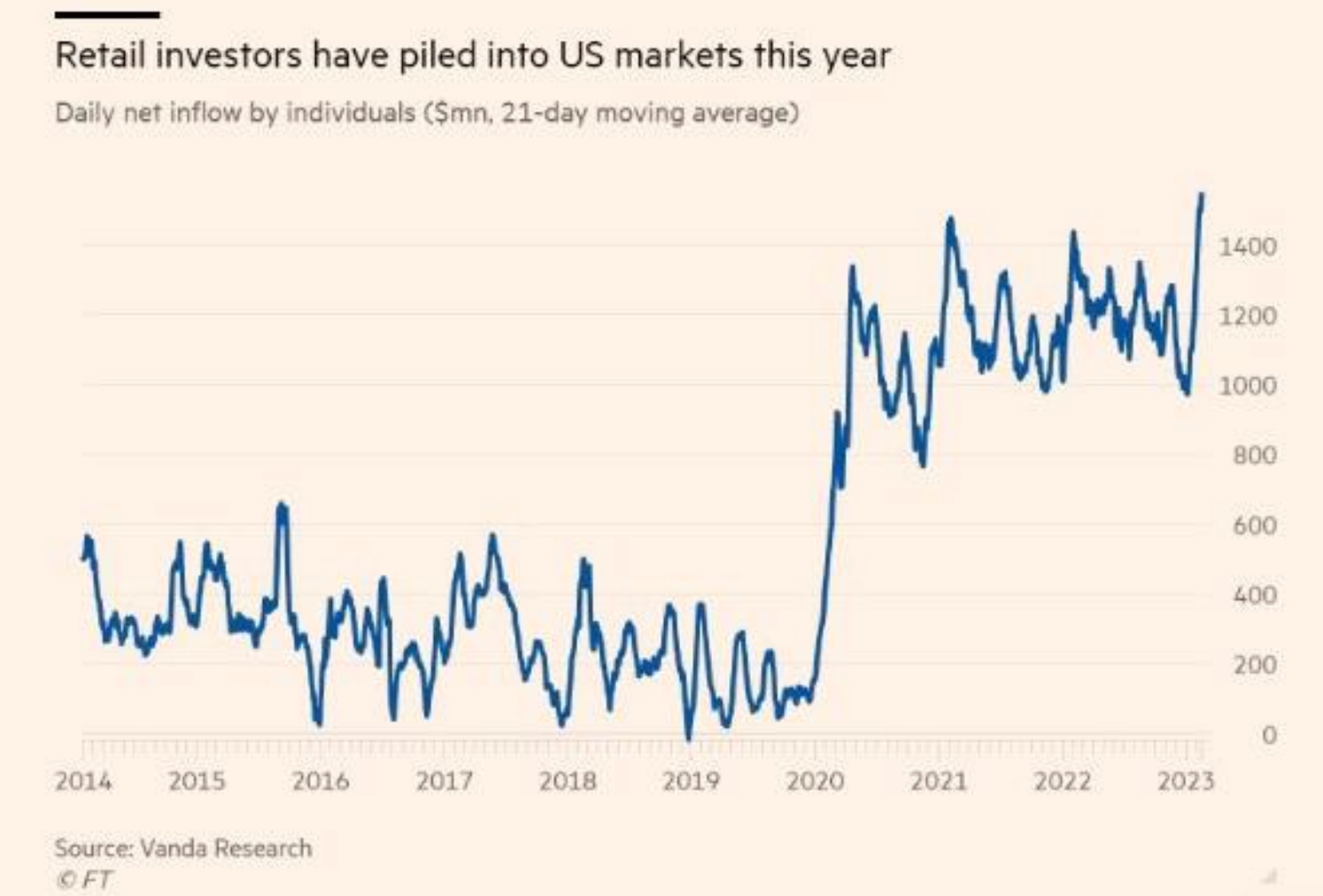
All these charts point to everyday citizens being affected by the 2022 crash but not finished with the need for trading action. Charlie Munger once said, “We have a stock market that some people use as a gambling parlor.” Although overall stock market valuations are still lower than Covid bubble highs, the gamblers in the market are still quite active - historically the bottom is not in until all the speculators raise the white flag. Although sentiment indicators tell us that investors are bearish, money flows like below prove retail investors are piling into the stock market.
Especially important, none of the above are a recommendations for you to buy or sell any security. This is for information purposes only. Please talk with your advisor regarding any advice around the subject matter and your goals.
Source:
Musixmatch
Part II - Speculation Back in Business
Although the IPO market and SPAC offerings remain dormant, speculation is coming back with vengeance. Options trading, Disruptor stocks, crypto, and non-profit tech stocks delivered huge returns in the first 3 months of 2023.
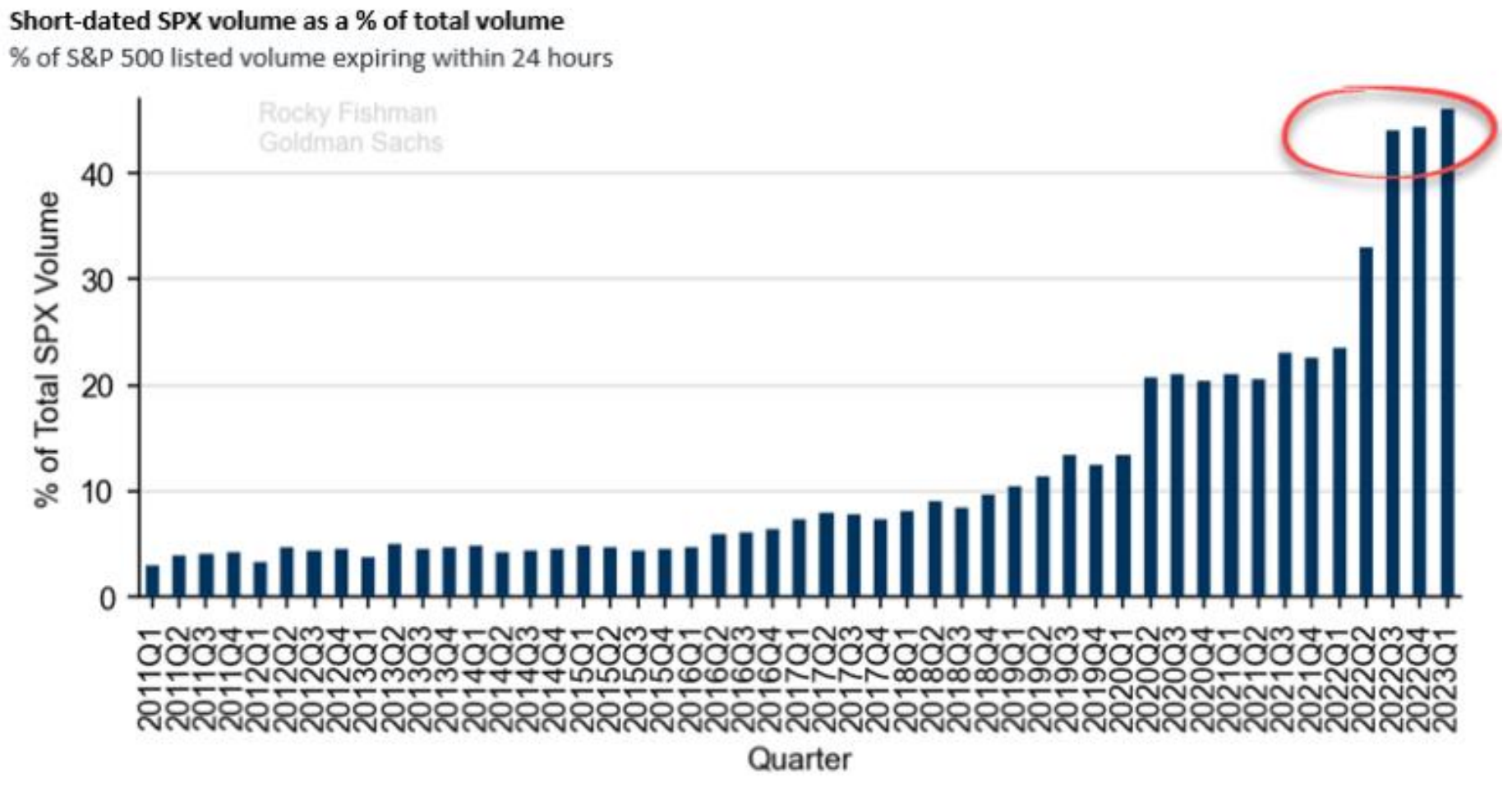
In previous Lansing Street letters, I have emphasized that retail investors have no business trading options. Professional investors have little reason to touch options outside of basic hedging. Mom and Pop should view options as kryptonite, instead, we have the below statistics.
BARRONS Randall W. Forsyth Now, insouciant speculation has returned in another acronym, 0DTE, which stands for Zero Days to Expiration options. Short-term calls and puts have long been favorites of speculative traders because they cost less than lengthier contracts. To help traders scratch that speculative itch, the exchanges have been offering ever-shorter options until they got to 0DTE.
And their growth has been explosive , so much so that their trading volume is swamping the turnover in the underlying securities, reports Doug Kass, who heads Seabreeze Partners and flagged the 0DTE phenomenon for us. He likens it to the speculative frenzy once seen in the trading of hot initial public offerings, when new shares would change hands several times on their first day, he said in a phone interview.
https://www.barrons.com/articles/zero-options-fuel-frenzy-wall-street-casino-meme-stocks51675445766
Part I - Technology Stocks Retake Leadership
The Value over Tech trade of 2022 disintegrated in less than 3 months with QQQ outperforming value by 22.7% in 3 months.
Q1 2023--QQQ +20% vs. RPV -2.7% (S&P value stocks)