
Introduction
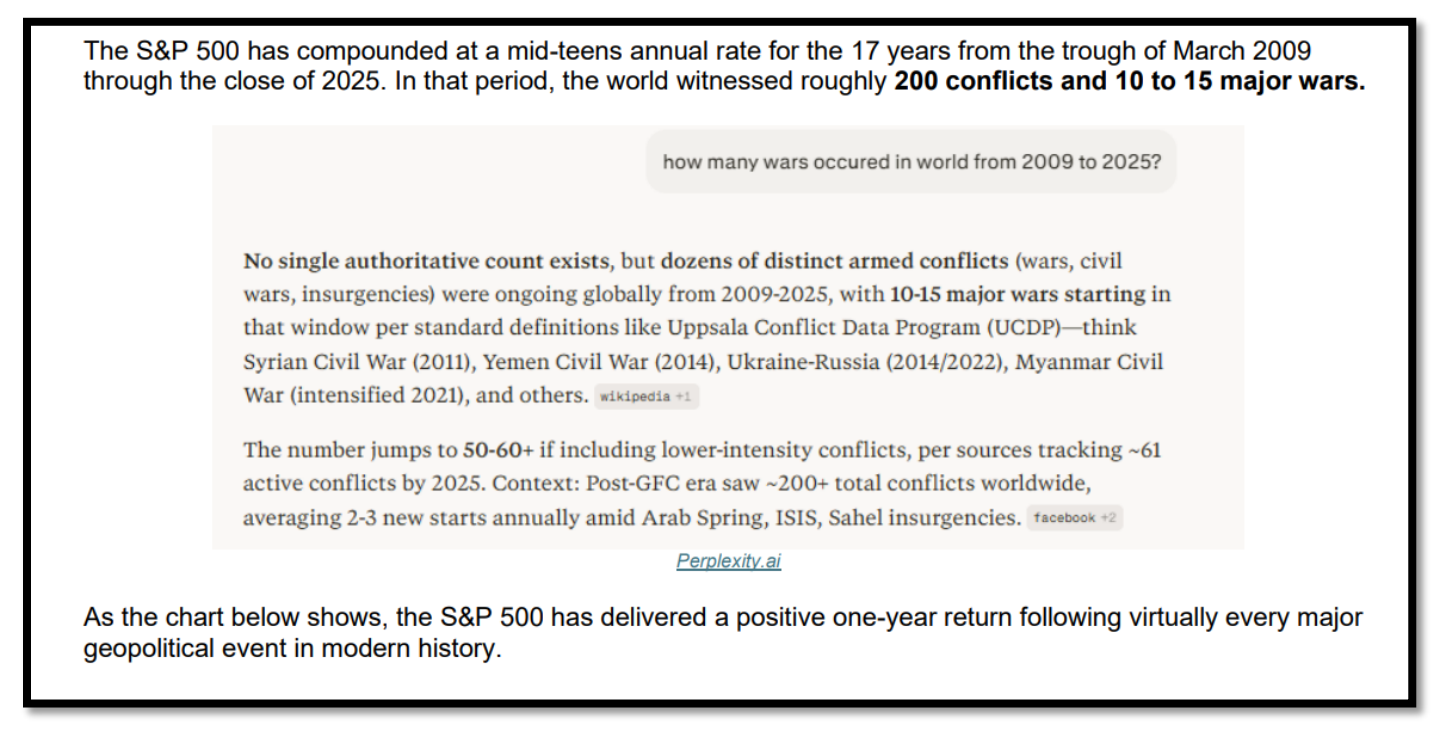
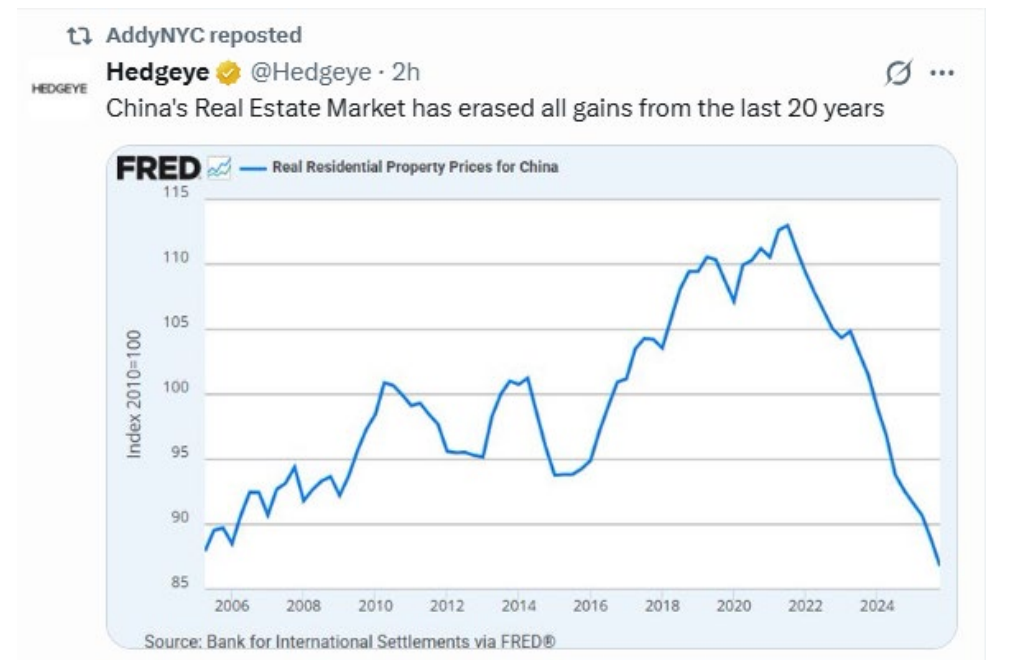
“All we are is dust in the wind.” Kansas wasn’t thinking about financial markets in 1977, but the line fits 2026 about as well as anything on a Bloomberg terminal. This year we watched fortunes that felt permanent blow away in a matter of days: MicroStrategy, a small-cap crypto sub-sector, and twenty years of Chinese real estate gains. The theme of the song, and of this letter, is humility: almost nothing in markets lasts as long as the people riding it believe it will.
In our Q1 Letter, “All Along the Watchtower,” we walked through the long history of military conflict and the stock market just as the Iran war began. Here is what we wrote:
“Markets are amoral. Wars tend to produce short-term disruptions that, historically, create buying opportunities. Right now, I rank the Iran war as #3 on the 2026 risk scale, behind the private equity / credit bear market at #2 and the ‘known unknown’ of the AI buildout at #1. We expect volatility to remain elevated through 2026 due to the midterm elections and the new Fed chair appointment.” (Q1 2026 Letter)
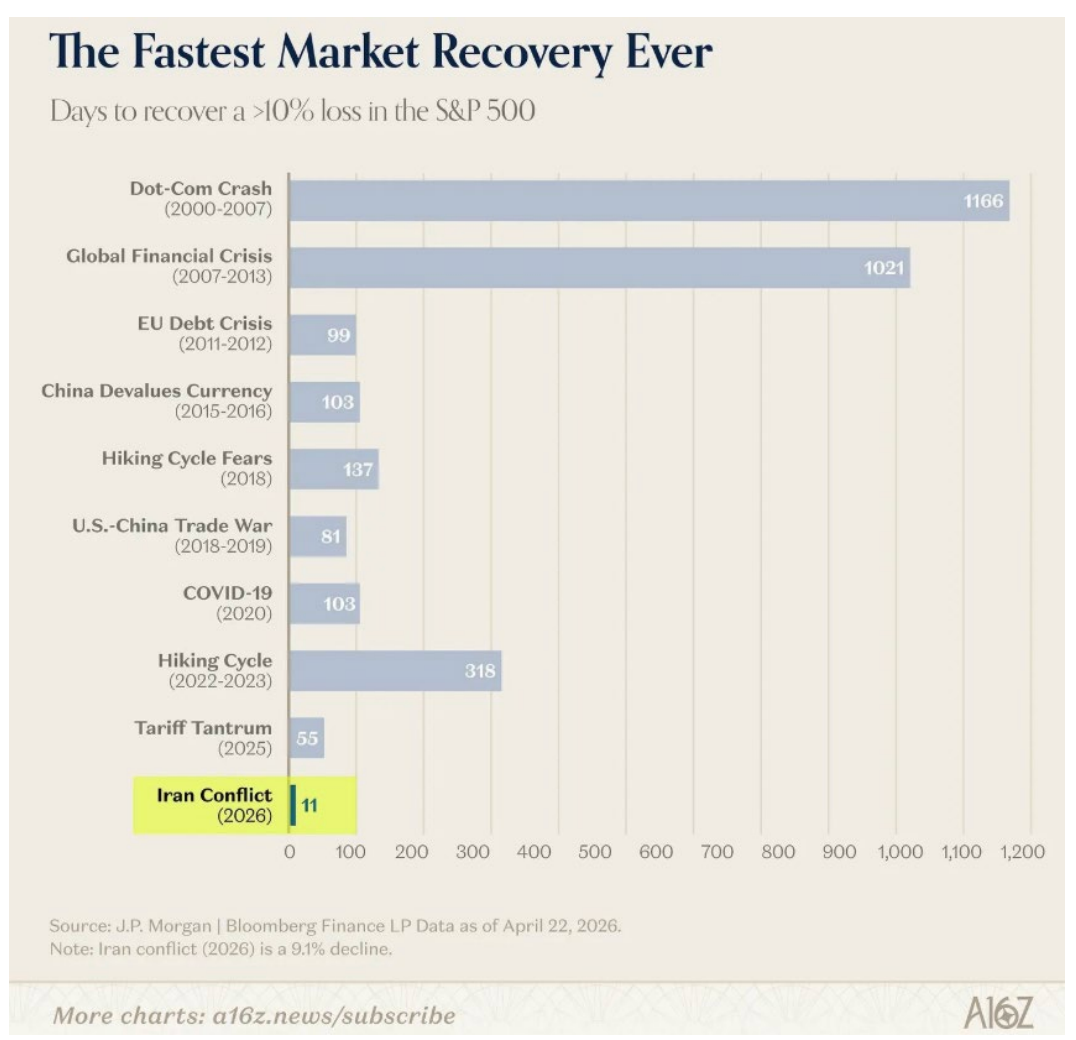
Once again, stocks delivered after the bombs dropped, but I never would have guessed the pace of the rally. How about the fastest V-shaped recovery in history? The S&P 500 sold off -10% at the start of the Iran conflict and made back every point just 11 days later. Dust in the wind.
Dust in the Wind
Song by Kansas (1977)
“I close my eyes,
Only for a moment, and the moment’s gone
All my dreams
Pass before my eyes with curiosity
Dust in the wind
All they are is dust in the wind"
These probabilistic return assumptions depend on current market conditions and, as such, may change over time.
IMPORTANT: The projections and other information generated by the Vanguard Capital Markets Model regarding the likelihood of various investment outcomes are hypothetical in nature, do not reflect actual investment results, and are not guarantees of future results. Distribution of return outcomes from the VCMM are derived from 10,000 simulations for each modeled asset class. Simulations are as of March 31, 2019. Results from the model may vary with each use and over time.
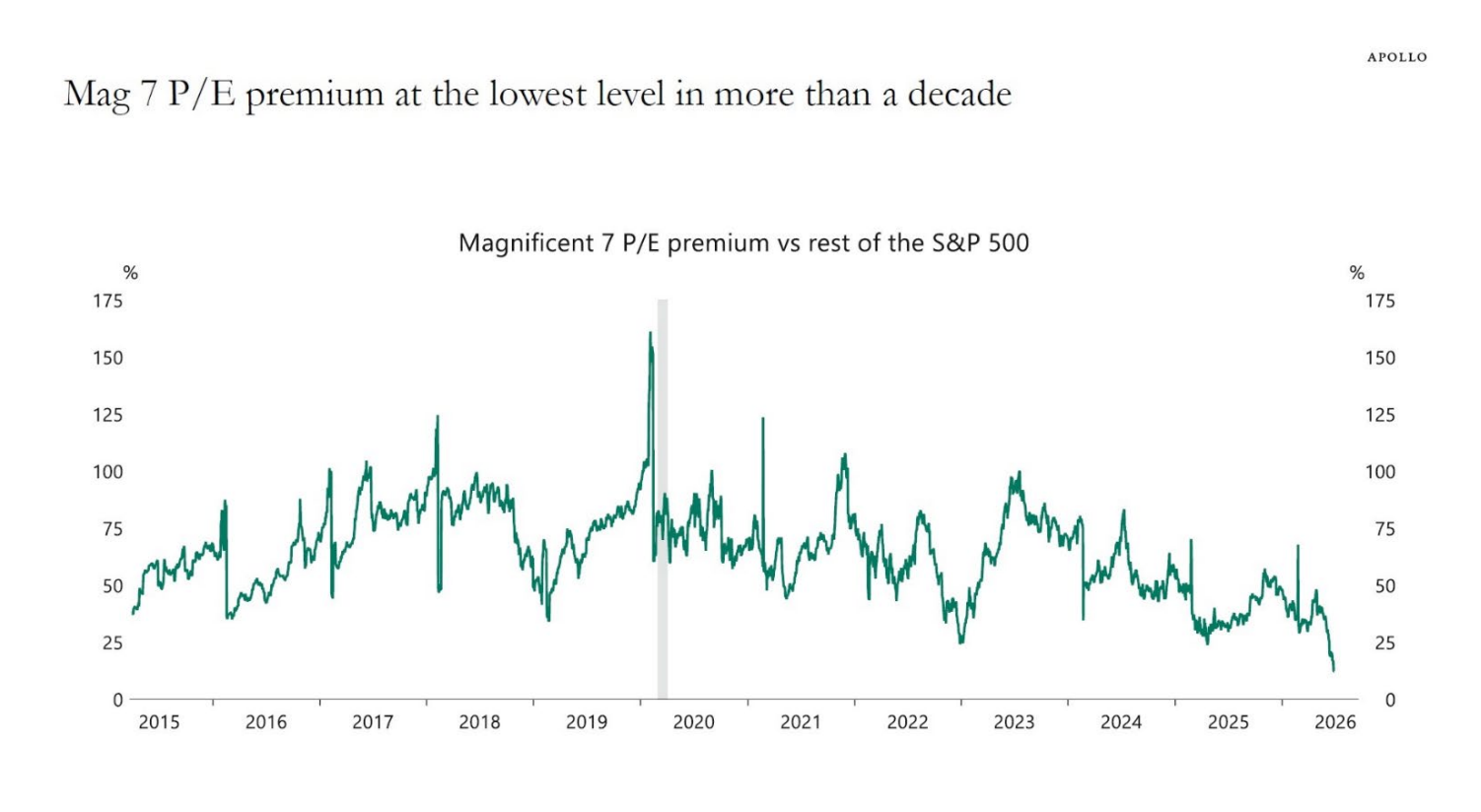
Remember when analysts warned the market was too concentrated in the Mag 7? The entire mega-cap premium has now been erased (see below). On a one-year basis, semiconductors have returned 4x the Mag 7, so much so that the semiconductor index is now record-expensive while Mag 7 valuations look cheaper. Just remember: every technology stock eventually faces the big O, obsolescence. Today's must-own name can be tomorrow's afterthought. Dust in the wind. As I write, the semiconductor index corrected -20% from hihgs.
On December 7th, 1999, Barron’s published the infamous “What’s Wrong,Warren” cover eerily before the Nasdaq crashed 50% and Berkshire recovered years’ worth of underperformance.
The below graph plots the time period 6/30/98 through 2/29/00 for the Nasdaq where many dot-com and technology stocks traded, and the price of Berkshire Hathaway, Warren Buffett’s holding company, which consisted of value stocks:
https://kailashconcepts.com/ Kailash Concepts
Was the Nasdaq 100 20% rally in the first quarter a repeat of the above or a new bull market in tech? A big portion of the answer will come from the direction of interest rates. The Fed came in like a hurricane upending markets across the world, but we have not begun to feel the effects of higher interest rates working their way across the system. As rates settle into a new range, it will have a profound effect on new business initiatives going forward and be exacerbated by the recent regional bank speed bump that will reduce lending to small business owners. Below are Vanguard’s projected 10-year returns that I include at the end of every letter. The interesting data point is treasuries and high-quality corporate bonds have higher projected returns than growth stocks at one-quarter of the volatility.
Like Neil Young says “I want to love you but I’m getting blown away.”
Leveraged loans are up 50 percent since 2015
Leveraged loans, which are issued by overleveraged companies with insufficient cash flows, are part of what Wolf Richter recently called the “gigantic pile of risky corporate debt that is now being brutally repriced as concerns over credit risk (the risk of default) are finally bubbling to the surface.” According to Richter, the S&P/LSTA US Leveraged Loan 100 Index, which tracks the prices of the largest leveraged loans, has plunged by 20 percent since February 22nd.
According to Richter, leveraged loans “are traded in slices like securities or are packaged into highly rated Collateralized Loan Obligations (CLOs). But for years, investors had the hots for them, driven by their relentless chase for yield, in a world of interest rate repression.”
These companies, noted Richter, were often acquired by private equity firms through leveraged buyouts, which means they loaded up those companies with lots of debt. In addition, “PE firms extracted special dividends from their companies,” which were funded by leveraged loans. That’s a form of asset stripping and it leaves the company “more leveraged, more precarious and more likely to topple. But who cares? Those were the good times and the chase for yield was on,” lamented Richter.
Disclosures
Lansing Street Advisors, LLC is a registered investment advisor with the State of Pennsylvania. You can read more about the Lansing team at http://www.lansingadv.com/
To the extent that content includes references to securities, those references do not constitute an offer or solicitation to buy, sell or hold such security as information is provided for educational purposes only. Articles should not be considered investment advice and the information contained within should not be relied upon in assessing whether to invest in any securities or asset classes mentioned. Articles have been prepared without regard to the individual financial circumstances and objectives of persons who receive it. Securities discussed may not be suitable for all investors. Please keep in mind that a company’s past financial performance, including the performance of its share price, does not guarantee future results.
Material compiled by Lansing is based on publicly available data at the time of compilation. Lansing makes no warranties or representations of any kind relating to the accuracy, completeness or timeliness of the data and shall not have liability for any damages of any kind relating to the use of such data.
Material for market review represents an assessment of the market environment at a specific point in time and is not intended to be forecast of future events or guarantee of future results.
Indices that may be included herein are unmanaged indices and one cannot directly invest in an index. Index returns do not reflect the impact of any management fees, transaction costs or expenses. The index information included herein is for illustrative purposes only.
The trademarks and service marks contained herein are the property of their respective owners.
Lansing Street Advisors is a registered investment adviser. Information presented is for educational purposes only and does not intend to make an offer or solicitation for the sale or purchase of any specific securities, investments, or investment strategies. Investments involve risk and, unless otherwise stated, are not guaranteed. Be sure to first consult with a qualified financial adviser and/or tax professional before implementing any strategy discussed herein. Past performance is not indicative of future performance.
Lansing Street Advisors may discuss and display, charts, graphs, formulas which are not intended to be used by themselves to determine which securities to buy or sell, or when to buy or sell them. Such charts and graphs offer limited information and should not be used on their own to make investment decisions.
Part I. The Known Unknown of the AI Buildout
The artificial intelligence buildout has its skeptics, and OpenAI has more than a few bears. Some analysts don’t believe OpenAI will ever IPO. Others are far more blunt, like Ed Zitron below:
“Look. OpenAI intends to burn over $852 billion by the end of 2030. It accounts for $748 billion of the remaining performance obligations of Microsoft, Amazon, and Oracle, on top of at least another $70 billion of RPOs across Cerebras, CoreWeave, Nebius, IREN, Lambda, and Nscale, and plans to spend indeterminate billions on Broadcom ‘Jalapeno’ chips. It intends to spend $50 billion or more on compute this year, which I estimate is more than 50% of all global AI compute spend.”
“OpenAI can only afford that thanks to its latest $122 billion funding round, of which it has received at least $50 billion, including $20 billion from SoftBank. NVIDIA noted in its latest quarterly earnings that ‘one AI research and deployment company contributed a meaningful amount of revenue by purchasing cloud services from our customers,’ referring, of course, to OpenAI.”
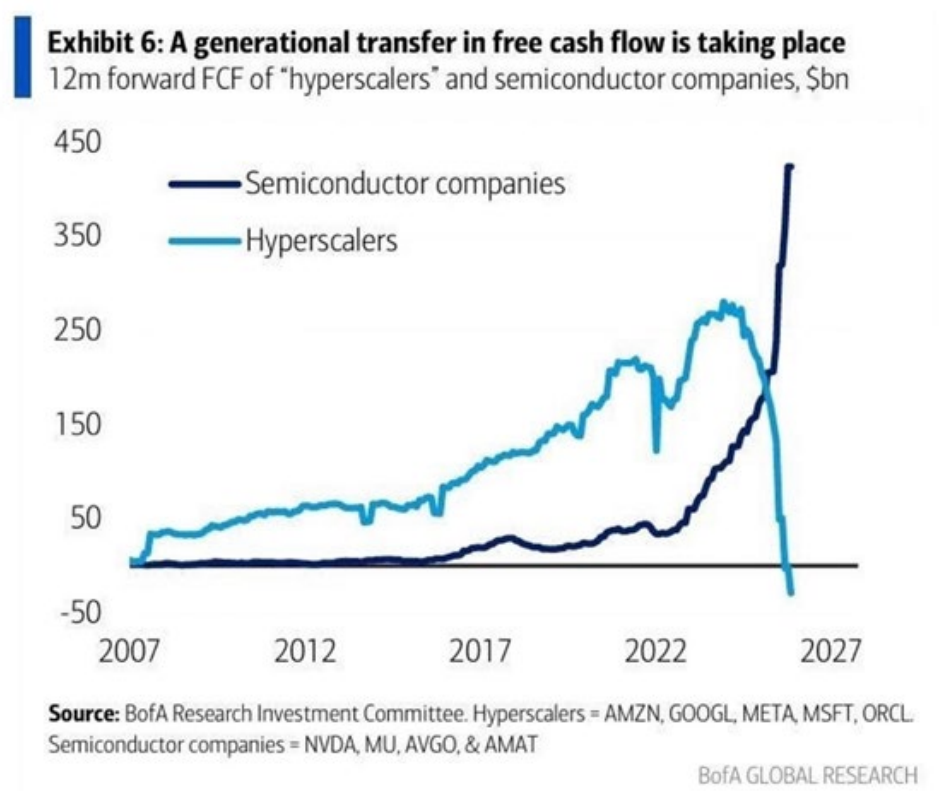
The cash burn is the top-ranked known unknown: revenue may arrive far slower than spending, with infrastructure getting built faster than a profitable business case can form. The chart below, one of the mostshared of 2026, from Bank of America, shows the hyperscalers (AMZN, MSFT, META, GOOGL) spending 80% of their free cash flow on chips and data centers.
Especially important, none of the above are a recommendations for you to buy or sell any security. This is for information purposes only. Please talk with your advisor regarding any advice around the subject matter and your goals.
That raises the next known unknown: bottlenecks. AI needs energy, water, chips, data, and people. In other words, our most profitable American companies have chosen to be short-term unprofitable on a bet that could stall out in a logjam.
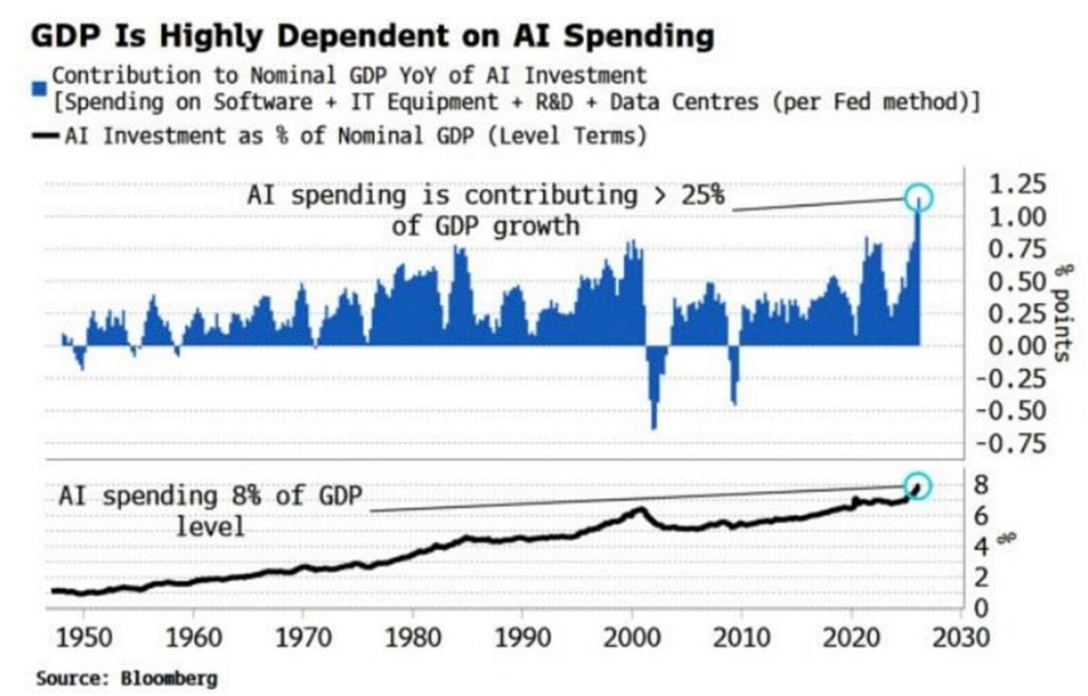
AI spending is now running near 8% of GDP. During the dot-com bubble, tech spending peaked around 6.5%. Read that again. We have already outspent the internet bubble, which means the stock market and the economy are deeply dependent on AI right now.
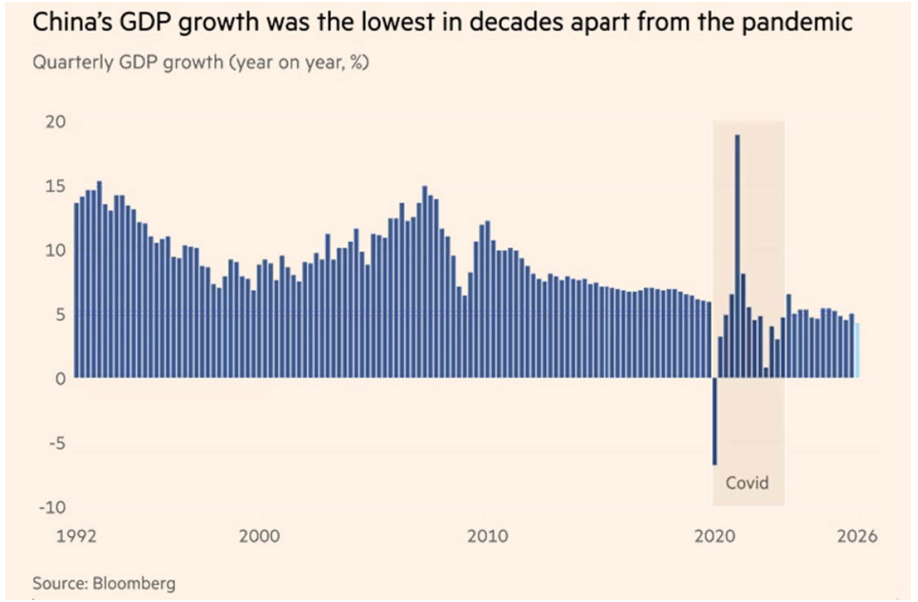
China is dealing with weak private investment and consumer spending, slumping property values, enormous youth unemployment, and a long-term demographic shrinkage of its population. On a one-year basis, emerging market ETFs are beating Chinese market ETFs by close to 40%.
Side Note: A One-Year Follow-Up on “TBD”
“The man with the briefcase can steal more money than the man with the gun.” -Vito Corleone
This is not investment advice. I am not a crypto expert, and this could just be another Bitcoin winter.
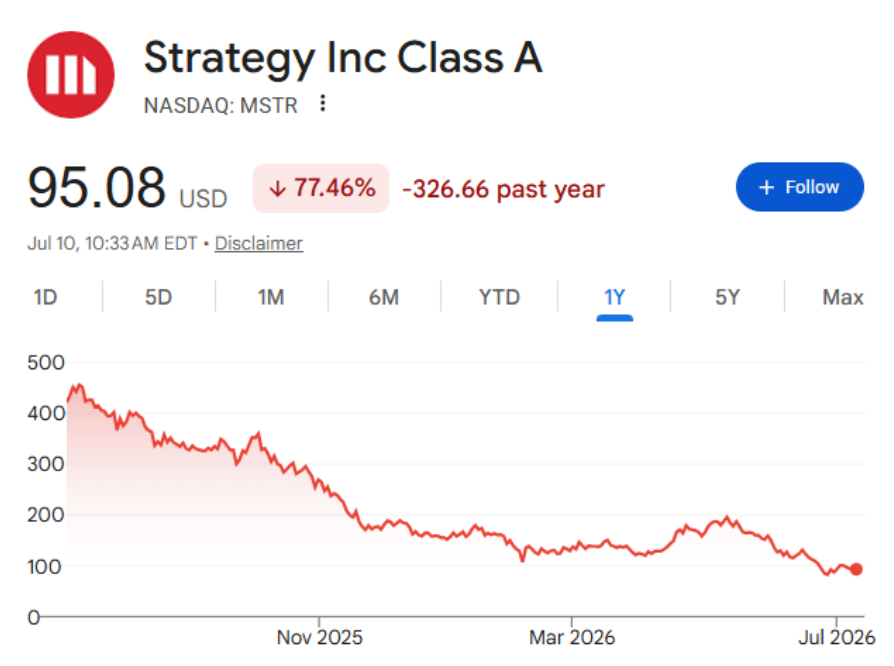
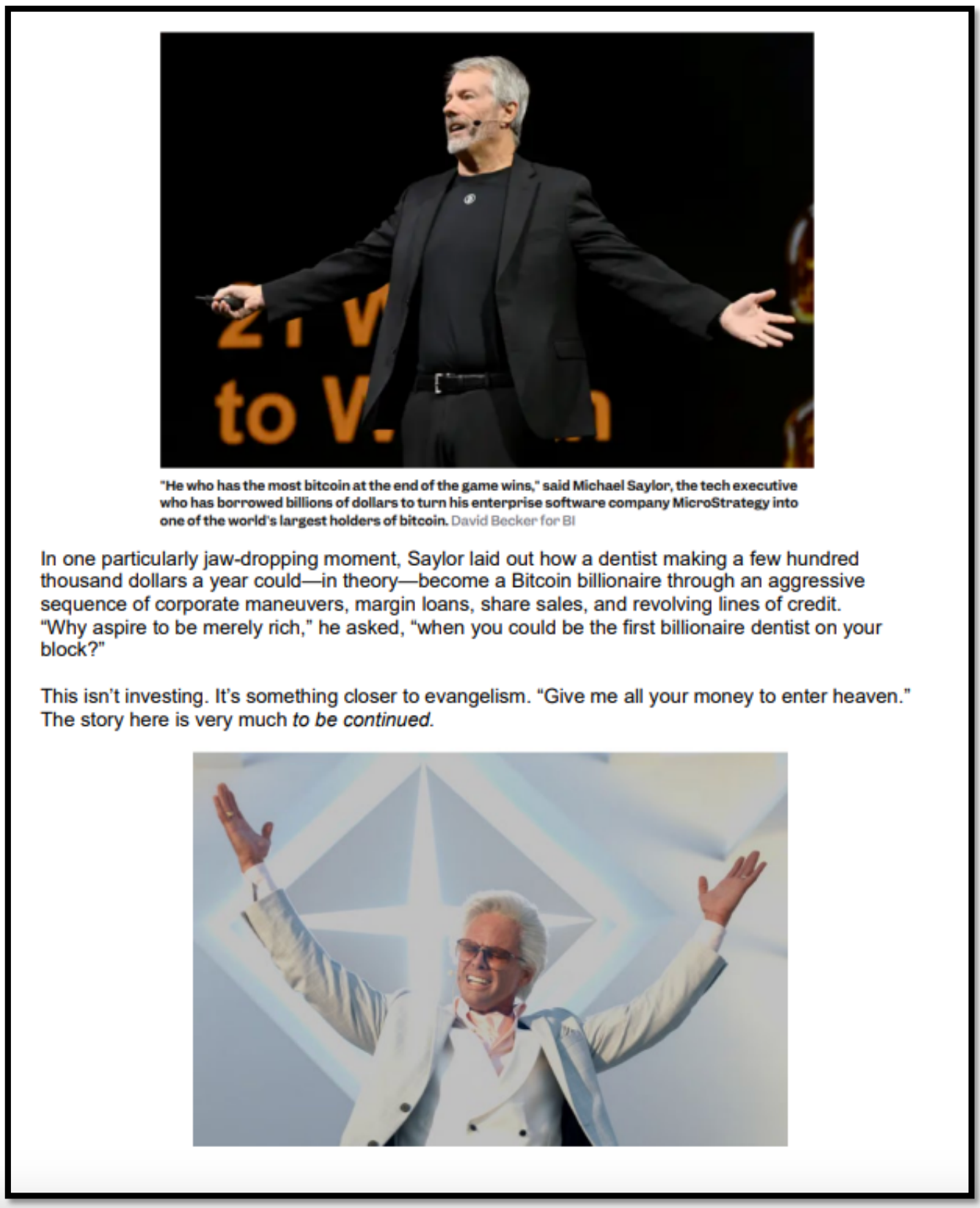
But it is the one-year anniversary of our Q2 2025 letter, “The Times They Are a-Changin’.” In it, we referenced Michael Saylor’s speech on how a dentist could become a Bitcoin millionaire. Since that day, MSTR is down - 77%. Dust in the wind.
The “first billionaire dentist” built on buying MSTR is not going to happen. Saylor has started selling Bitcoin, a transaction he swore he would never make.
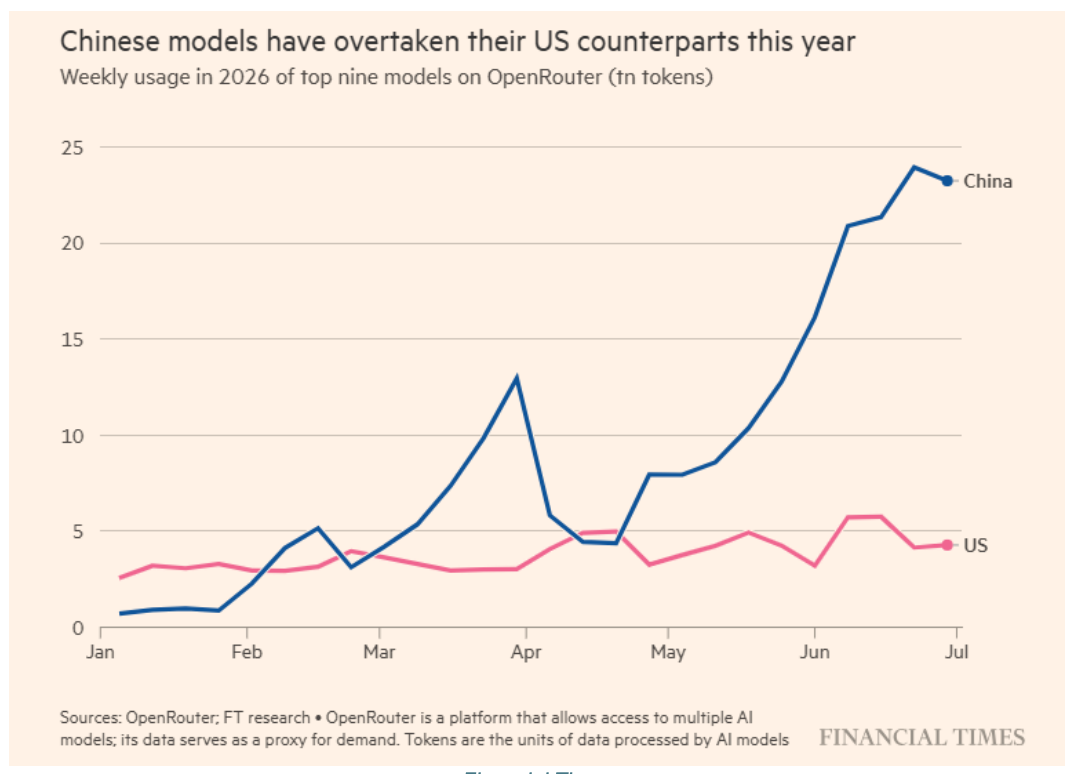
Like a broken record, China is here to copy our work and sell it cheaper. The next chart was a punch in the face this week: in just three months, cheap Chinese models have taken massive market share. “Buy American” won’t hold with technology this transformative. Companies around the world will act in the best interest of their own bottom line. This chart screams “price war.”
New world-changing technologies often see a first move higher that turns into a speculative run-up before the long-term winners and losers are clear. The first move is the knee-jerk reaction to the new technology; the real move comes later, when the strongest survivors prove their profitability. Historically, there is a bubble in between. The first movers that look invincible today are often gone before the real winners arrive. Dust in the wind.
As I’ve noted in previous letters, both midterm election years and the arrival of a new Fed governor have a history of coinciding with stock market corrections. But there is a big difference between the -20% correction that shows up every five years and the bursting of a true bubble. The small-crypto-coin bubble burst in October 2025, sending that sub-sector down -90% in a single day; the Nasdaq fell -70% during the internet bubble.
Those were real bubbles. We will see winners and losers around the AI trade, with some companies facing obsolescence, but let me revisit the internet bubble one more time.
Part II. Good News: However the Known Unknown Falls, It’s Not the Internet Bubble
We keep moving from one mini-bubble to the next without blowing up the broader market. NVDA was the most important stock in the world; now MU has taken the lead. The Mag 7 used to drive the entire market. Now semiconductors are driving returns.
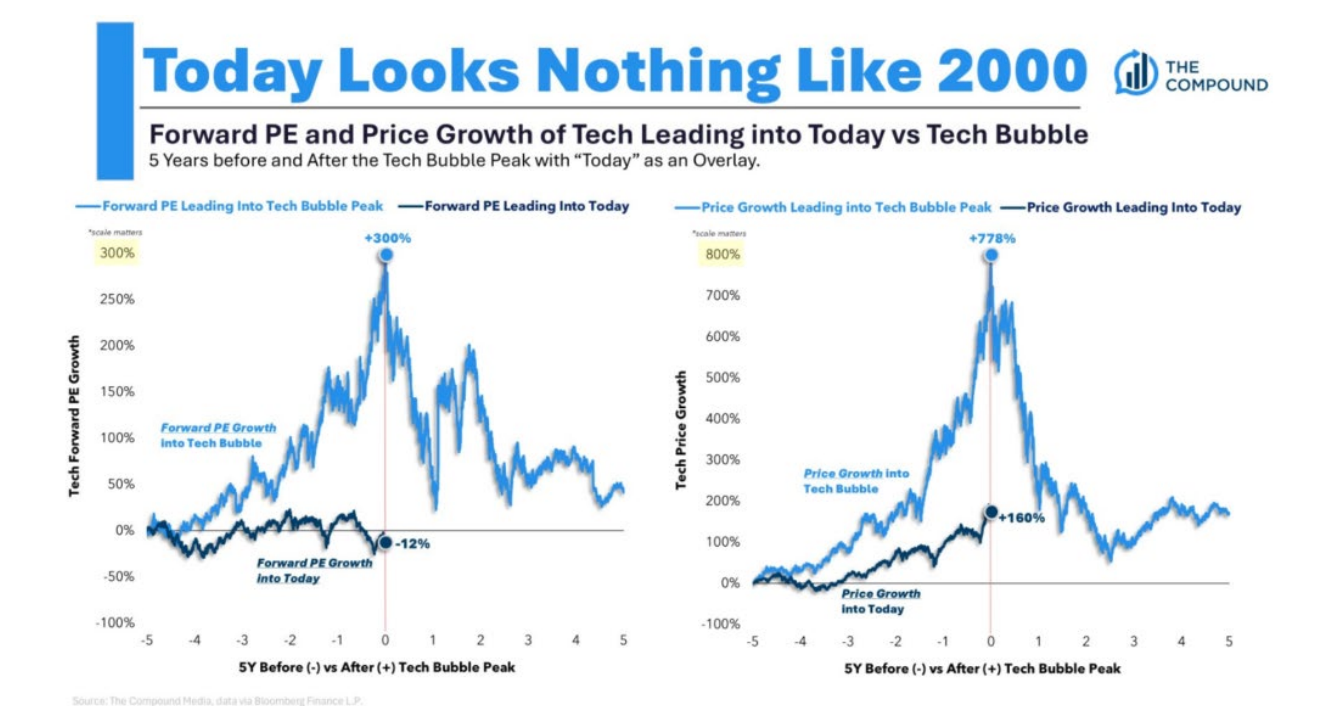
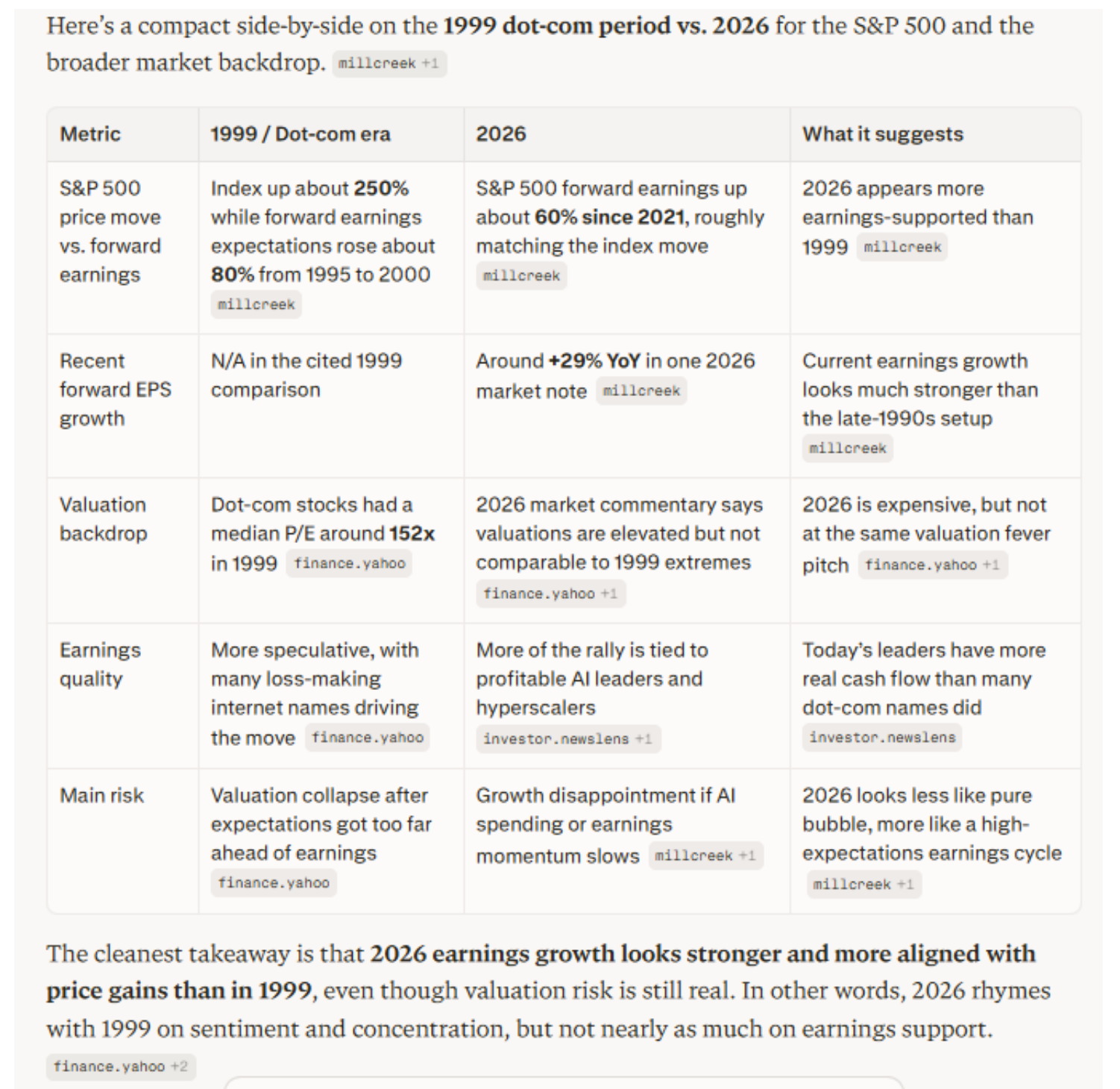
To repeat my stance from the Q4 2025 letter: this is not the 1999 to 2000 bubble. Speculation is rampant: record margin debt, the explosive growth of leveraged ETFs, same-day options (rat poison), prediction markets Q2 2026 Letter – Dust in the Wind (here to stay), and a parade of sub-sector mini-bubbles.
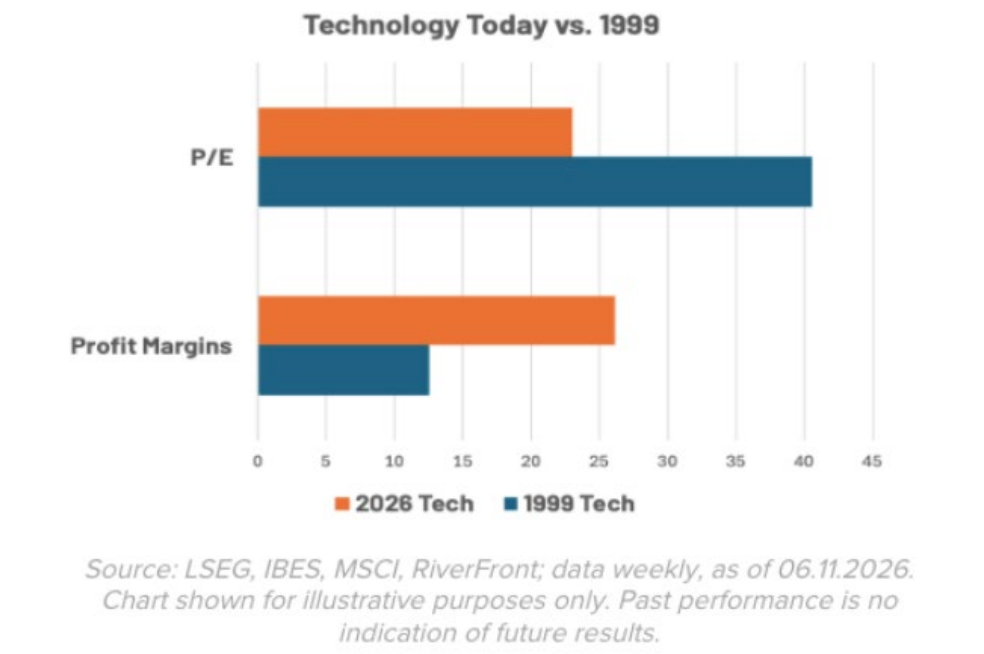
But the tech sector today carries 2.5x the profit margins of 1999 at half the P/E ratio. Over the last nine months we have lived through a crypto winter, a private equity bear, negative Mag 7 returns, a silver bubble, and an energy-price explosion, and the S&P and Nasdaq are still up strong.
Here is Chart Kid Matt (not me) showing that the forward price-to-earnings ratio of the S&P has actually fallen in 2026, versus climbing 300% in 1999. The U.S. market is expensive and dotted with sub-sector bubbles, but it is not a copy of the internet bubble.
Part III. Is Diversification Back?
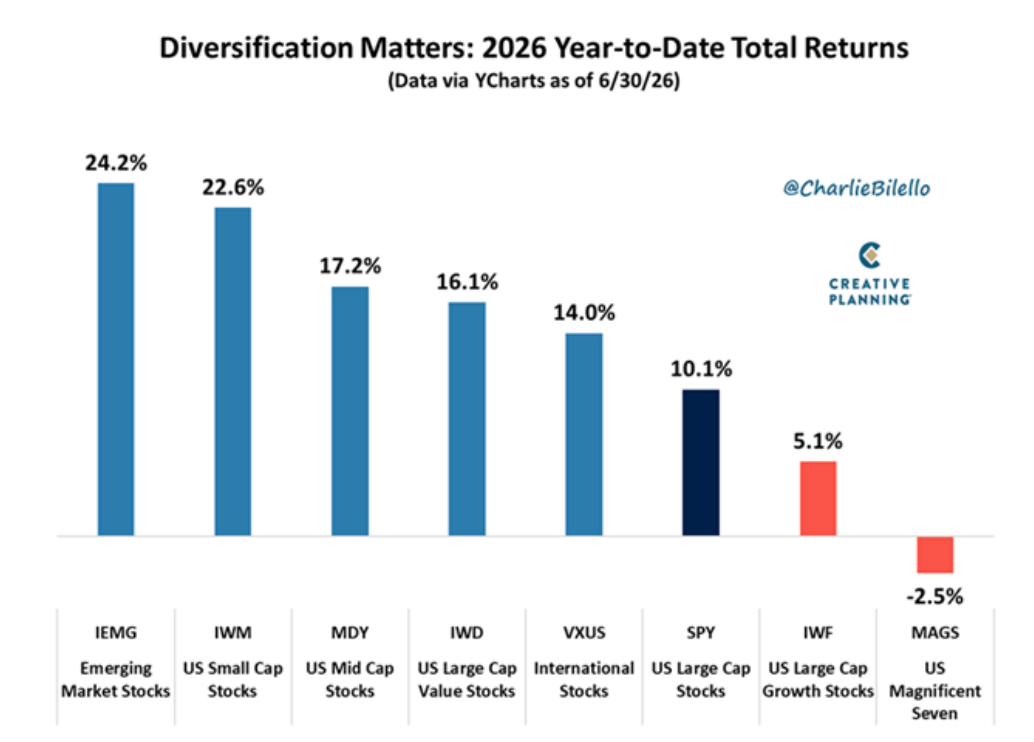
For 15 years, with little interruption, large-cap growth stocks outran the diversified portfolio, leaving nearly every other asset class looking cheap relative to the S&P 500. Over the last 12 months and year to date, it has been revenge for the diversified portfolio.
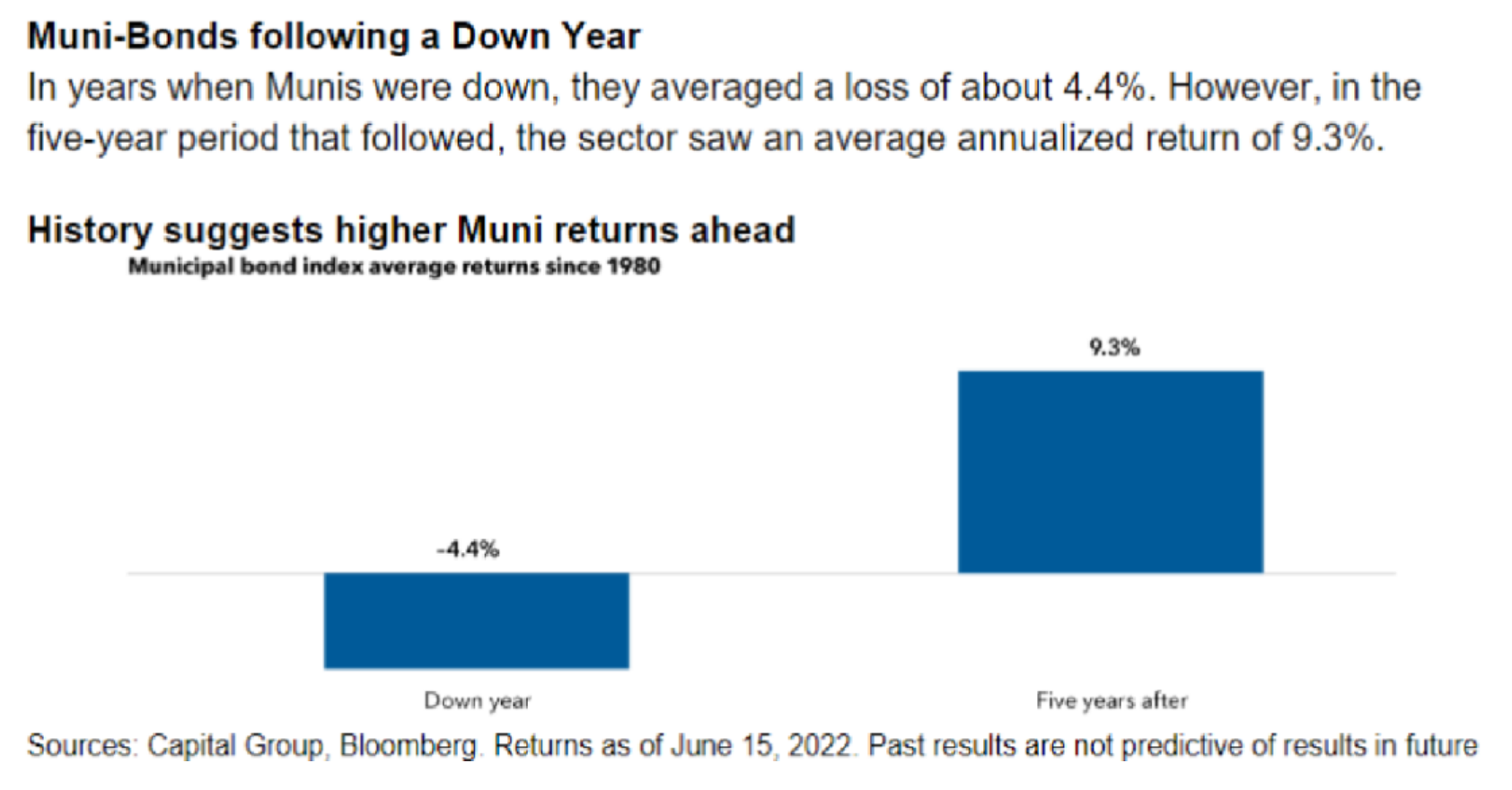
Emerging markets and small-cap stocks have returned 5x U.S. large-cap growth. Just when everyone had given up on diversification, it worked. Bonds are in the worst bear market in history; in the next true market meltdown, I would expect them to do their job again.
In markets, leadership is borrowed, never owned. Kansas had it right: almost nothing lasts but the earth and the sky.
Part IV. Communism Still Sucks
Here is the good news about China rolling out cheap AI models: communism still sucks.
Can you imagine 20 years of American residential real estate gains being wiped out? That is -50% on every home in America. My handicap on that happening here is 1%, but in a top-down economy like China’s, they just lived it. Two decades of gains, gone. Dust in the wind.
Conclusion
Wall Street is an amazing wealth generator. The American economy is so dynamic that it still astonishes me after 30 years in the business. But public markets, like life, are also about storytelling, and some of those tales are spun by the unscrupulous cousins of Wall Street who are coming for your family’s wealth.
As we have covered in previous letters, today’s market carries a high level of speculation and outright gambling. That is what is creating these rolling mini-bubbles that burst without taking down the broader indexes. It will keep punishing the risk-takers, but America will innovate and grow.
There is a Wolf of Wall Street documentary on Paramount Plus right now, this was true boiler house theft at the highest level, but I am not sure we don’t have more sophisticated legal financial grift happening today. Let’s be careful out there.
The AI buildout is the biggest American known unknown in 25 years, and history says these moments create bubbles before the true winners reveal themselves on the other side of the volatility. That unpredictability is exactly why we diversify and stay composed. Investing is a psychology game, not an IQ game.
Which brings us back to Kansas. The comfort in “dust in the wind” isn’t fatalism. It’s perspective. The minibubbles will keep forming and bursting, the known unknowns will keep us guessing, and the storytellers will keep spinning their tales. What endures, the earth and sky, in the song’s words, is a diversified portfolio, a long time horizon, and the discipline to stay composed while everyone else chases the next gust of wind.
Dust in the Wind Song by Kansas (1977)
“Now don't hang on
Nothin' lasts forever but the earth and sky
It slips away
And all your money won't another minute buy
Dust in the wind
All we are is dust in the wind
(All we are is dust in the wind)
Dust in the wind
(Everything is dust in the wind)
Everything is dust in the wind
(In the wind)”