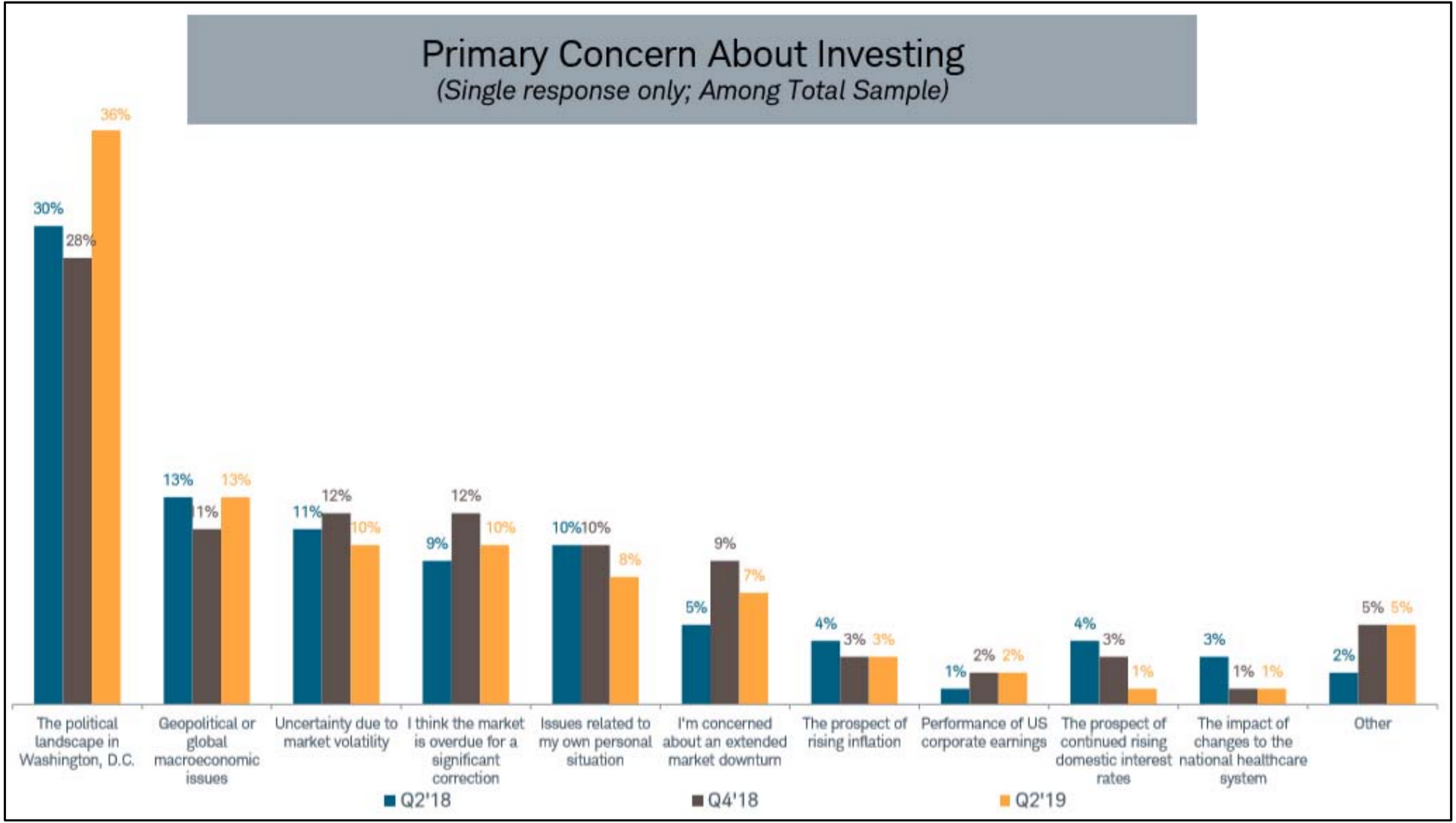
The U.S. Political Landscape is Leading Concern Among Investors – SCHWAB
The U.S political landscape is overwhelmingly the leading concern about investing among clients.
“For What It Is Worth”
Buffalo Springfield
Paranoia strikes deep
Into your life it will creep
It starts when you're always afraid
You step out of line,
the man come and take you away
We better stop, hey, what's that sound
Everybody look what's going down
Stop, hey, what's that sound
Everybody look what's going down
Stop, now, what's that sound
Everybody look what's going down
Stop, children, what's that sound
Everybody look what's going down
Written by: Stephen Stills
Lyrics © Warner Chappell Music, Inc
Click here for image source and full document
Keep in mind, you should definitely care in a passionate manner about your political beliefs and always participate in the political process, but you should probably turn off the dashboard of your investment portfolio when you do it. Treat investments and politics as church and state, two completely separate silos of thinking within your household.
Raymond James surveyed 1,000 US investors with at least $75,000 in the markets in August. Forty percent said that politics were either "extremely or very important." What's more, 70% said that news headlines in general influence their investment decisions.
Click here for source
In my opinion, don’t make changes to your long‐term portfolio based off elections but do get ready for short‐term volatility from political storms especially an impeachment. Thankfully, we don’t have much history on impeachment hearings, but my friend Bill Stone at Avalon does a good job of summarizing the stock market returns under Nixon and Clinton impeachments. It’s tough to flesh out much from these statistics because the economic cycle was in massively different stages during these presidencies. The Nixon 1970’s saw inflation, stagnation and high employment while the Clinton 1990’s saw low inflation, booming economic growth and full employment.
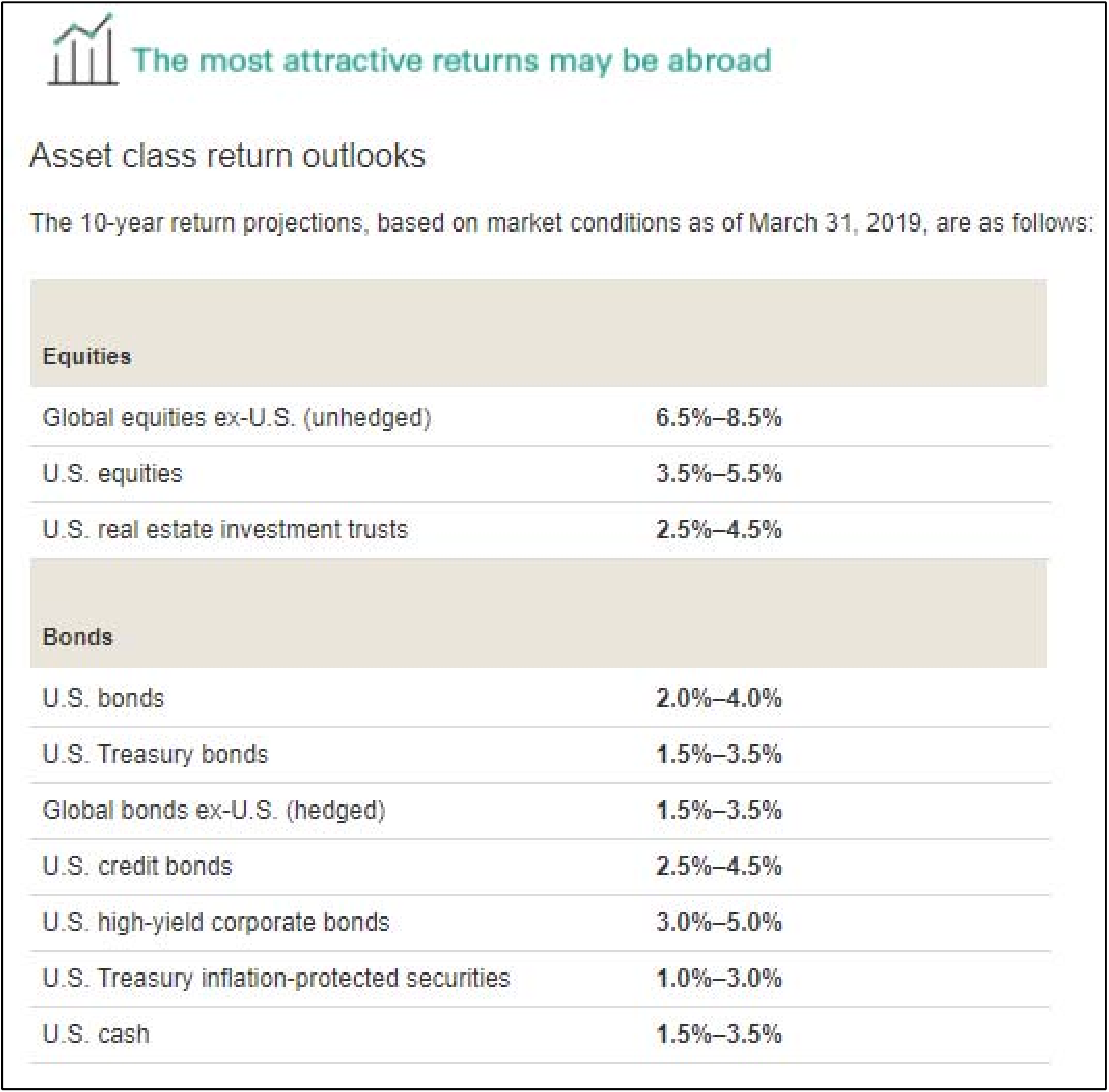
These probabilistic return assumptions depend on current market conditions and, as such, may change over time.
IMPORTANT: The projections and other information generated by the Vanguard Capital Markets Model regarding the likelihood of various investment outcomes are hypothetical in nature, do not reflect actual investment results, and are not guarantees of future results. Distribution of return outcomes from the VCMM are derived from 10,000 simulations for each modeled asset class. Simulations are as of March 31, 2019. Results from the model may vary with each use and over time.
Click here for source and full document
The paranoia around presidential elections is hitting record levels, we better stop and listen to what’s going down. We spend a big portion of our life listening to storytelling. As kids, parents and teachers tell us stories. As adults the news media is about storytelling, investing is about storytelling, and nothing paints a better story than politics. I may be early with this letter as the presidential election is more than a year away but it’s possibly shaping up to be the ultimate scary story for investors.
As I write this letter, it is increasingly looking like a Trump vs. Warren election and a Trump impeachment investigation, which may be the ultimate binary event for American voters. Never in history has an election been so important except for every other election in history. Most of my conservative friends thought the world would end if Obama got elected and most of my liberal friends thought the world would end if Trump got elected.
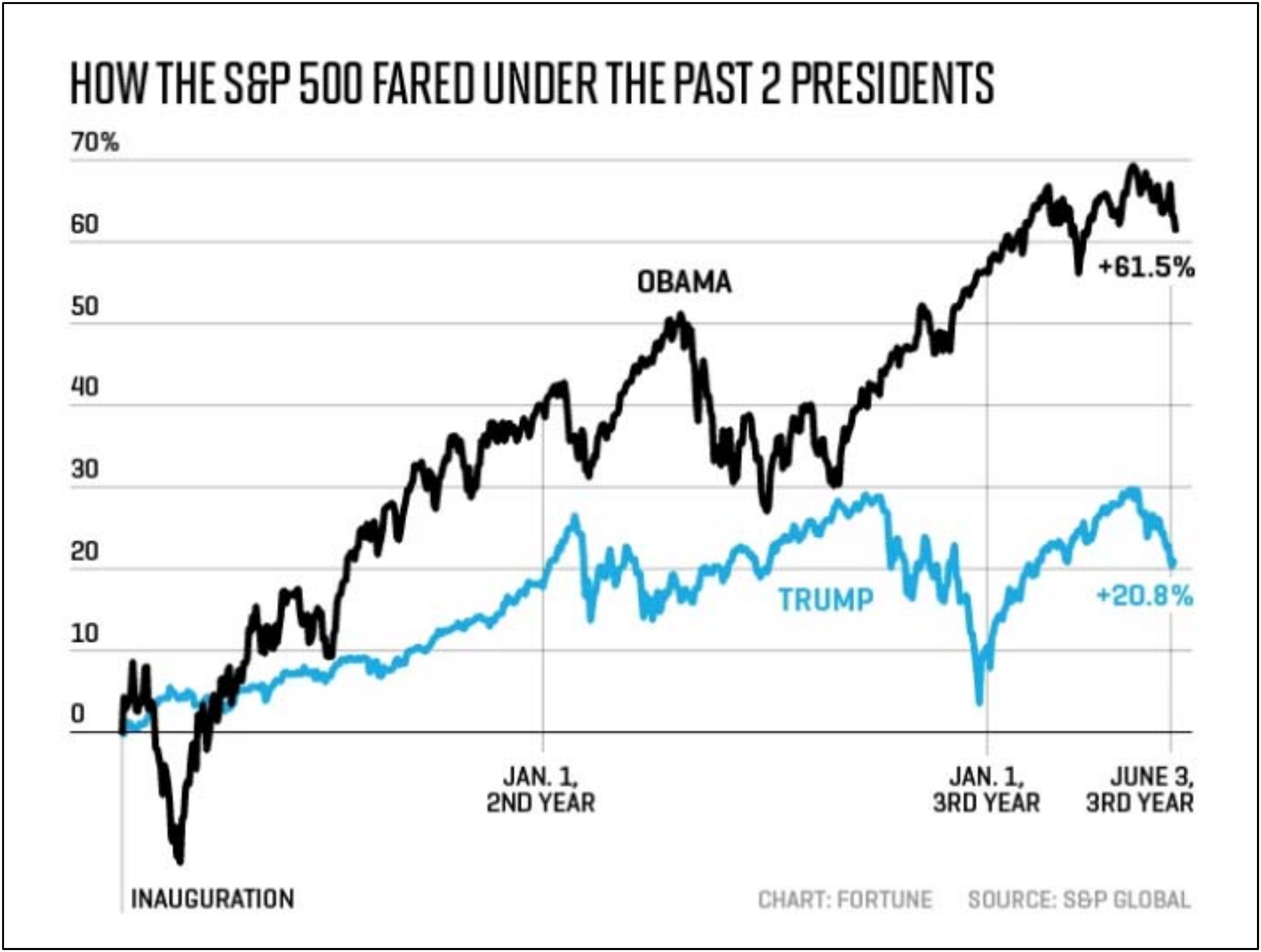
If you made either of those investing bets based on politics, your wallet is probably lighter. The chart below shows that Obama obviously did a better job with the economy. Actually this would be a false assumption, as Obama took office when the S&P was trading at generational low valuations. The single best predictor of future returns is where valuations are today, the next President will not have the luxury of beginning his or her term with low valuations.
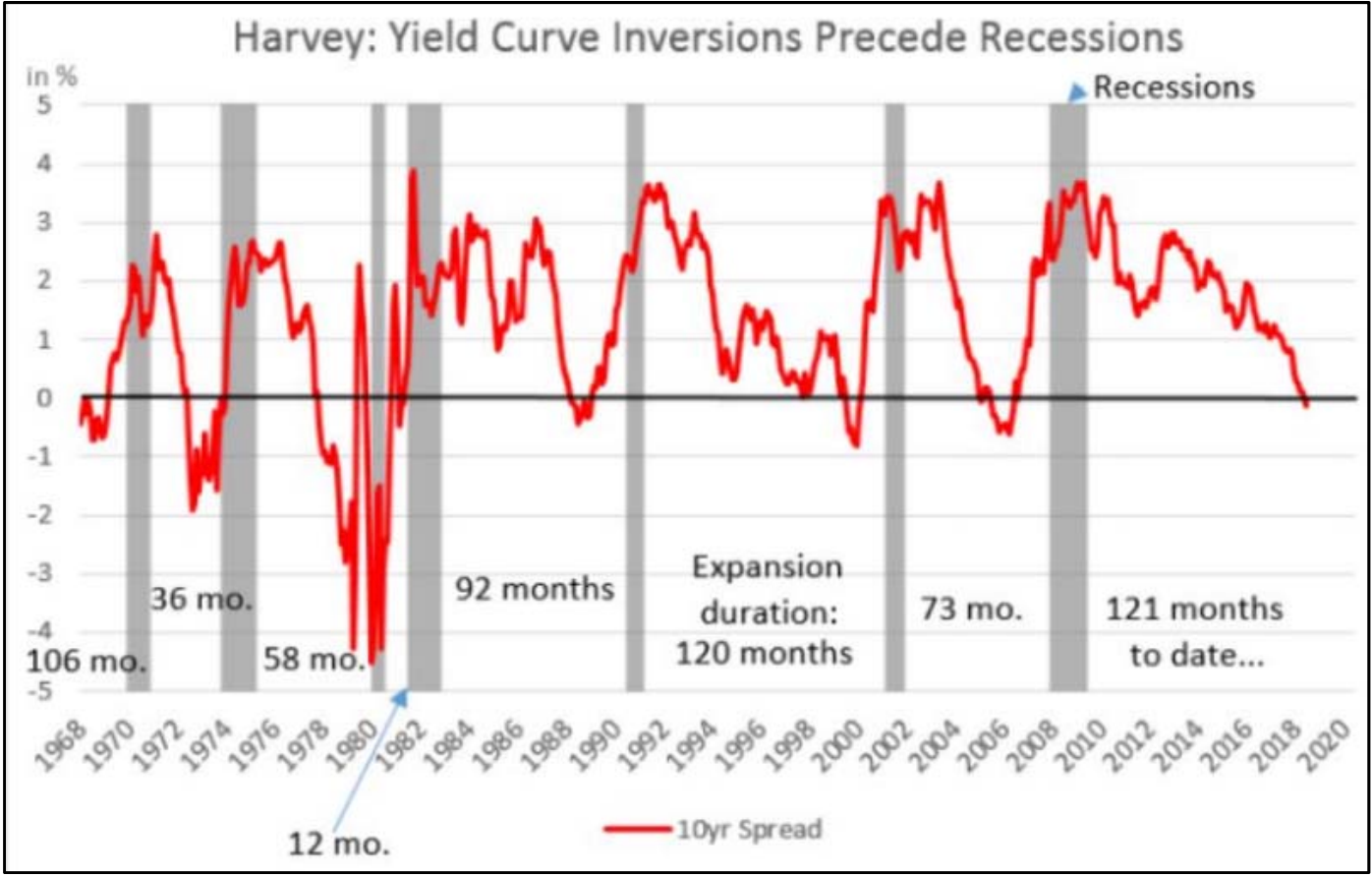
1. The Q2/2019 Letter Pointed Out Inverted Yield Curve.
5 Investing Topics to Think About Seriously
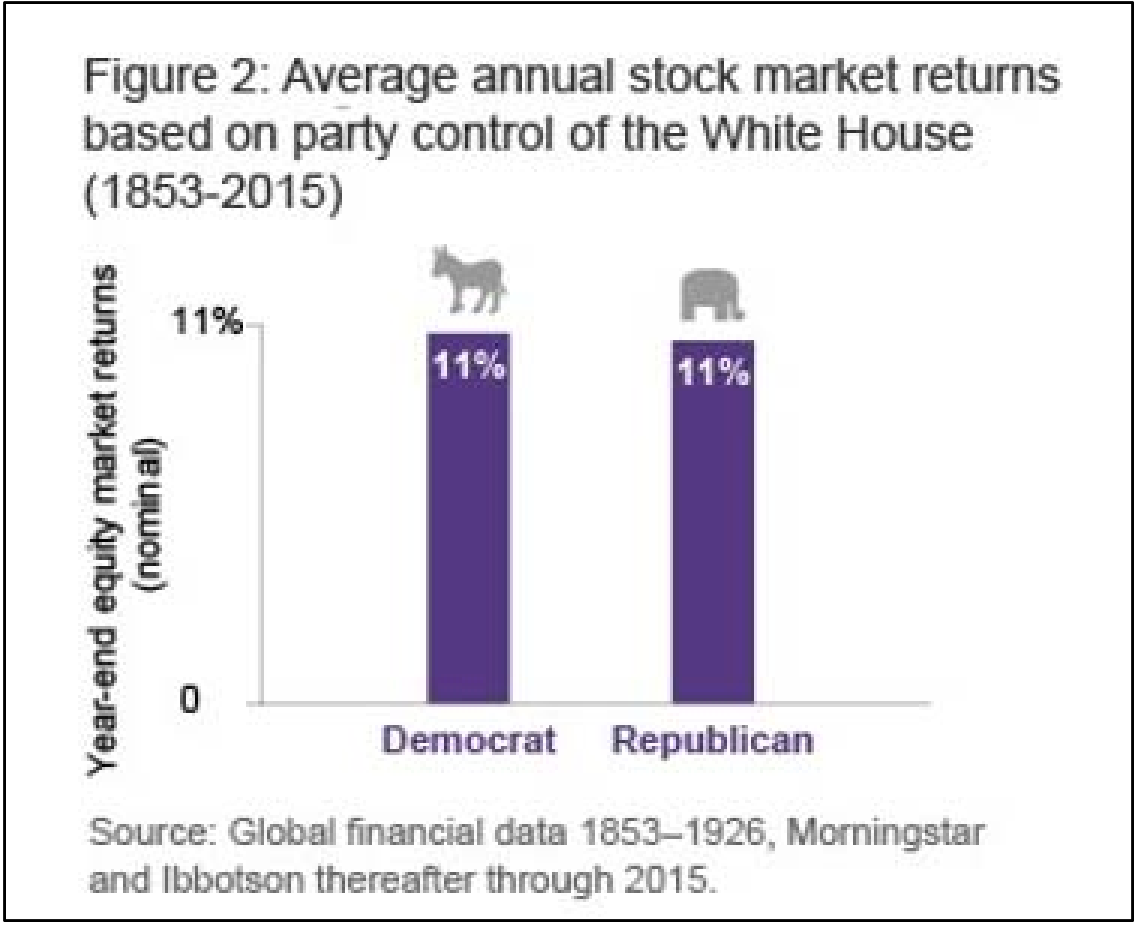
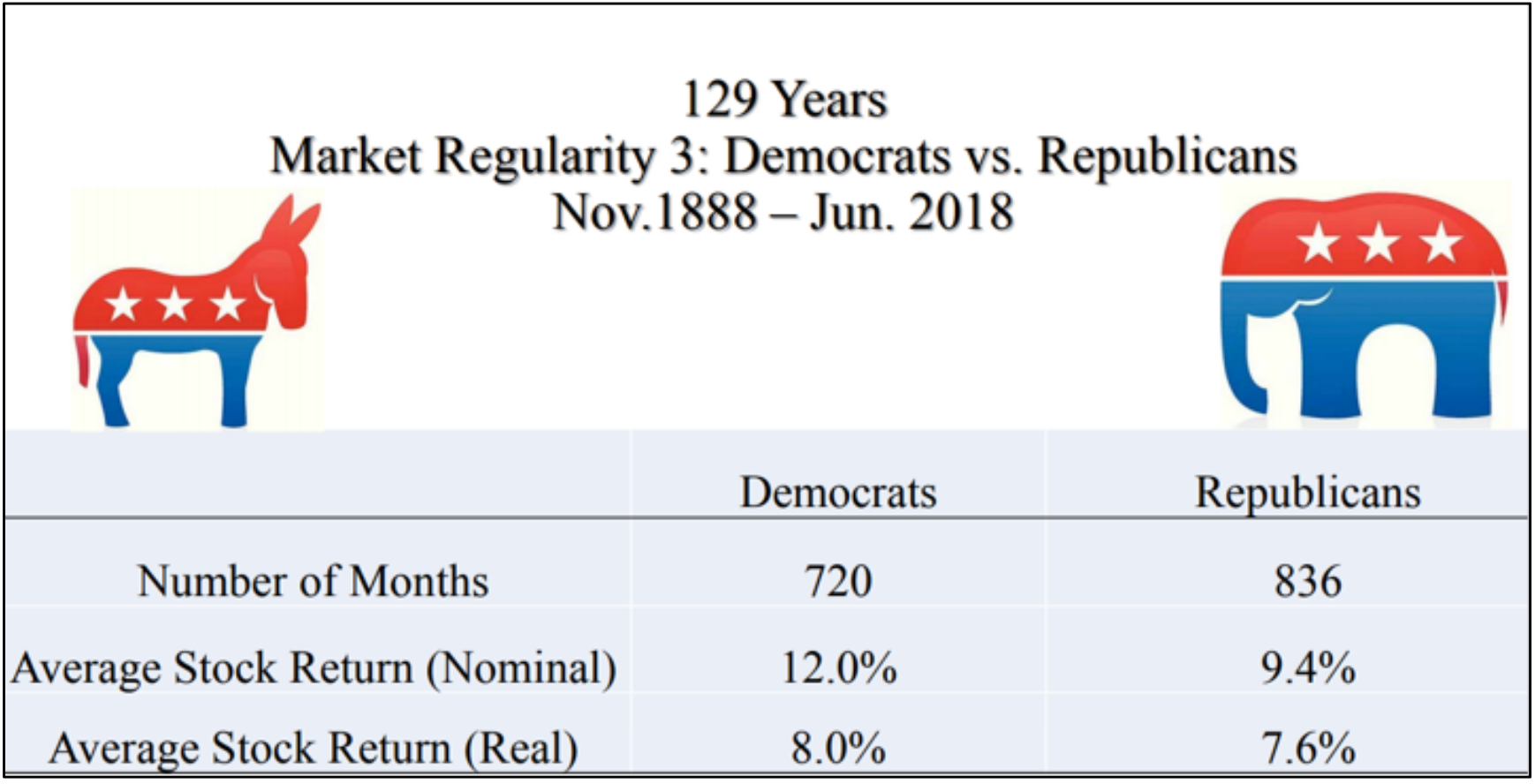
Inevitably when friends and clients see this chart, they flat out don’t believe it. It’s simple math but the political tribe pull is so strong that it seems for many it’s hard to comprehend the truth. In very few sports rivalries as vicious as politics does a 150‐year game end in a tie but Republican versus Democrat stock returns delivered a dead tie from 1853‐2015.
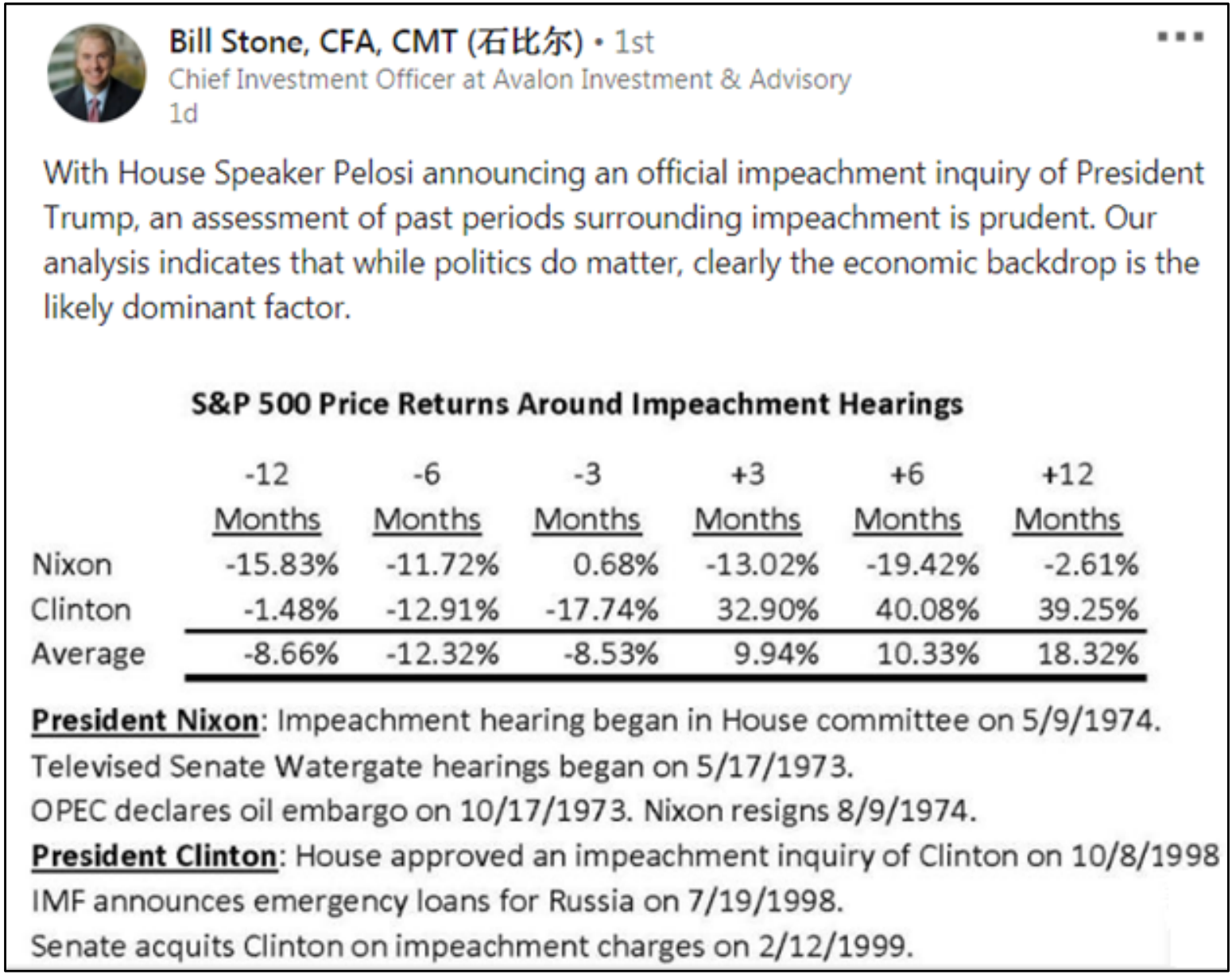
From Bill Stone Avalon
Click here for source
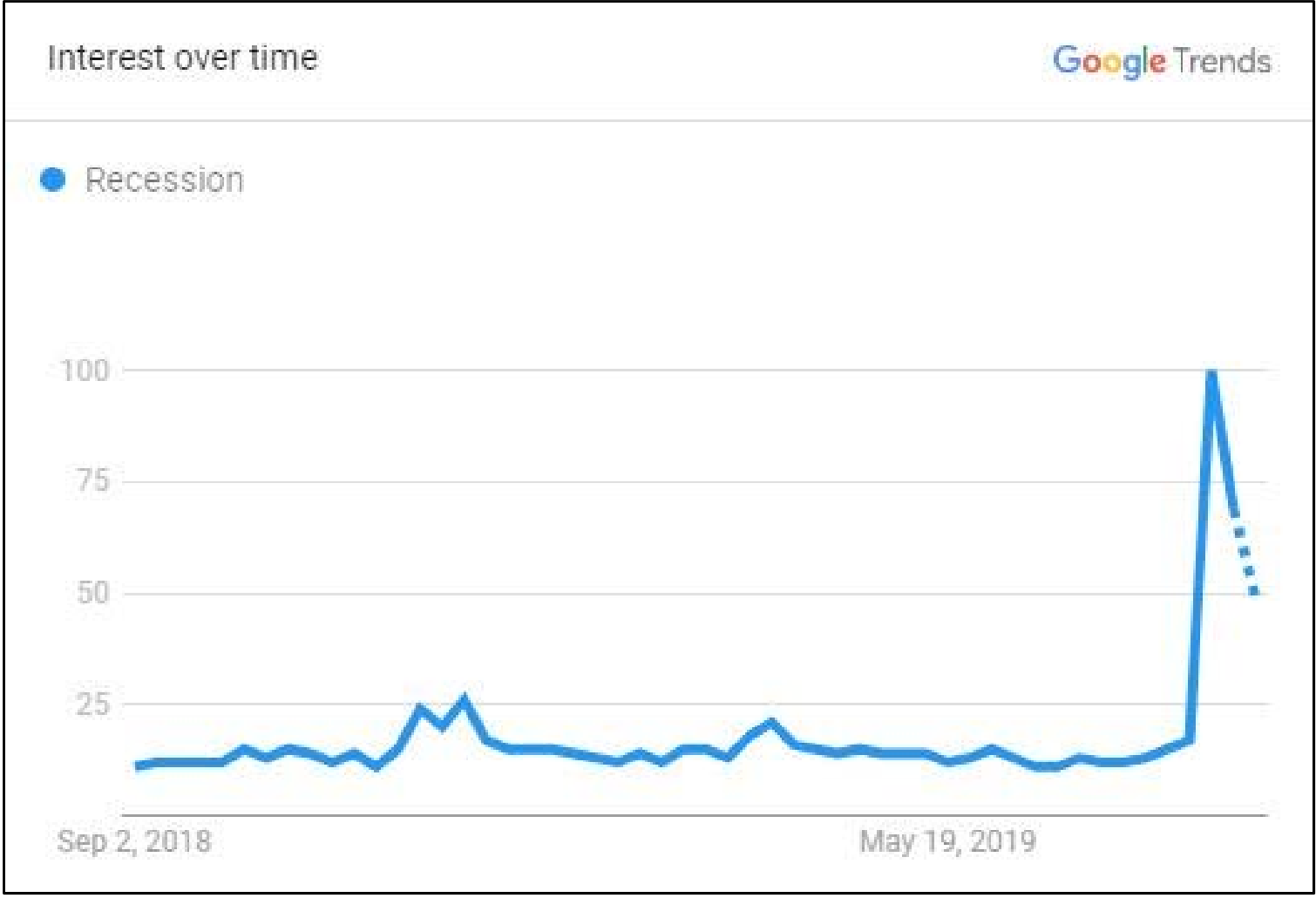
Right now, the American investor is obsessed with a slowdown and recession, every CPA, banker, investment professional and lawyer I speak with uses the same term “late in the cycle.” Every investor I speak with asks when is the stock market going to crash, as you can see in the below image, Google searches on the word recession took a hockey stick spike as we enter possible impeachment hearings and a heated election season, this obsession could be exacerbated.
Google searches show recession fears have spiked dramatically since the end of July, when the Federal Reserve cut interest rates for the first time since the financial crisis.
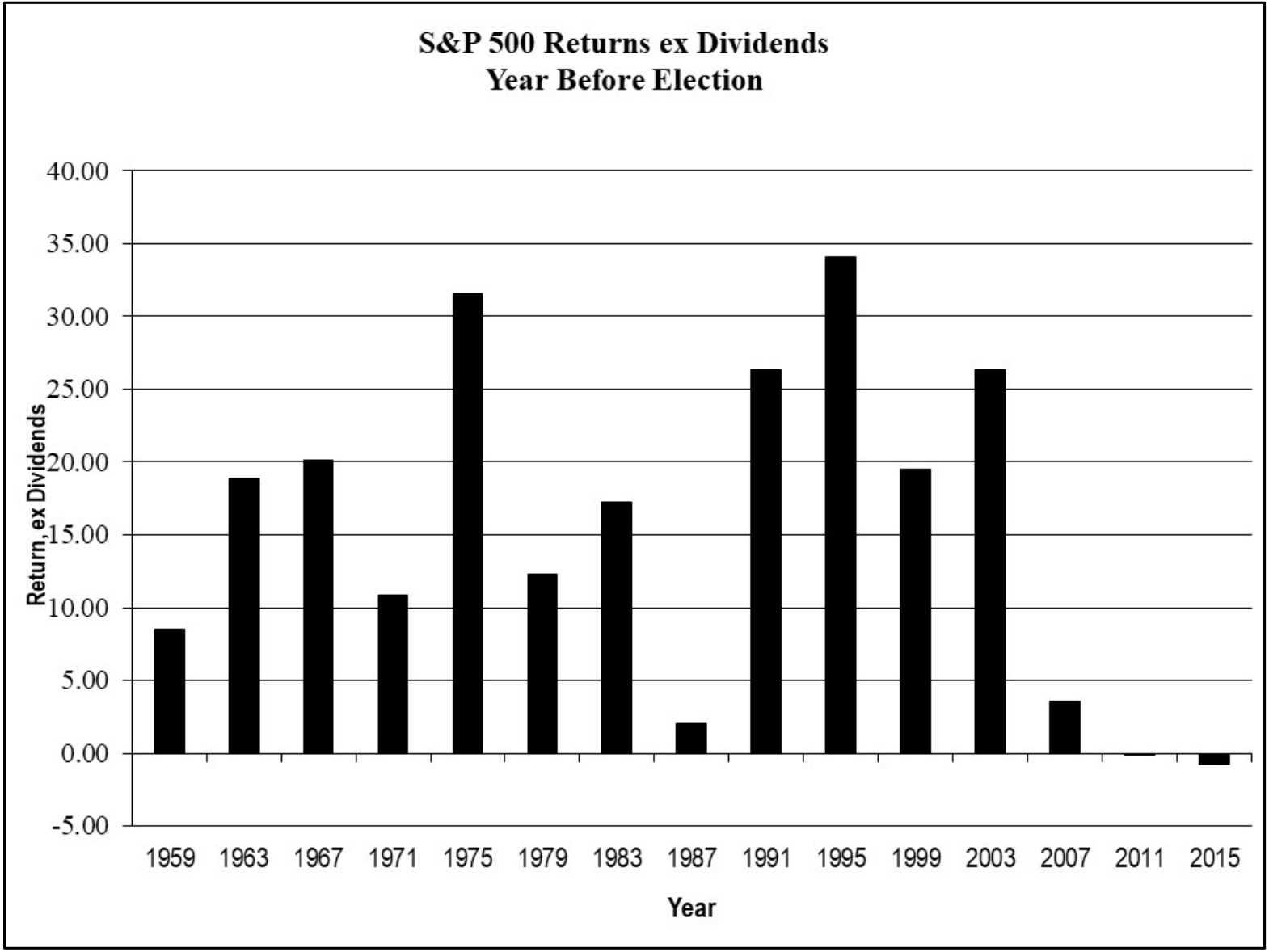
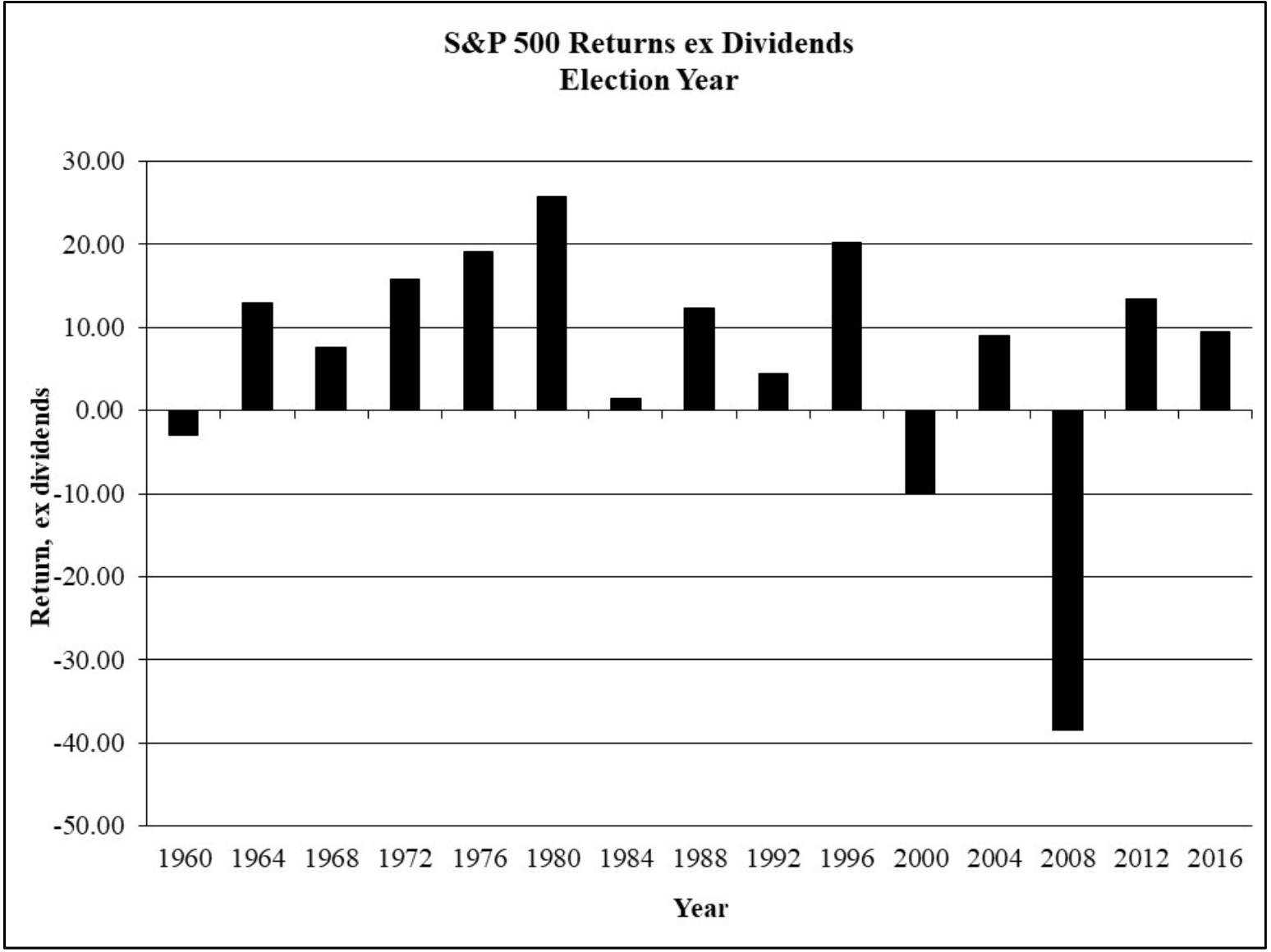
It would appear this negative obsession heading into election season is not grounded in the history of the stock markets as the following images illustrate. As you can see below, the years prior to a presidential election, and the election year itself, tend to be good for stocks as candidates make promises for a new tomorrow.
On December 7th, 1999, Barron’s published the infamous “What’s Wrong,Warren” cover eerily before the Nasdaq crashed 50% and Berkshire recovered years’ worth of underperformance.
The below graph plots the time period 6/30/98 through 2/29/00 for the Nasdaq where many dot-com and technology stocks traded, and the price of Berkshire Hathaway, Warren Buffett’s holding company, which consisted of value stocks:
Conclusion
If you built an investment portfolio based off politics or geopolitical events, it could permanently sit in cash because the world is such a scary place. As pointed out in previous letters, reality is that the S&P 500 is up 15,000% in the last 70 years surviving an endless amount of doomsday scenarios that never fully pan out.
Now as we are about to move to the forefront of our news cycle political theatre is at its highest level, but the end of the bull market will likely not be about presidential election combat. Bull markets historically end due to higher inflation, rising interest rates, war, overvaluations or recessions. This bull is likely to fall under traditional recession with overvaluations but timing it, as always, will be impossible. An inverted yield curve is certainly a first shot across the bow of this bull but the average time before a recession starts after inversion is one year out.
If the bull market was to end quickly in the next couple quarters, it would certainly be a strange set‐up with the Fed lowering interest rates, money pouring into bonds, and positive election cycle seasonality kicking in.
As hard as it may be, we should separate our political passions from our investment passions. In my view invest based off your goals not your political affiliation, if you don’t need to live off your investments in the near term, embrace any political sparked stock market volatility as an opportunity to buy lower priced stocks.
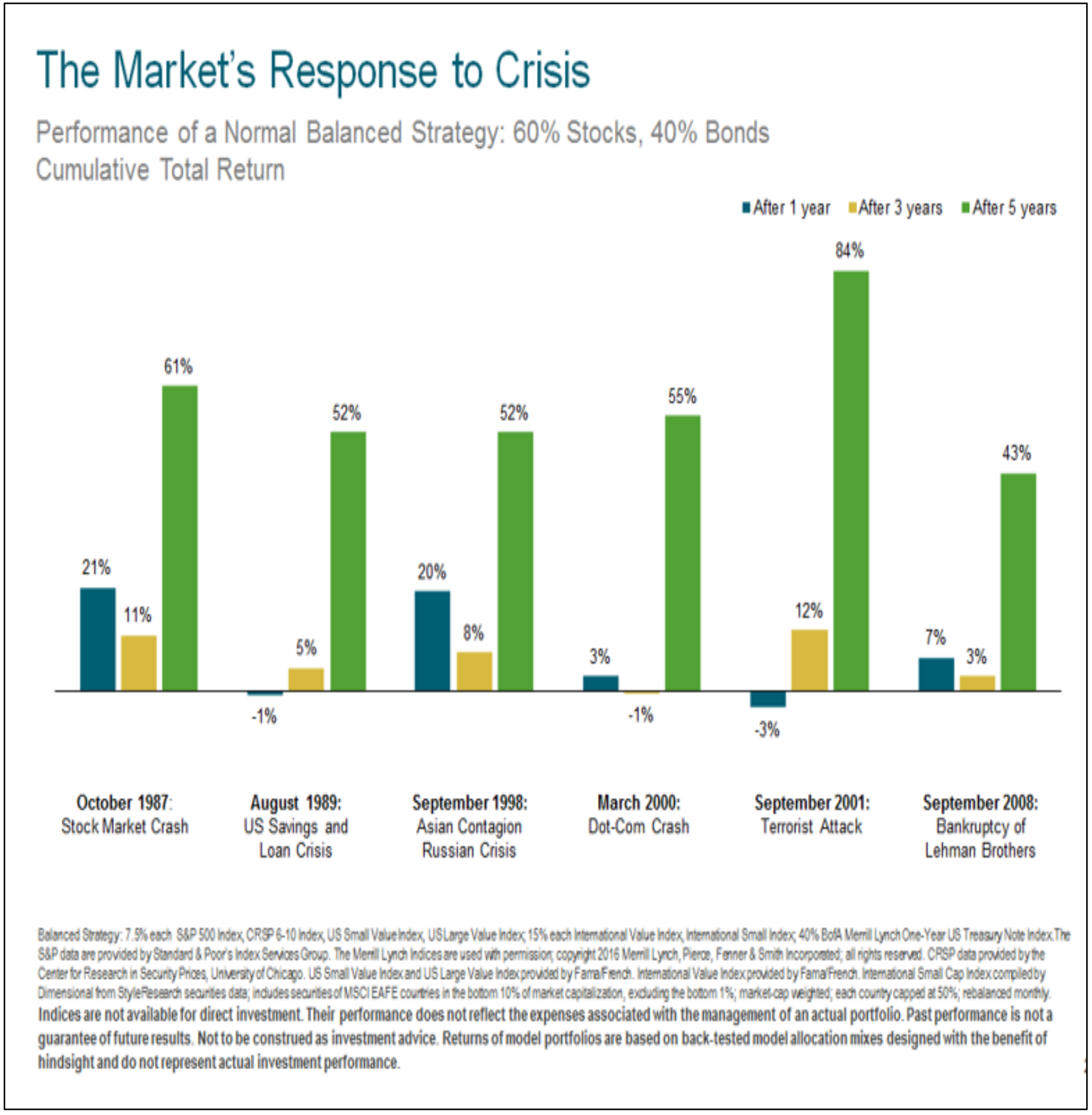
At some point America will have a crisis but I expect we will survive and thrive because that’s what Americans do. When the crisis hits just don’t make things worse by getting emotional and making irrational decisions. You don’t have to be super smart, just keep it simple and don’t be foolish. Do you think the next crisis will be worse than the 6 on the following graph? We survived them all.
Click here for source
I write a daily blog, a weekly newsletter, quarterly letters and occasional white papers, none of which mention politics as that is not my expertise plus the last thing people need in today’s connected world is another political pundit. I am also a registered independent so although I do not worship at a partisan political church, I do worship at the altar of behavioral investing. Many of you who have read my letters in the past know the mantra “investing is a psychology game not an IQ game.” Our emotions are the enemy, and nothing agitates the emotions like politics. For a perfect example of knee jerk emotional reaction see the bottom left of previous image marked “inauguration,” on Obama’s inauguration day the S&P, Nasdaq and Dow all dropped over 5% in a spontaneous short‐term reaction to the thought that America could indeed become communist.
Every investor I speak with today goes right to politics and the presidential election; I believe that would make you normal. All issues are political issues, so keeping out of politics is an impossible human folly but I think keeping them out of your investment portfolio is a necessity. As humans, we are full of personal biases, it’s best not to let them creep into your retirement portfolio because the result could be permanently toxic.
Why is it so toxic? When the chips are down, we would rather be wrong and still belong to our tribe.
Let me quote from a Financial Times article that, in my assessment, goes to the core of human behavior:
“We humans are social creatures. Given a choice between being right on a partisan question (abortion, guns, Brexit, globalisation, climate change) and having mistaken views that our friends and neighbours support, we would rather be wrong and stay in the tribe. ... in surveys of views on climate change: college‐educated Republicans and Democrats are further apart on the topic than those who are less educated.”
Click here for source
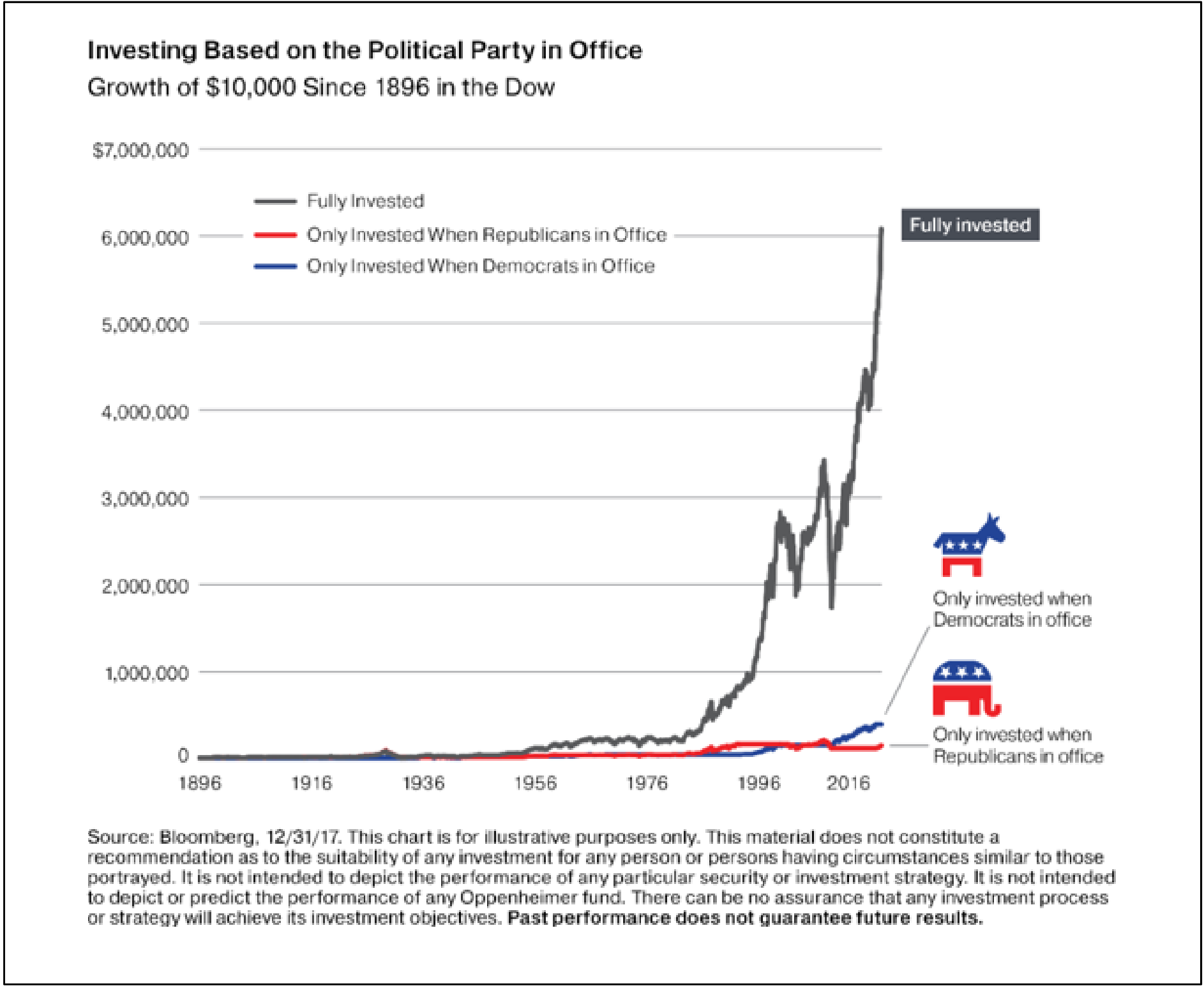
Sticking with your tribe may be fine for social purposes as we all need a community to achieve a sense of happiness but leave your tribes behind when it comes to investing. Investing based on political party in office can get you broke in a hurry as the following chart depicts staying fully invested versus riding only your tribe's donkey or elephant.
S&P Returns Around Impeachment Hearings
In a 1986 dissertation, economist Campbell Harvey identified an economic indicator that would precede the next seven recessions that indicator is known as “a yield curve inversion”
Courtesy of Campbell Harvey
2. Vanguard Updated 10 Year Projected Returns.
Vanguard returns appear to be telling investors to temper expectations after a great 10 year run and
we may see a rotation in leadership for the next decade.
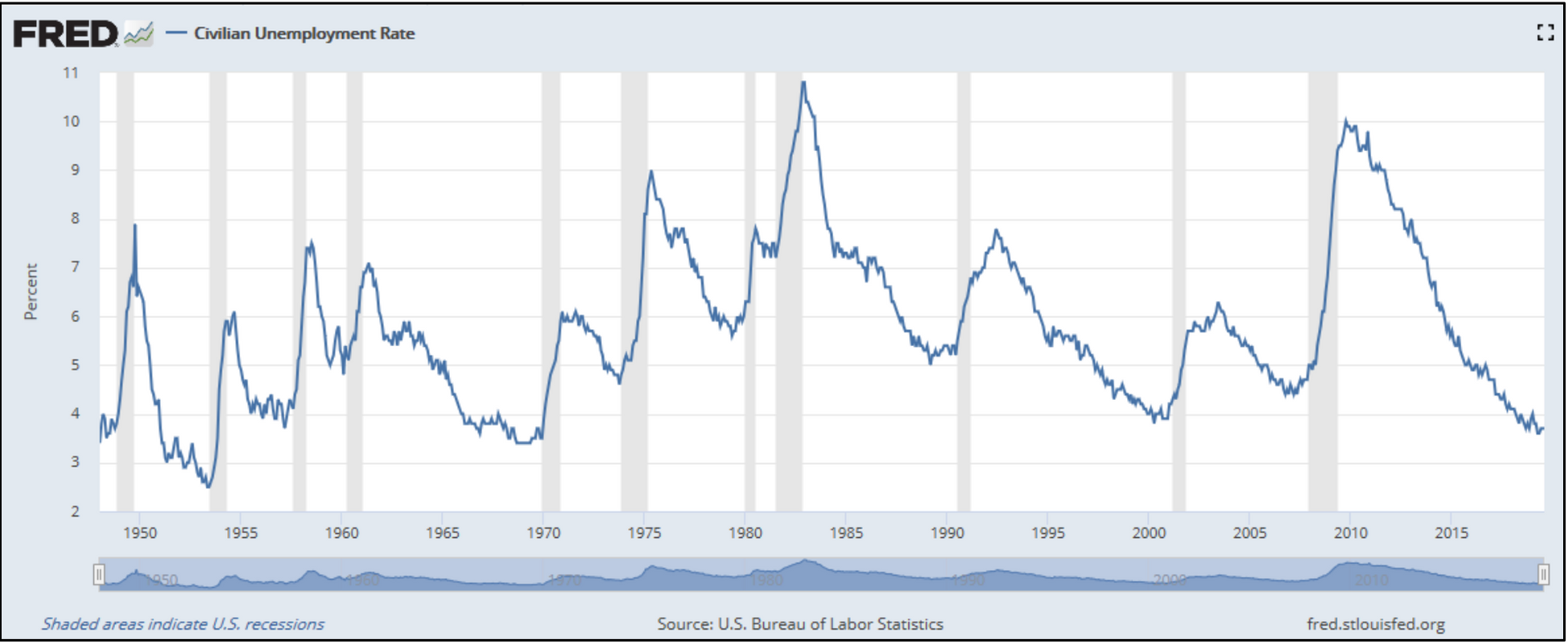
3. The Unemployment Rate Can’t Go Much Lower So Wages Have to Go Higher.
Unemployment Rate Slightly Higher than Post WW II Record Lows.
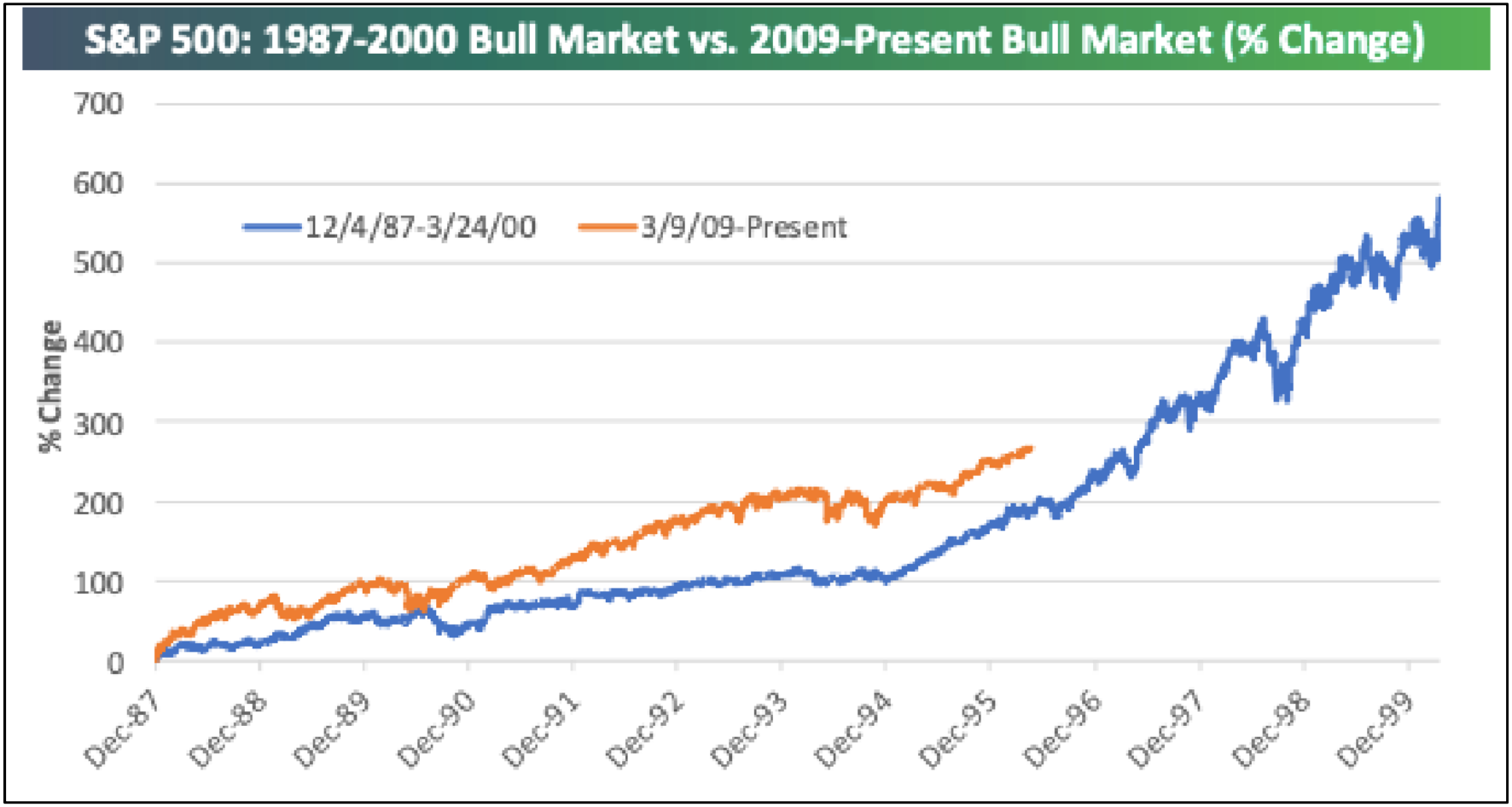
4. This Feels Like the Biggest Bull Market Ever but Reality is the Last One Was A lot Bigger.
1987‐2000 Bull Market +600%
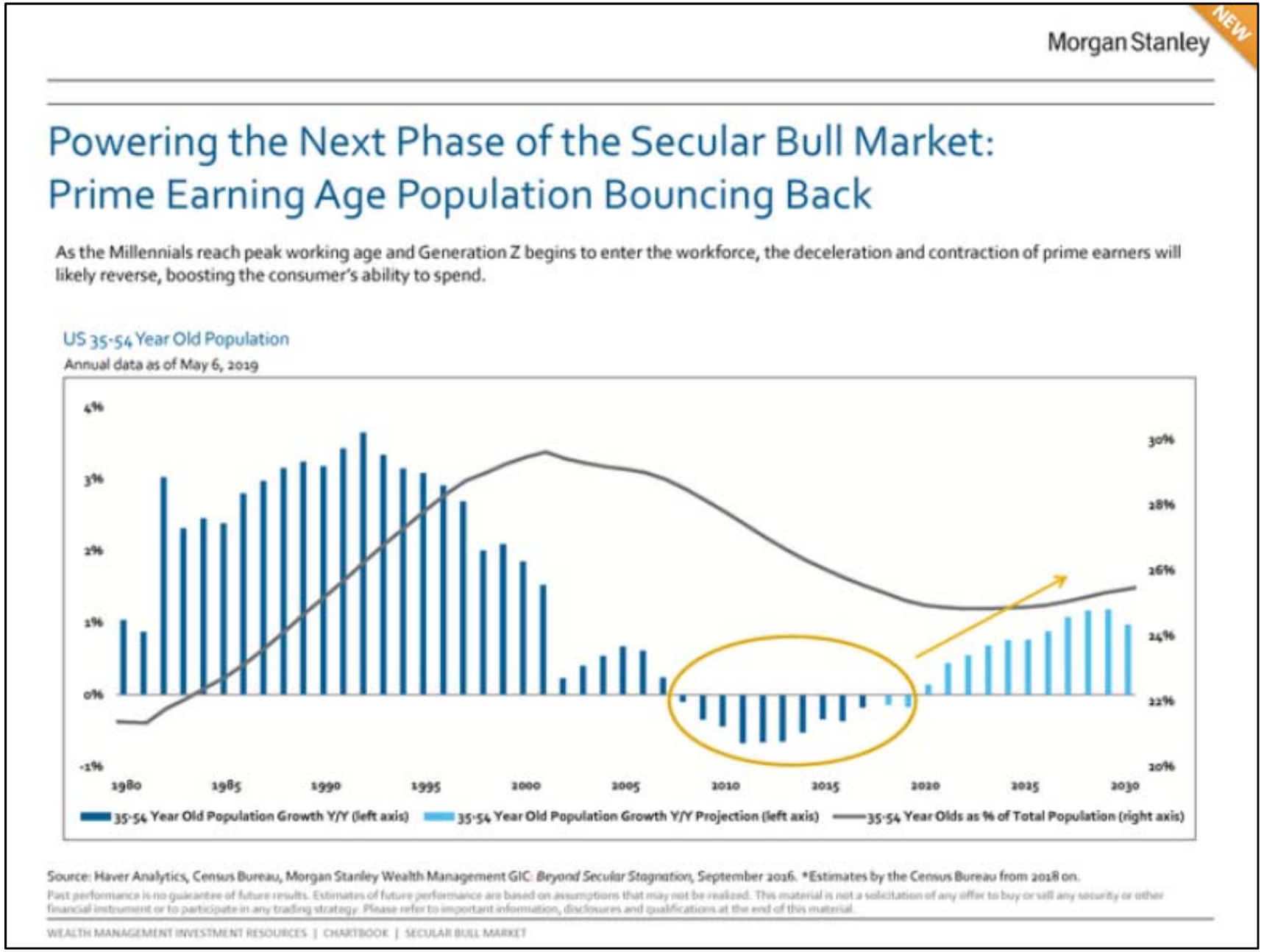
5. After a Demographic Lull, American Prime Age Spenders may be About to Hit a Growth Spurt.