
My Generation
Song by The Who (1965)
“Why don't you all f-fade away? (Talkin' 'bout my generation)
And don't try dig what we all s-s-say (talkin' 'bout my generation)
I'm not trying to cause a big s-s-sensation (talkin' 'bout my generation)
I'm just talkin' 'bout my g-g-generation (talkin' 'bout my generation)”
Introduction
Most rankings put The Who among the top 10 rock bands in history, with "My Generation" as one of their greatest hits. American Millennials are making their own generational push toward becoming the wealthiest cohort in history, right as the media tells us the American Dream is dead. While China and India, the two most populous countries in the world, face social unrest from a lack of opportunity for their young people, Millennials are setting the standard for the next generation of Americans.
As for the stock market, Q3 2026 was a microcosm of the themes that run through every Lansing Street quarterly letter: tune out the end-of-the-world noise driven by traditional and social media. Inflation, $100 oil, higher interest rates, war, the end of humanity by AI. The result? Just another day at the office for stocks, with the S&P 500 up +2% and the Tech sector up +7%.
This is not to make light of the world's problems or anyone's monthly bills. But this letter is about investing, especially in stocks, and for our readers, ignoring short-term volatility has historically been one of the most reliable ways to build wealth. Period.
Volatility did strike in Q3. The Nasdaq 100 sold off -10% and the semiconductor sector corrected -15%, but earnings kept rising and stocks recovered. As we discussed in our Q1 letter, "All Along the Watchtower," corrections are commonplace in midterm election years and in years with a change in Fed leadership. 2026 has both.
Part I. People Tried to Put Us Down: Millennials Take the Lead
America has problems to address, starting with $40 trillion in government debt. We also have a media-cycle epidemic of storytellers painting a picture of America in decline, where the next generations will never experience the wealth of their parents and grandparents. There is only one problem with this deluge of experts: the math does not work.
Post-Covid, every wealth group in America is better off. Yes, I understand there was record government stimulus, but the chart below is still impressive, with the bottom 50% gaining the most on a percentage basis.
Again, we have empathy for the spike in monthly bills due to inflation, but here we are focused on assets and stocks.
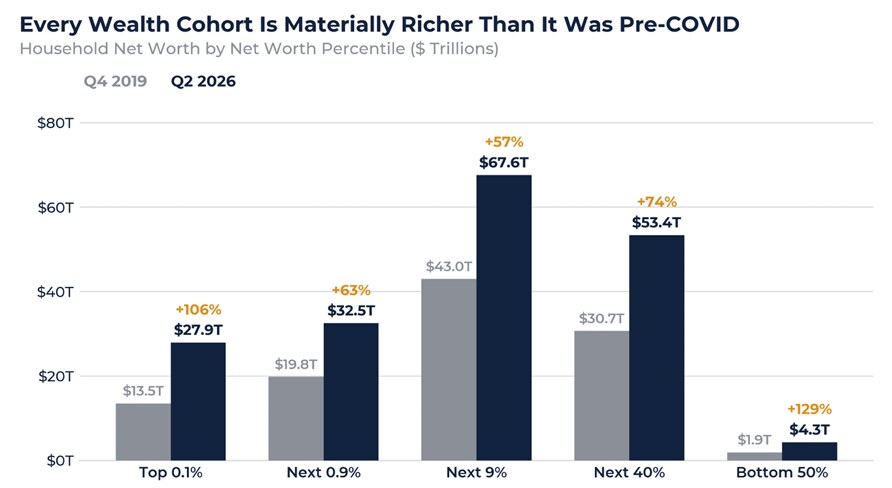
Source: Federal Reserve Distributional Financial Accounts and Financial Accounts (Z.1); Aptus Capital Advisors. Data as of 9/30/2026.
In Part III, we look at rock-solid American household balance sheets. The chart below crystallizes the situation: in a nutshell, American households de-leveraged after the 2008 crisis.
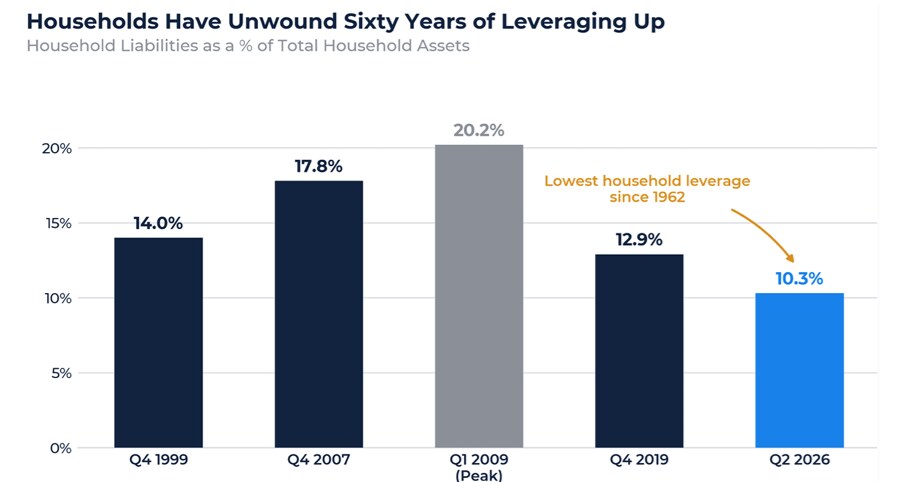
Source: Federal Reserve Distributional Financial Accounts and Financial Accounts (Z.1); Aptus Capital Advisors. Data as of 9/30/2026.
The maligned Millennials are running almost double the stock exposure of Gen X and triple that of their Baby Boomer parents at a similar age. Their investing careers started after the 2008 crisis, so they have never experienced a structural bear market (2000 and 2008). But they did witness the altcoin wipeout and the 2022 crash in speculative stocks. Judging by the chart below, they survived and remain stock believers.
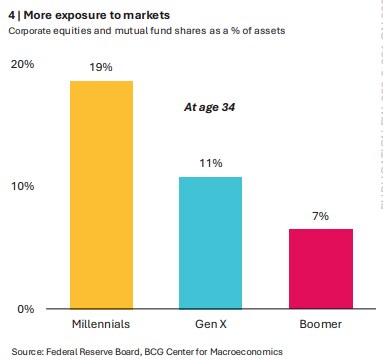
Source: Federal Reserve Board, BCG Center for Macroeconomics
The chart below gives a more complete picture of Millennials taking the financial lead over their parents: passing them in income and wealth, while matching them in homeownership. Keep in mind this generation is set to inherit between $40 and $100 trillion, depending on whose research you use.
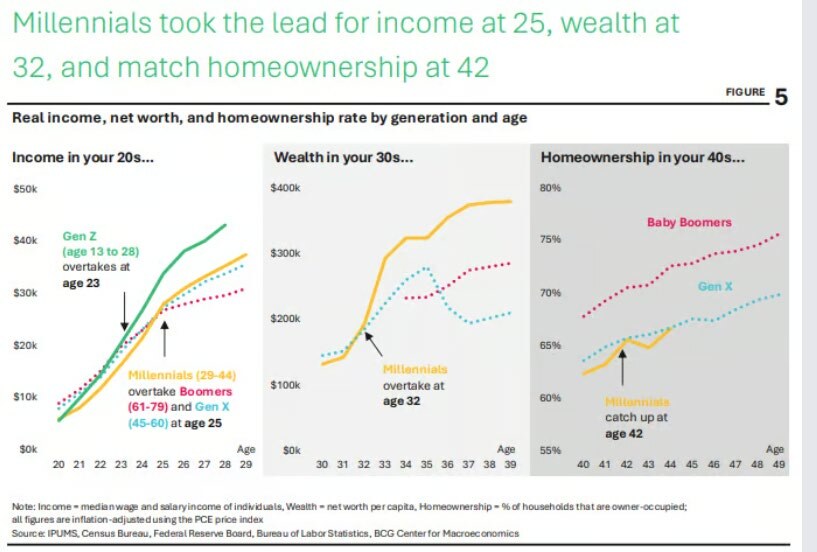
Source: The Irrelevant Investor
This last chart shows Millennials, age-adjusted to their mid-thirties, tracking ahead of Gen X and Baby Boomers in inflation-adjusted net worth. Time will tell how Gen Z fits into this picture, but this is not a doom-loop story where future generations can't grasp the American Dream.
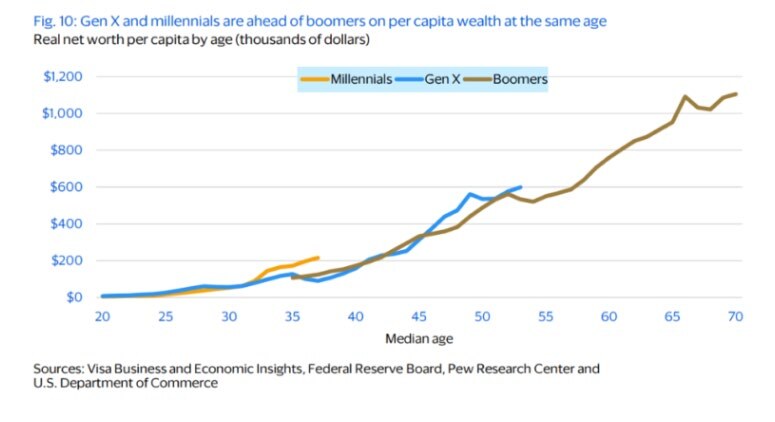
Source: A Wealth of Common Sense
Finally, yes, the American middle class is shrinking, but it's because so many households are moving up into the high-income group. After examining Census data, economist Mark Perry wrote on X:
"New evidence shows America's middle class IS shrinking, but it is because more US households are moving into higher income groups over time. The share of High-Income households earning $100,000 or more (in 2025 dollars) has almost tripled since 1967, from 16.5% to 44.7%. The share of Low-Income households earning $35,000 or less has decreased from 29.8% in 1967 to 19.2% last year. The share of Middle-Income households has decreased since 1967 from 53.7% (more than half) to 36.1% (slightly more than one-third)."
— Mark J. Perry
I would encourage everyone to read the full Wall Street Journal article by James Freeman.
Part II. Inflation, Oil Shock, and Rising Rates
Americans are experiencing price shock at the pump and in the grocery store, while mortgage and credit card rates are rising. As the chart below shows, gasoline is doing most of the damage.
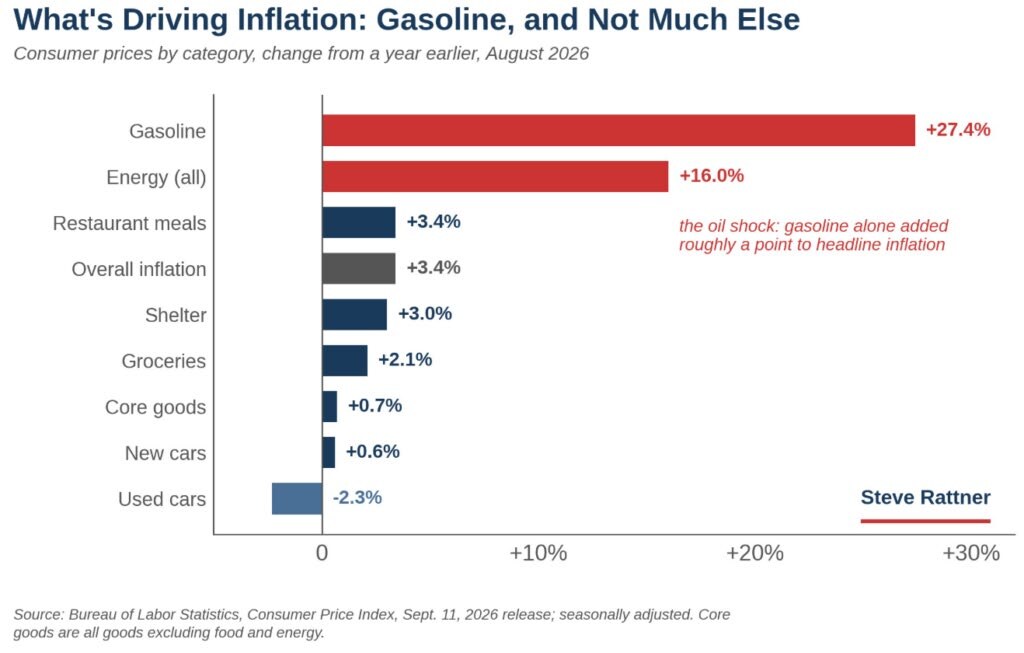
Source: Steve Rattner
Is this an oil price shock driven by the war in Iran, especially in diesel? Or is it something systemic and long-lasting?
Diesel prices affect the cost of nearly everything Americans buy, and they just hit all-time highs, up +70% in 2026. As the Wall Street Journal put it, it is costing more to get stuff into the hands of American shoppers:
"Trucking expenses are at their highest level since the Covid pandemic snarled operations around the world. Diesel prices are up 77% in the past year. Freight railroads are adding surcharges. And the nation's busiest port is the busiest it has ever been."
— The Wall Street Journal
But there is another inflation measure, core inflation, that strips out food and energy costs, and it is running at just 1.6% in 2026. That tells us energy prices are driving inflation. If we can get energy prices down, costs will follow.
All of this is happening against the backdrop of a technology revolution in AI, robotics, space, fintech, and biotech. Historically, technology leans disinflationary. During the 1990s internet boom, productivity strengthened, unemployment fell, and inflation stayed under control.
Part III. Can Investors Survive 2026 Inflation?
Will Americans survive rising rates and inflation in 2026? To answer that, let's check household balance sheets. As the chart below shows, U.S. household leverage (borrowing) is at 50-year lows, the exact opposite of 2008.
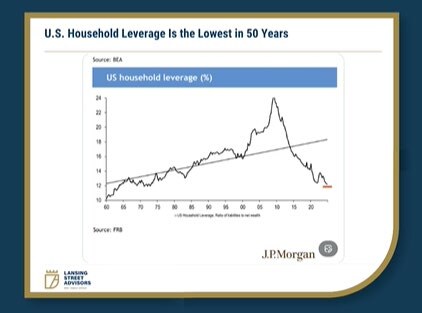
Source: J.P. Morgan
Yes, we have $40 trillion in debt. But as the next chart shows, the interest payments on that debt are in line with the average going back to post-WWII. Americans don't feel good about these debt levels, and neither do foreign investors, but we still have the deepest, most liquid markets in the world.
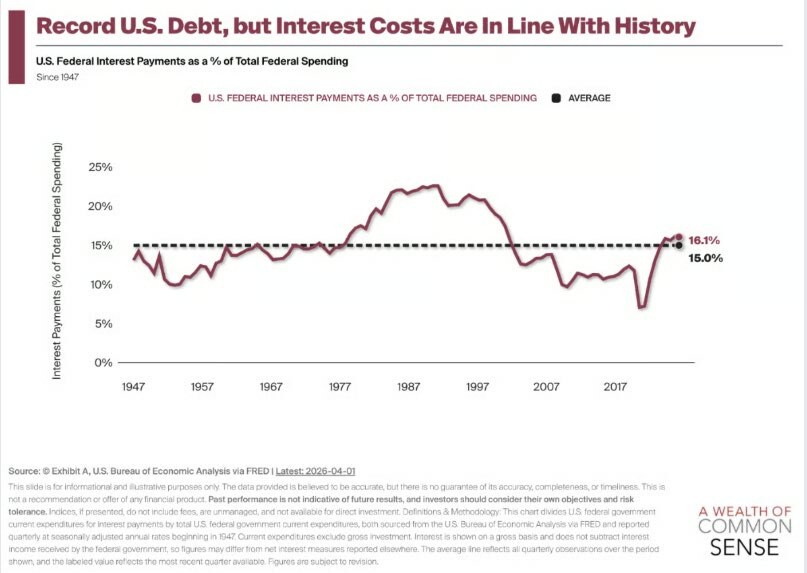
Source: The Irrelevant Investor
Should we panic that rising rates will cause a stock market correction? See below: U.S. stock returns show only a slight difference following Fed rate hikes versus rate cuts. In fact, stocks have performed better following rate hikes.
It is true that when the Fed raises rates, something tends to break. But we already have bear markets in housing, commercial real estate, private lending, and private equity.
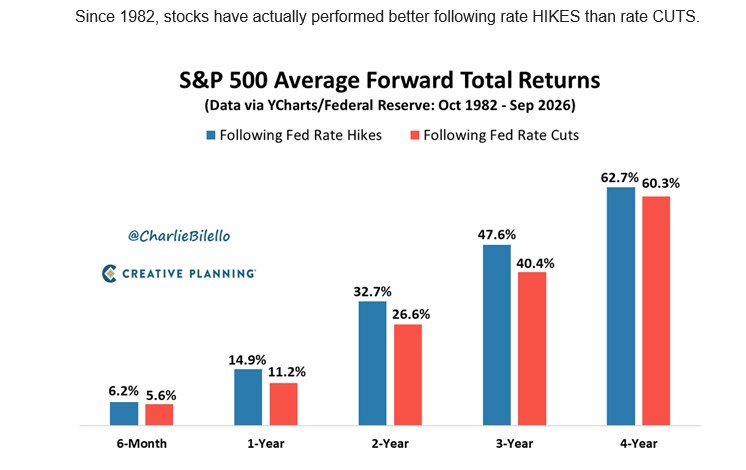
Source: Charlie Bilello
Part IV. How Can the Stock Market Keep Rising?
As covered in previous letters, earnings just keep on trucking, with the strongest growth in five years (see below). Yes, I understand it is AI-driven and there are moving parts around private investments, but it is still remarkable.
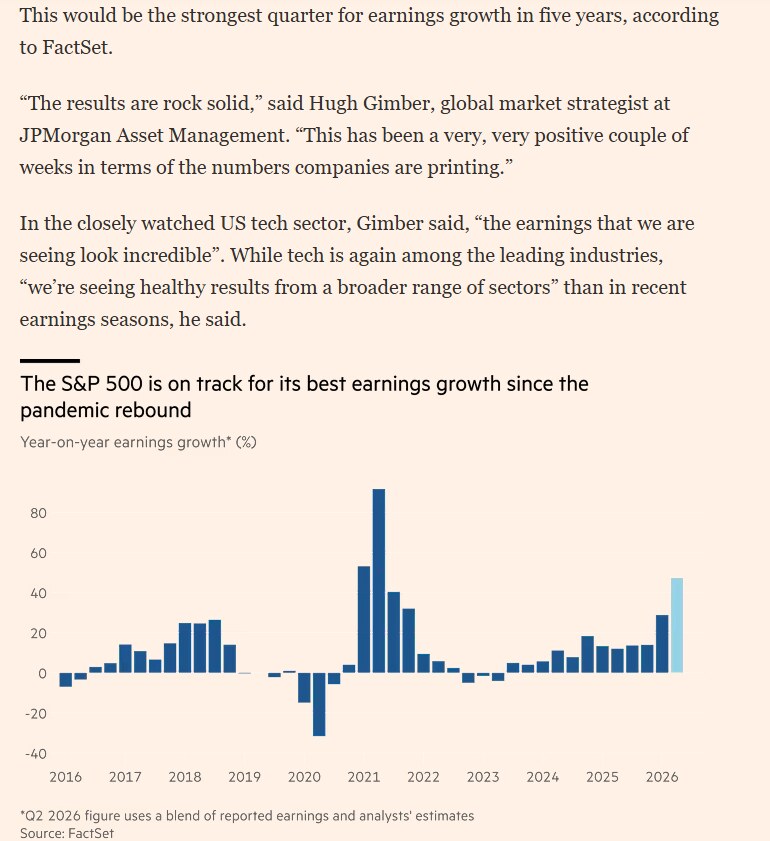
Source: Financial Times
In my Q1 letter, "All Along the Watchtower," I wrote that the Mag 7 was no longer trading at a premium to the S&P. As the chart below shows, the overall market is not cheap, but it is not in speculation mode either. In 2020, four times as many stocks traded above 40 times forward earnings as today. That was the post-Covid speculation bubble that led to the 2022 bear market.
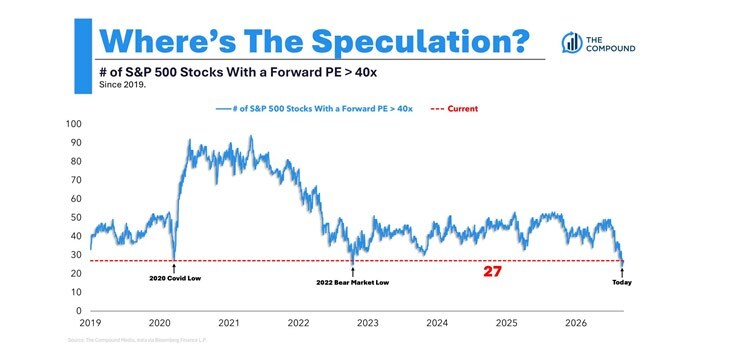
Source: Chart Kid Matt
Is the bull market running too long? Earnings are good, and valuations are not cheap but not a bubble. So how far along is this bull compared with history? We are four years in (see below), so the gray hair has not fully grown in. Expect continued volatility, but history says a run that ends from old age alone is not in the cards.
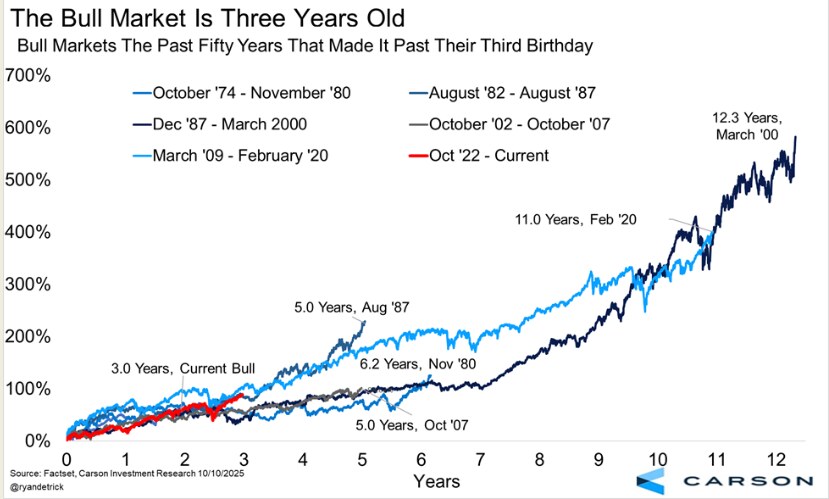
Source: Carson Investment Research
This does not mean that major risks are not underlying the current stock market, starting with the AI infrastructure being built out on a mountain of debt. Historically, technology revolutions produce bubbles and speculation, and this one will be no different. Expect weaker-balance-sheet AI stocks and private AI-related companies to disappear in a downturn; the real winners will appear post-correction.
Conclusion
Again, we do not want to downplay inflation's impact on American households, especially the spike in everyday bills: gas, groceries, and utilities. Higher interest rates and a rising cost of living are hurting the American consumer. But when it comes to your portfolio, social media doomsday scenarios should be ignored. Inflation could lead to a stock market downturn, and investors need to stay disciplined. This spike may turn out to be a gas shock that reverses.
Market downturns happen frequently. The Nasdaq has already had two -10% corrections in 2026, and the S&P has had a pullback of close to -10%. As the Capital Group grid below shows, corrections are frequent, but recoveries have historically been fast.
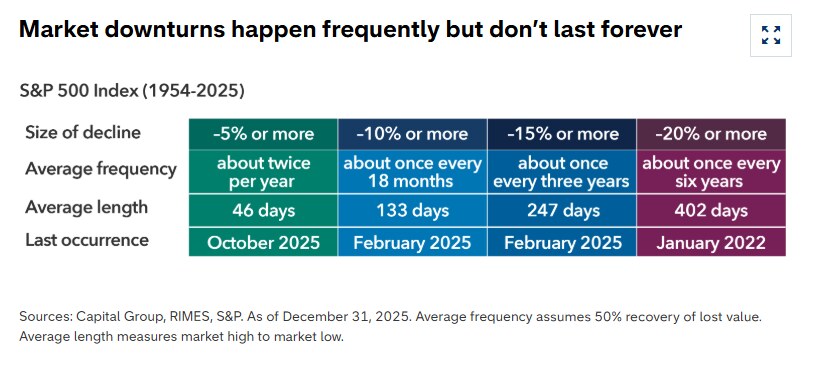
Source: Capital Group
There is a considerable difference between the market downturns in that grid and the bursting of a full stock market bubble. As we enter the fourth quarter of 2026, the headlines are saturated with economic misfortune, but stock earnings, American household balance sheets, and Millennial wealth growth tell a different story. Even more telling is the wealth growth among the bottom 50% and the mass movement out of the middle class into the upper-income class. Now we need to uplift the bottom half even more through high-paying jobs and exposure to the markets.
Which brings us back to The Who. Pete Townshend wrote "My Generation" as a young man's answer to everyone trying to put his generation down. Six decades later, Millennials are writing their own version. They have been called entitled, broke, and priced out of the American Dream, yet the data shows them out-earning and out-investing the generations before them at the same age. People tried to put them down. The math says otherwise.
Heading into the midterm elections, remember: keep your politics out of your portfolio. As always, stay the course.
My Generation
Song by The Who (1965)
“Why don't you all f-fade away? (Talkin' 'bout my generation)
And don't try dig what we all s-s-say (talkin' 'bout my generation)
I'm not trying to cause a big s-s-sensation (talkin' 'bout my generation)
I'm just talkin' 'bout my g-g-generation (talkin' 'bout my generation)”
Disclosures
Lansing Street Advisors LLC is a registered investment adviser with the U.S. Securities and Exchange Commission (CRD #306882). You can read more about the Lansing team at www.lansingadv.com.
To the extent that content includes references to securities, those references do not constitute an offer or solicitation to buy, sell or hold such security as information is provided for educational purposes only. Articles should not be considered investment advice and the information contained within should not be relied upon in assessing whether to invest in any securities or asset classes mentioned. Articles have been prepared without regard to the individual financial circumstances and objectives of the persons who receive it. Securities discussed may not be suitable for all investors.
Please keep in mind that a company's past financial performance, including the performance of its share price, does not guarantee future results.
Material compiled by Lansing Street Advisors is based on publicly available data at the time of compilation. Lansing Street Advisors makes no warranties or representations of any kind relating to the accuracy, completeness or timeliness of the data and shall not have liability for any damages of any kind relating to the use of such data.
Material for market review represents an assessment of the market environment at a specific point in time and is not intended to be a forecast of future events or guarantee of future results.
Indices that may be included herein are unmanaged indices and one cannot directly invest in an index. Index returns do not reflect the impact of any management fees, transaction costs or expenses. The index information included herein is for illustrative purposes only.
The trademarks and service marks contained herein are the property of their respective owners.
The information presented is for educational purposes only and is not intended to make an offer or solicitation for the sale or purchase of any specific securities, investments, or investment strategies. Investments involve risk and, unless otherwise stated, are not guaranteed. Be sure to first consult with a qualified financial adviser and/or tax professional before implementing any strategy discussed herein. Past performance is not indicative of future performance.
Lansing Street Advisors may discuss and display charts, graphs, formulas which are not intended to be used by themselves to determine which securities to buy or sell, or when to buy or sell them. Such charts and graphs offer limited information and should not be used on their own to make investment decisions.