
KEY TAKEAWAYS
- Trump, like Reagan is passionate about change, but he inherits a completely different America from an economic, military and globalization perspective.
- Not sure if today’s stock market is overvalued? Warren Buffet uses a handy ratio that we’ll share.
- Once the elections are over, root for whichever party is in office to make America thrive based on our underlying principles.
INTRODUCTION
It is neither my job nor my desire to comment on politics and elections. But, with our Presidentelect’s proposed policies being compared to Ronald Reagan’s, I feel the need to step up. As a financial and investment commentator, I thought it would be important to reflect upon the backdrop of Reagan’s America (1981) versus President-elect Donald Trump’s America today. This is not an opinion piece about whether or not Trump’s policies will work–I always root for America no matter which political party is in office. Whether or not I agree with Presidential policy rates is far less important than being a patriot who believes that America will thrive based on our underlying principles. It shouldn’t matter which party is in charge. 2 The world economic backdrop that Trump is walking into looks vastly different than the one Reagan inherited. Here we’ll discuss the many differences between 1981 and 2017 in terms of U.S. military spending, stock market valuation, interest rates, globalization and immigration.
Source: Third Way
You’re not shy, you get around You want to fly, don’t want your feet on the ground You stay up, you won’t come down You want to live, you want to move to the sound Got fire in your veins, burning hot, but you don’t feel the pain Your desire is insane, you can’t stop until you do it again
— 1981 HIT SONG, “URGENT” BY FOREIGNER
Military Spending
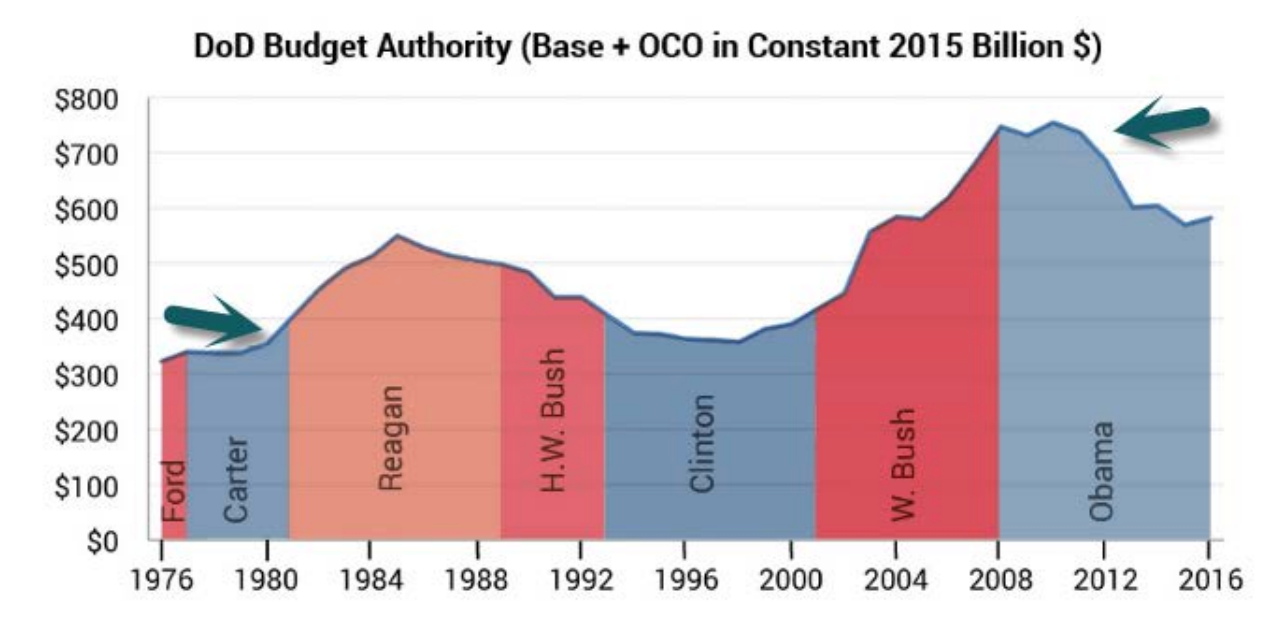
When many people think of Reagan, the first thing that comes to mind is his legendary “tear down these walls ” speech and the collapse of the Soviet empire. Some would say the Soviet collapse was accelerated by Reagan’s military buildup, including the Star Wars program. But, remember, Reagan stepped into office during a post-Vietnam military drawdown that began with the Carter administration. By the time Reagan completed his second term, he had expanded the U.S. military budget by a staggering 43 percent over what the country had spent during the height of the Vietnam War! Today, coming out of the post-9/11 war on terror, it’s a very different story. President Bush II ramped up military spending to $700 billion from $400 billion during his term and it was not until President Obama’s second term that we started to see a decline in military spending. Now it looks we’re going the other way (again). Trump wants more military personnel, more ships, more aircraft and enough Marines to fight two wars. But, he wants the money to come from “cuts in waste.” When it comes to government spending, cutting waste is much easier said than done.
NATIONAL DEFENSE SPENDING: CARTER TO OBAMA ADMINISTRATIONS
When many people think of Reagan, the first thing that comes to mind is his legendary “tear down these walls ” speech and the collapse of the Soviet empire. Some would say the Soviet collapse was accelerated by Reagan’s military buildup, including the Star Wars program. But, remember, Reagan stepped into office during a post-Vietnam military drawdown that began with the Carter administration. By the time Reagan completed his second term, he had expanded the U.S. military budget by a staggering 43 percent over what the country had spent during the height of the Vietnam War! Today, coming out of the post-9/11 war on terror, it’s a very different story. President Bush II ramped up military spending to $700 billion from $400 billion during his term and it was not until President Obama’s second term that we started to see a decline in military spending. Now it looks we’re going the other way (again). Trump wants more military personnel, more ships, more aircraft and enough Marines to fight two wars. But, he wants the money to come from “cuts in waste.” When it comes to government spending, cutting waste is much easier said than done.
Now let’s take a look at the financial markets of three decades ago compared to today.
STOCK MARKET VALUATION: 1981 VS. TODAY
In 1981, Reagan’s inaugural year in office, the price-to-earnings (P/E) ratio of the S&P 500 Index was a historically low 9. By contrast, the market’s P/E ratio is about 26 today. Reagan entered office during the final phase of a secular bear market that began in 1966. By August 1982, the Dow had closed at its secular low of 776. Following a 1981-1982 recession, Reagan’s economy grew at a real rate of 16 percent. Compare that to today when real U.S. growth is plodding along at a paltry 2 percent almost a decade after the Great Recession.
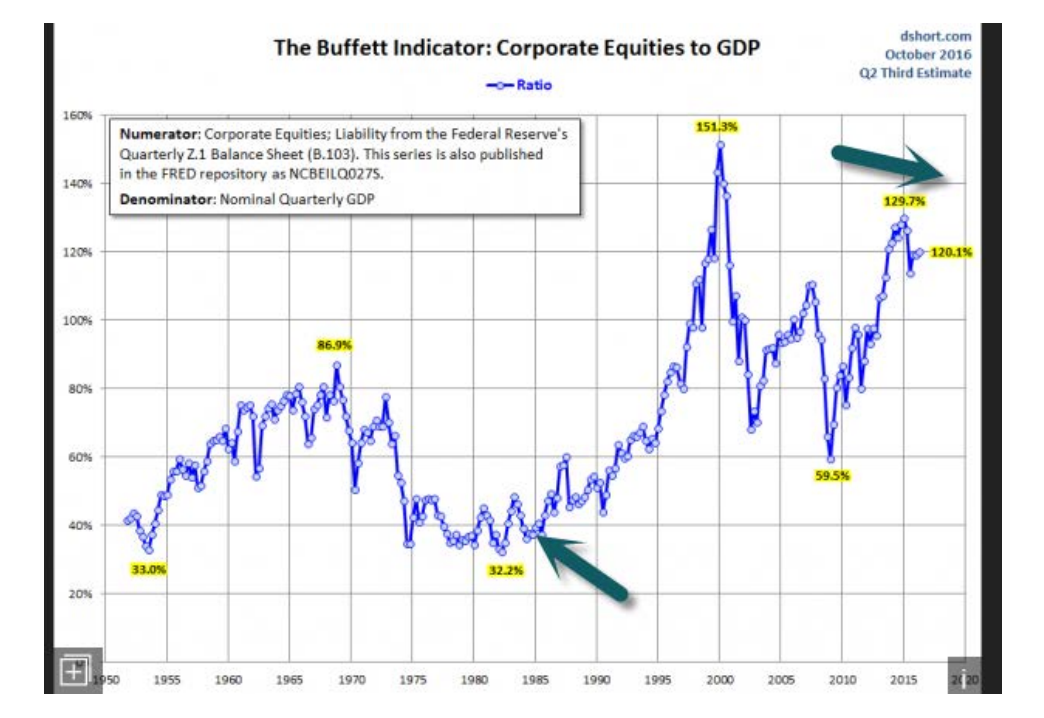
With the stock market at its all-time high and the economy in slow-growth mode, is there still a relationship between the economy and the markets? Well, investing guru, Warren Buffet, uses a ratio comparing the economy (as measured by GDP) to the stock market capitalization to determine whether or not the stock market is overvalued . A ratio used to determine if a stock market is overvalued or undervalued. It is equal to stock market capitalization divided by gross domestic product times 100. The result of this calculation is the percent of GDP represented by stock market capitalization. A result of over 100 percent is a sign the market is overvalued. A result of 50 percent or less is a sign the market is undervalued. This shows the drastically different valuation during the two Presidents inaugural years.
Read more: http://www.investorwords.com/18956/stock_market_capitalization_to_GDP_ratio.html#ixzz4T2Wn57Ol
IN 1981 MARKET CAP TO GDP WAS 32%…TODAY IT’S 120%.
INTEREST RATES
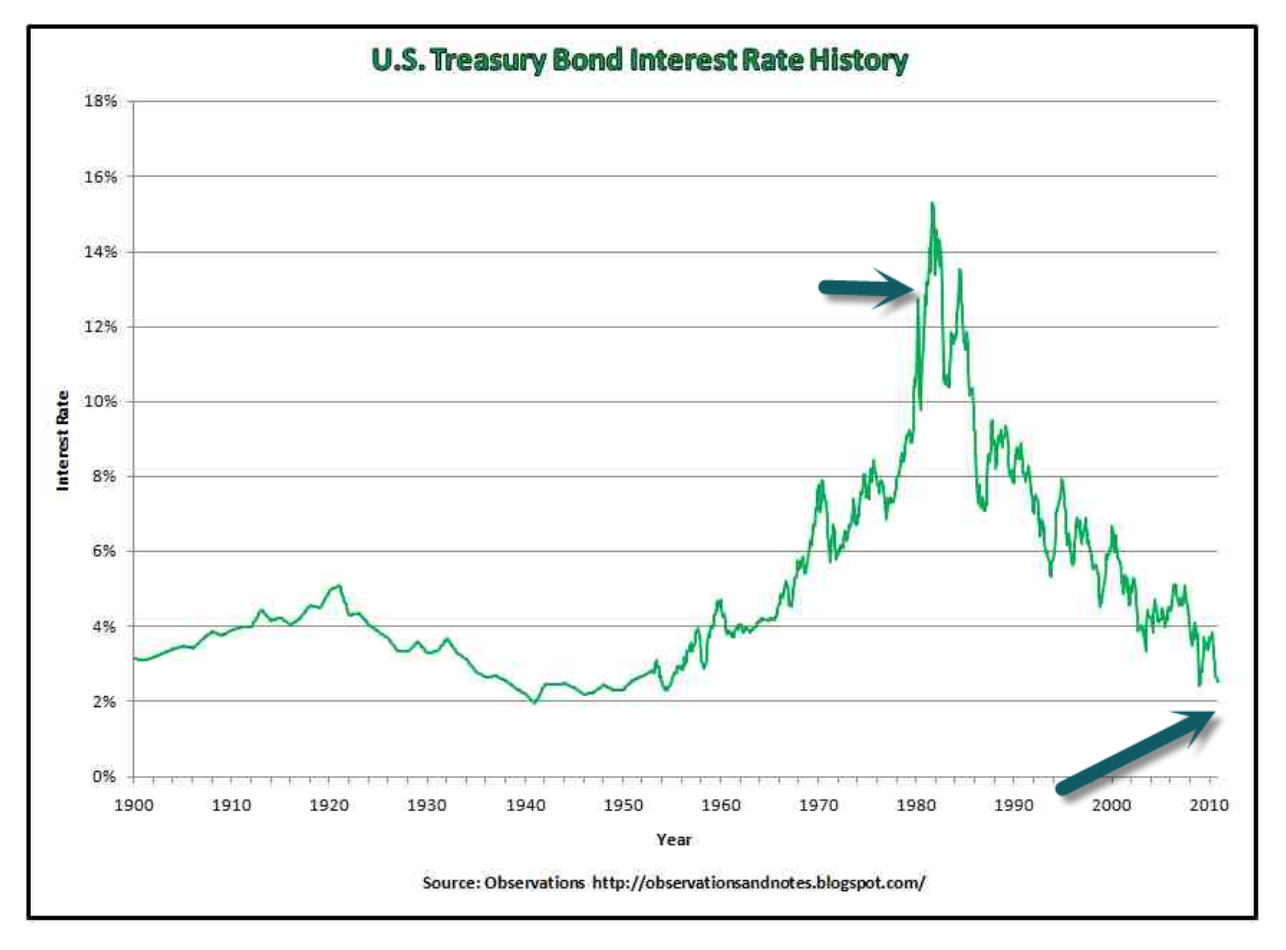
When Reagan was elected, we were coming out of the 1970s when interest rates were a sky-high 20 percent and the big hammer Paul Volcker was just running out of ammo on the upside. Fast forward to today with rates bottoming near 2 percent. This is especially important because the overall debt in the U.S. economy was on a 30 year downtrend since the end of World War II when Reagan took office.
U.S. TREASURY BOND INTEREST RATE COMPARISON: REAGAN VS. TRUMP
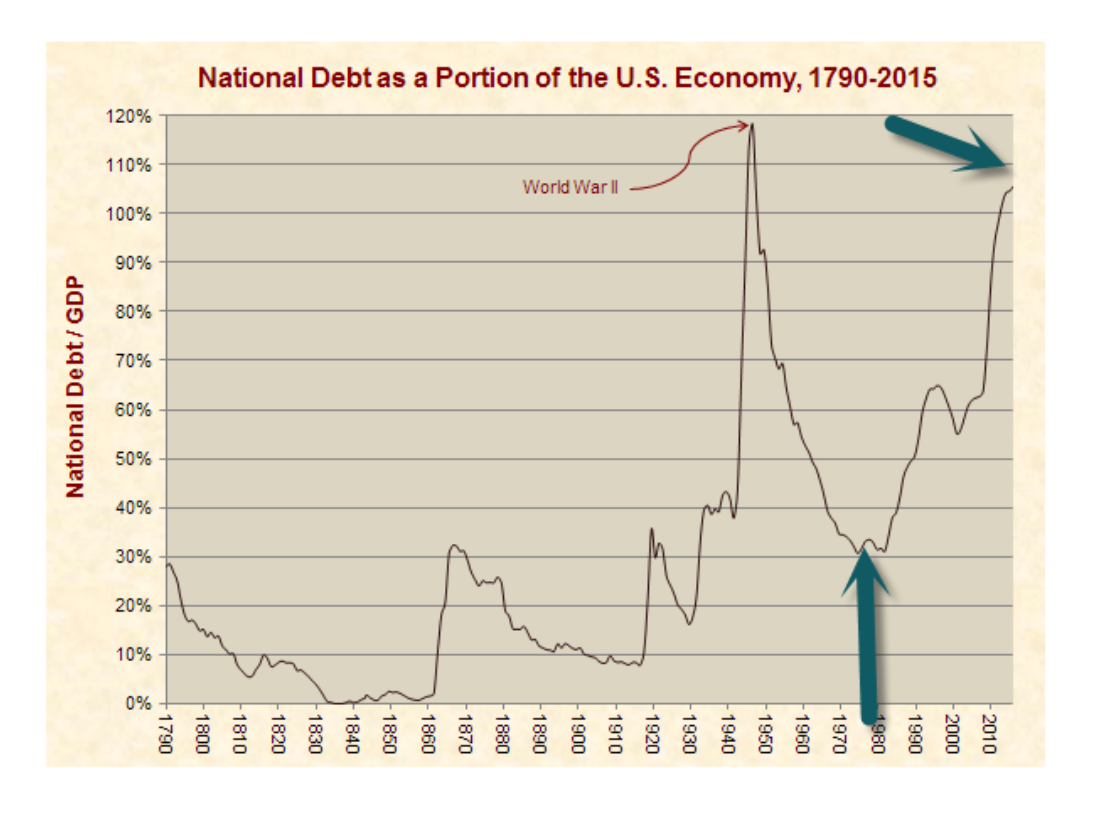
DEBT AS A PORTION OF THE U.S. ECONOMY: REAGAN VS. TRUMP
According to Stephanie Pomboy of Macromavens, non-financial obligations now total 251 percent of our nation’s GDP. Compare that to a level of just 135 percent when Reagan came to office with $2 trillion of corporate debt coming due in the next two years . National debt in the chart below is over 100 percent of U.S. economy compared to 35 percent when Reagan kicked off his tax cuts.
Source: Just Facts
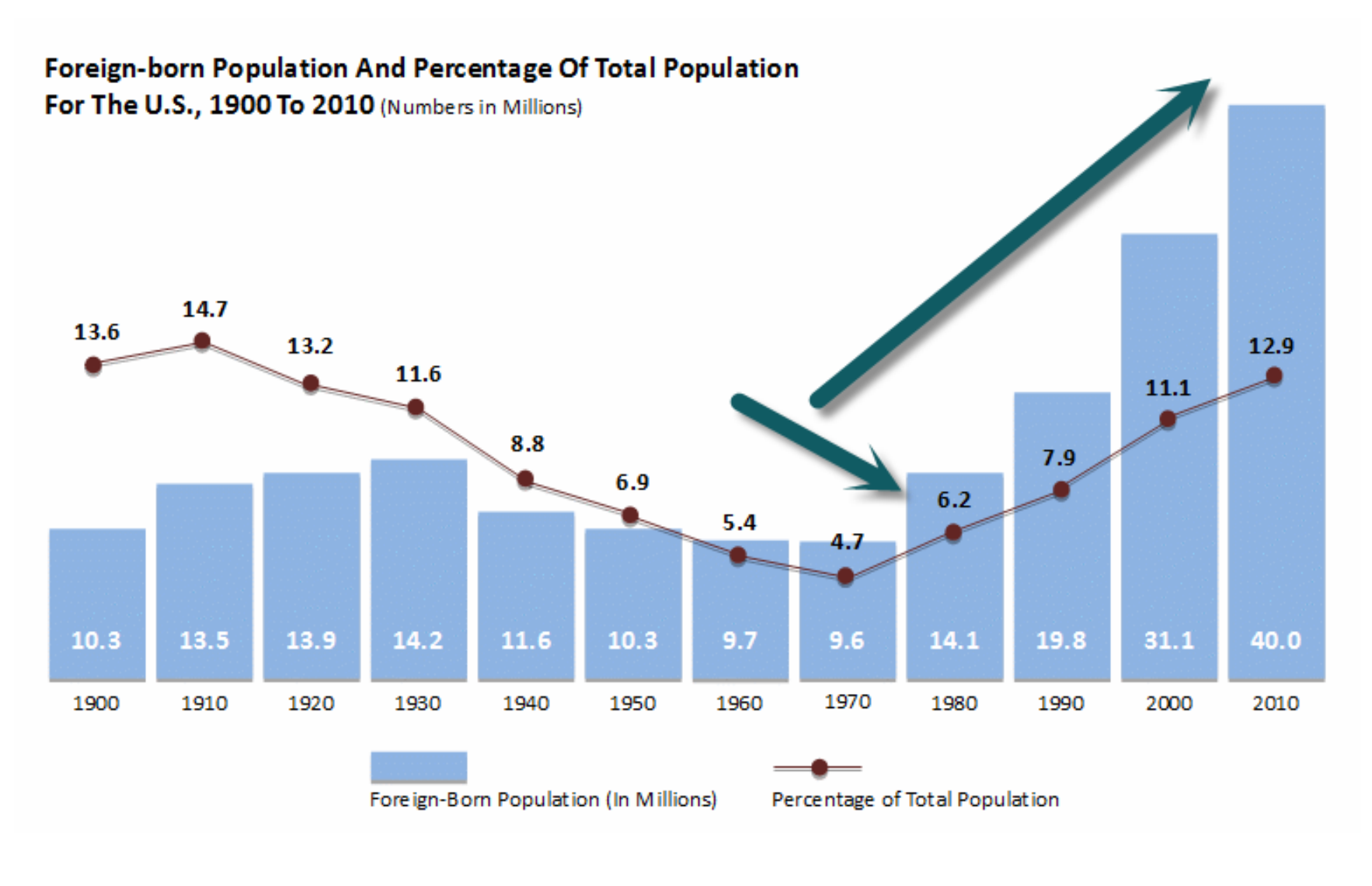
IMMIGRATION AND THE U.S. WORKFORCE.
Reagan took office at the end of an 80 year sideways move in immigration, while Trump takes over during a 25-year boom in foreign workers coming to our country. This boom means different things to different social classes. To some, the boom is a positive driver in terms of more educated talent, entrepreneurship and low-cost labor all in one. To others, the boom means competition for American jobs needed by our own long-time citizens. Reagan didn’t even have the immigration debate on his economic plate while Trump made it a key focus of his campaign.
CONCLUSION
Although both Trump and Reagan have burning hot fire in their veins for change , the economies they inherited have different urgencies. The major economic factors such as debt, interest rates and stock market valuations the two Presidents faced are not just different, they are polar opposites. It could be argued that Reagan kicked off globalization, but Trump is now dealing with a world economy that has added over a one billion people to the workforce, thus driving down wages and upending job safety in developed countries like the U.S. Again, I root for whoever is President to enact positive change for our country, but the economic canvas you start with is not blank. If Trump’s goal is to paint an economic masterpiece, then his vision will have to look very different from Reagans.
You’re not shy, you get around You want to fly, don’t want your feet on the ground You stay up, you won’t come down You want to live, you want to move to the sound Got fire in your veins, burning hot, but you don’t feel the pain Your desire is insane, you can’t stop until you do it again
— 1981 HIT SONG, “URGENT” BY FOREIGNER
All source links in this post will take you to third party website – we are not responsible for the content therein.